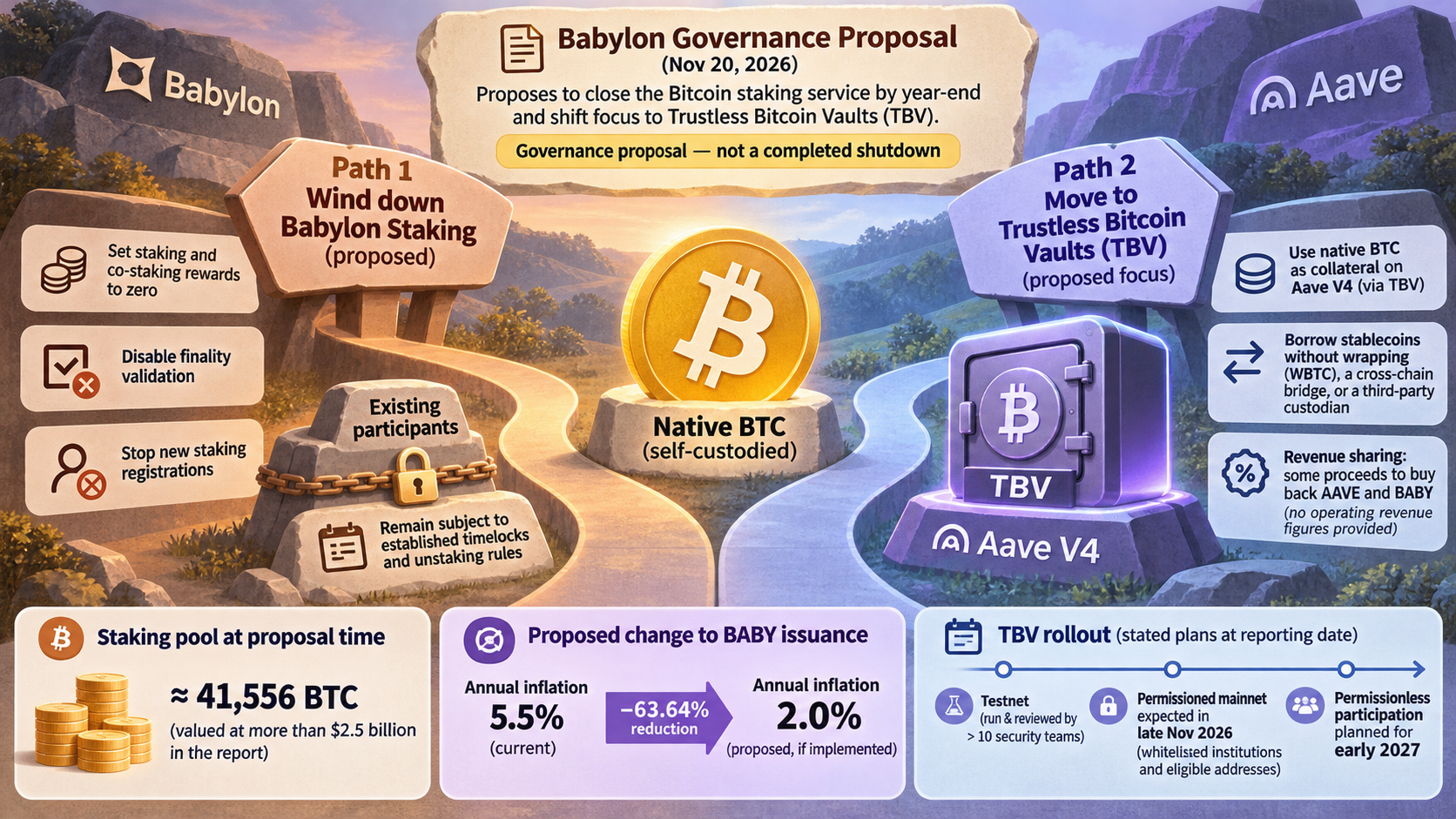
As reported on November 20, 2026, Babylon co-founder Fisher Yu had proposed closing the protocol’s Bitcoin staking service by year-end and shifting its focus to Trustless Bitcoin Vaults (TBV). This was a governance proposal, not a completed shutdown.
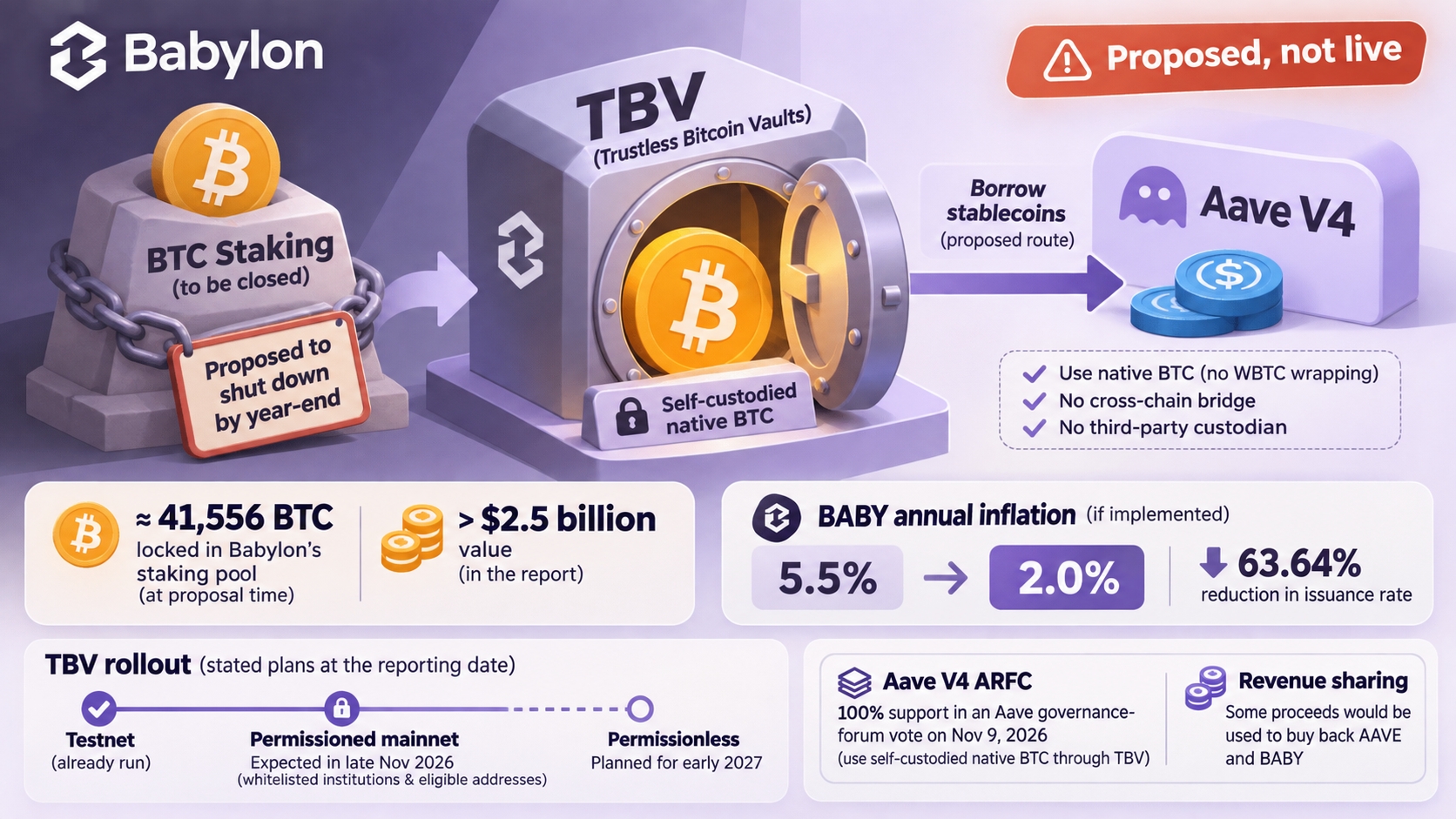
At the time of the proposal, approximately 41,556 BTC, valued in the report at more than $2.5 billion, was locked in Babylon’s staking pool. The proposed transition would set staking and co-staking rewards to zero, disable finality validation and stop new staking registrations. Existing participants would remain subject to the established timelocks and unstaking rules. The report describes withdrawals as protected by Bitcoin scripts, but provides no independent assessment that the transition would be risk-free.
The proposed change to BABY issuance
If implemented, the plan would reduce BABY’s annual inflation rate from 5.5% to 2.0%—a 63.64% reduction in the rate of new issuance. The proposal frames this as a move away from token-funded staking incentives toward a model tied to fees from TBV activity. Lower issuance is a specified change to token supply; future fee revenue and its effect on BABY are not established by the proposal.
The TBV path remains to be tested
The report says an Aave V4 ARFC concerning the use of self-custodied native BTC through TBV received 100% support in an Aave governance-forum vote on November 9, 2026. It describes a proposed route for borrowing stablecoins against BTC without wrapping it as WBTC or using a cross-chain bridge or third-party custodian. That vote should not be read as evidence that the borrowing route was already live. The report also describes a revenue-sharing arrangement under which some proceeds would be used to buy back AAVE and BABY; it provides no operating revenue figures.
According to the report’s account of Babylon Labs’ portal, TBV had run on a testnet and undergone reviews by more than ten independent security teams. A permissioned mainnet was expected in late November 2026, initially for whitelisted institutions and eligible addresses, with permissionless participation planned for early 2027. Those were stated plans at the reporting date, not confirmed launches.