In a weekly roundup published on November 20, 2026, at 18:10 UTC+8, covering November 13–20, the reported RWA and stablecoin figures pointed in different directions: asset values and transfer volume fell, while holder and address counts rose. Those measures describe activity and participation, but do not establish why either changed.
The measurements
Citing RWA.xyz data as of November 20, 2026, the roundup put on-chain RWA value at $41.42 billion, down 2.47% from the same point a month earlier. Its text reported 5.8599 million asset holders, up 2.42% on that comparison.
There is an unresolved discrepancy in the supplied source material: the accompanying chart shows 5,859,858 holders and 7.42% growth over 30 days, rather than the text’s 2.42% increase. The chart and text do not establish which growth rate should be used, so neither should be treated as independently verified.
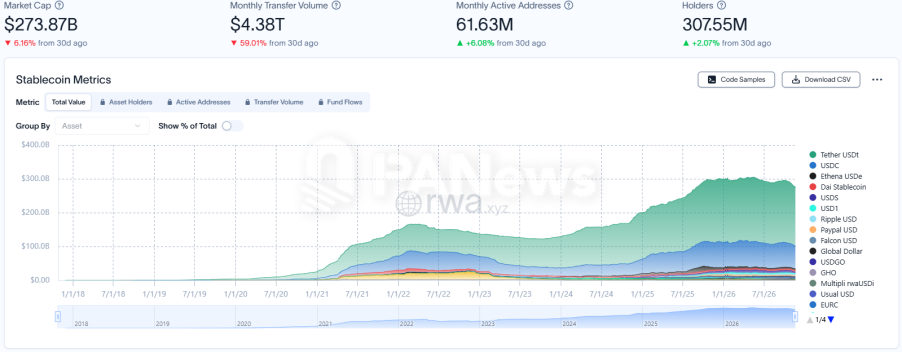
The roundup also reported stablecoin market value of $273.87 billion, down 6.16% from the same point a month earlier. Monthly transfer volume was $4.38 trillion, down 59.01%, while monthly active addresses rose 6.08% to 61.63 million and holders rose 2.07% to 308 million. These counts do not, by themselves, show how many participants were new users or explain the decline in transfers.
Interoperability moved through tests, not one shared network
Several developments in the roundup addressed how tokenized claims might move between institutions or ledgers. On November 16, the Hong Kong Monetary Authority announced work with Swift and banks to explore interoperability between the Swift ledger and Project Ensemble’s settlement layer for multicurrency tokenized deposits.
In Singapore, StraitsX, OCBC and Standard Chartered completed a proof of concept coordinating payments between the banks’ tokenized-deposit systems. The parties said legal, regulatory, operational and commercial arrangements still require assessment before broader implementation. DBS and Kinexys, meanwhile, introduced an interoperability solution intended to support around-the-clock US-dollar transfers between their blockchain deposit networks in the United States and Singapore.
Under Singapore’s BLOOM initiative, Ant International said it had piloted its Whale orchestration protocol with DBS and Franklin Templeton, connecting tokenized deposits and a tokenized money-market fund for delivery-versus-payment settlement. These are distinct arrangements; the reported tests do not demonstrate interoperability across all tokenized-deposit systems.
Issuance and rights remain separate questions
According to The Block, Singapore’s monetary authority issued S$100 million, approximately US$77 million, in tokenized MAS bills on November 6, settling them with wholesale central bank digital currency on a test network. The bills were due to mature on December 4. Five primary dealers participated, with bids exceeding twice the issue size. Further issuance and uses of the bills as collateral were plans for a later phase, not outcomes of this auction.
Tokenizing an asset also raises questions about what its holder can exercise. Coinbase and Broadridge proposed an open standard for delivering shareholder notices and disclosures to tokenized-stock holders and enabling voting through wallets. The roundup described on-chain proxy voting as a next step, not an already deployed feature. On Ethereum, Invesco’s stablecoin reserve fund began issuing tokenized shares; the cited Etherscan records showed an initial issuance of 80,000 IROXX shares on November 16, following contract deployment on November 12. Its prospectus provides for daily net investment income to be reinvested into new shares unless an investor elects cash.
Taken together, the November report documents measured changes in RWA and stablecoin activity alongside specific issuance, settlement and interoperability efforts. Its conflicting holder-growth figures—and the gap between controlled tests, proposed standards and operational use—limit broader conclusions.