In reporting published on November 10, 2026, NeoSoul’s Believe plan posed a question for its DNA token: can a project make team allocations depend on performance rather than the passage of time? The proposal changes the conditions for team unlocks and places DNA in the payment flows around NeoTrade. Neither the eventual KPI design nor evidence of sustained product demand was established in the report.
What changes in the unlock schedule
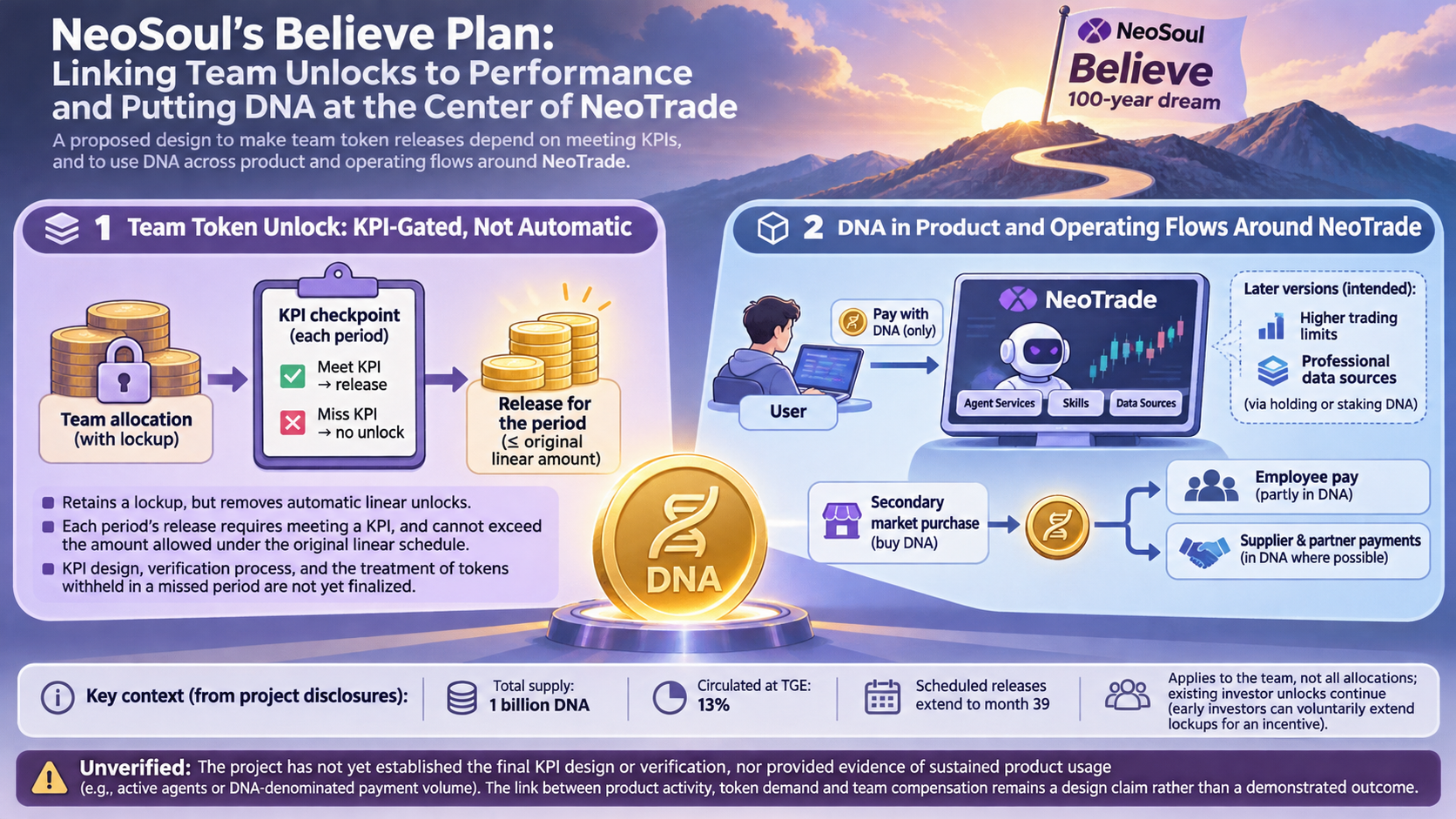
NeoSoul announced the Believe plan on November 5. Under its proposed terms, team tokens retain a lockup period but no longer unlock automatically on a linear schedule. Each period’s release would require the team to meet a KPI and could not exceed the amount allowed under the original linear schedule. A missed KPI would mean no team unlock for that period. NeoSoul invited community members and KOLs to help formulate the targets; the final metrics, verification process and treatment of tokens withheld in a missed period remained unresolved.
The change applies to the team, not to all allocations. Existing investor unlock arrangements would continue, while early investors who voluntarily extend their lockups could receive an incentive. According to tokenomics disclosed by the project, DNA has a total supply of 1 billion tokens, 13% circulated at its token generation event, and the scheduled releases extend to month 39. Those figures describe the project’s disclosed schedule, not a forecast of future circulating supply under KPIs that had yet to be finalized.
Where DNA enters the product and operating model
NeoSoul said routine internal settlements would default to DNA, part of employee pay would be denominated in DNA, and suppliers and partners would be paid in DNA where possible. It said DNA used for pay, partnerships and internal rewards would be bought on the secondary market rather than drawn directly from its treasury, without a lockup on recipients. Purchases could create demand, but unlocked recipients could also sell; the announcement provides no transaction data from which to assess the net effect.
For NeoTrade, the plan says Agent services, Skills and data sources would accept only DNA. Later versions are intended to make higher trading limits and professional data sources available through holding or staking DNA. These are stated product and token-design intentions, not measured DNA payment volume.
NeoTrade, launched on August 17 according to the report, is described as a workspace for users to define an AI trading agent’s logic, capital rules and risk boundaries. Its Skill Builder followed on September 1. The report also describes a shadow mode in which a new agent can read live market information without permission to trade real funds, along with controls to stop an individual agent or all agents. It cites a public wallet SDK covering wallet derivation, encrypted key storage, order-signing policies and EVM interaction. Those descriptions do not, by themselves, establish how the controls perform in practice.
The research test for Believe is therefore twofold: whether NeoSoul adopts KPIs that are independently checkable, and whether NeoTrade can disclose meaningful usage—such as active agents and DNA-denominated payments. Without those measures and their measurement dates, the proposed link between product activity, token demand and team compensation remains a design claim rather than a demonstrated outcome.