In an assessment published on November 12, 2026, Glassnode described a Bitcoin market with weakening inflows but less long-side leverage near the prevailing price. Bitcoin was trading around $74,000, below the $75,600 average cost basis of short-term holders—investors who had bought within the preceding 155 days. The evidence points to a tension, not a confirmed turn: several demand measures were deteriorating, while parts of the derivatives market and order book showed less immediate downside pressure.
Prices and derivatives data in the assessment were measured through 11:00 UTC on November 11, 2026; spot order-book data through 09:00 UTC. ETF flows, stablecoin supply, cost-basis data and accumulation scores were measured through November 9.
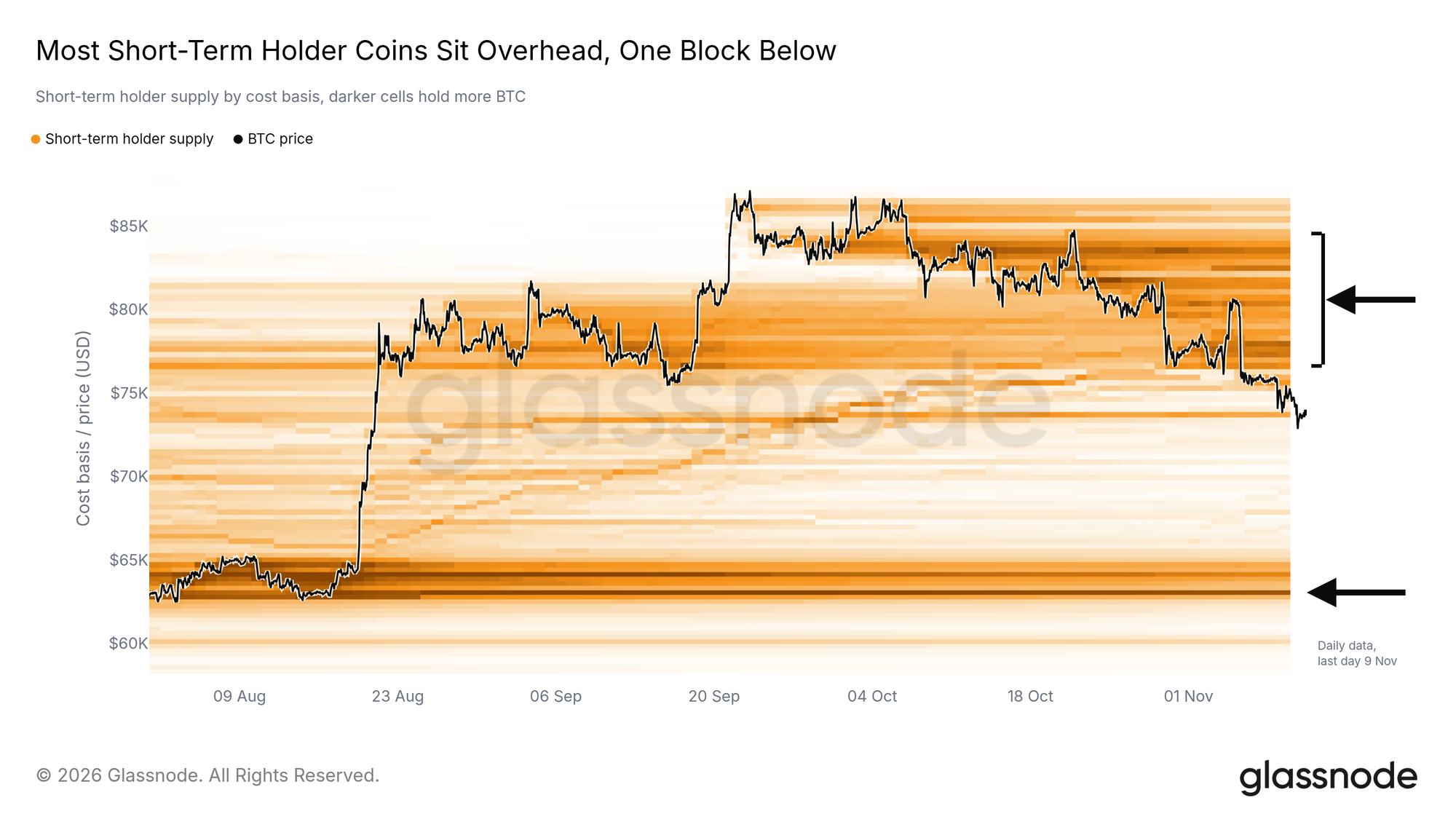
Recent buyers face an overhead supply test
At Bitcoin’s September high, nearly all short-term-holder coins were in profit. Glassnode put that share at about 35% at the time of its assessment, with roughly two-thirds of short-term-holder coins acquired above the prevailing price. Three purchase clusters from August through October extended as high as $83,600. Holders seeking to exit near their purchase prices could therefore add selling pressure to a rebound.
Below the market, the main concentrated cost-basis area was $62,000–$66,000, associated chiefly with buying near the August low. Glassnode identified $77,500, its True Market Mean, as a level at which roughly half of short-term-holder coins would return to profit. It also noted that September produced the first higher high since Bitcoin’s 2025 all-time peak; a close materially below the June low of $58,500 would invalidate the reversal structure it traced from August.
Cross-market performance and rates
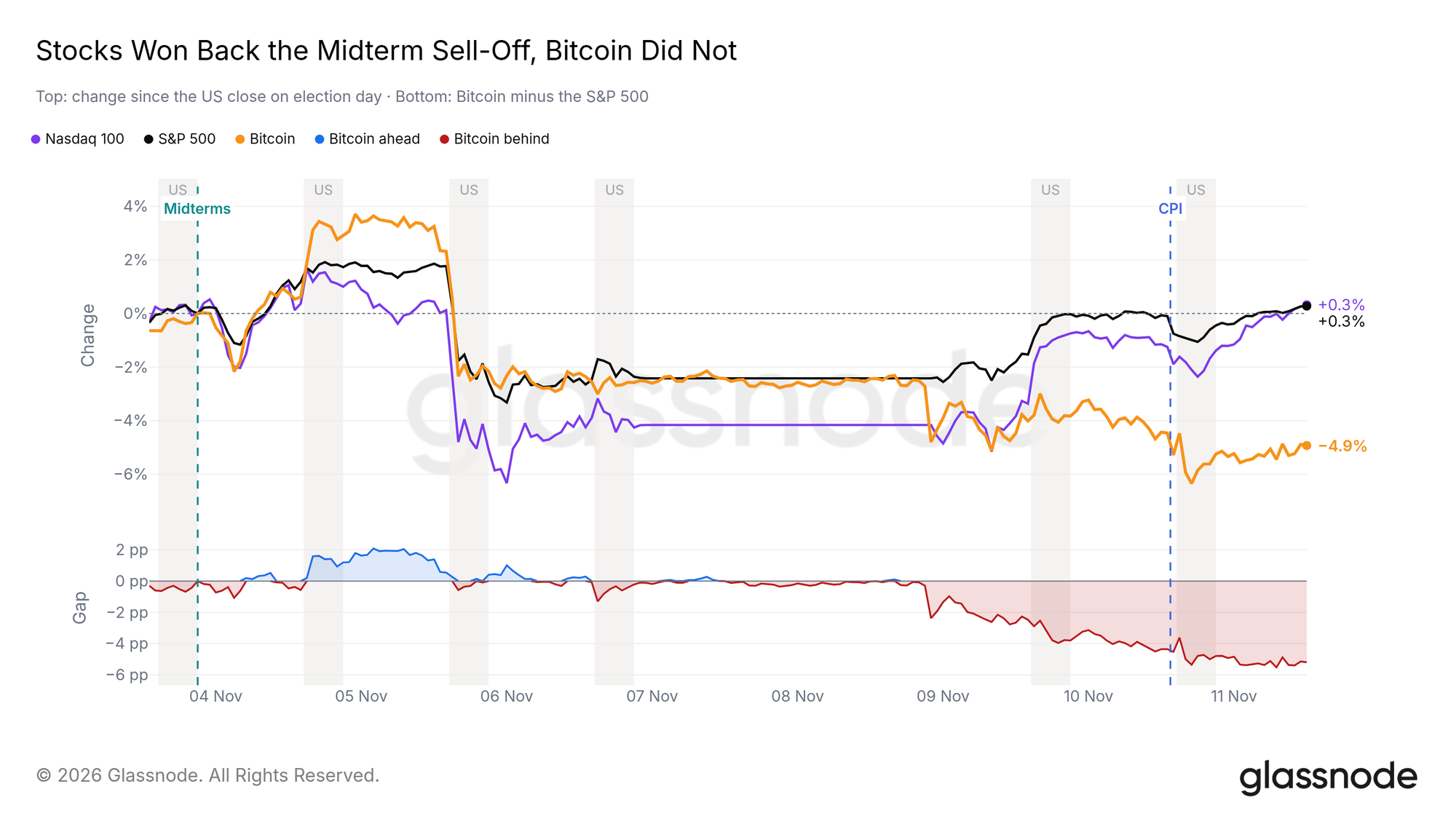
Glassnode reported that selling beginning November 5 affected both Bitcoin and US equities, but their paths diverged from November 9. The S&P 500 and Nasdaq 100 had regained their election-day closing levels, while Bitcoin fell again after the November 10 CPI release and remained down about 5% relative to its election-day close. Glassnode put that Bitcoin closing level at $77,800.
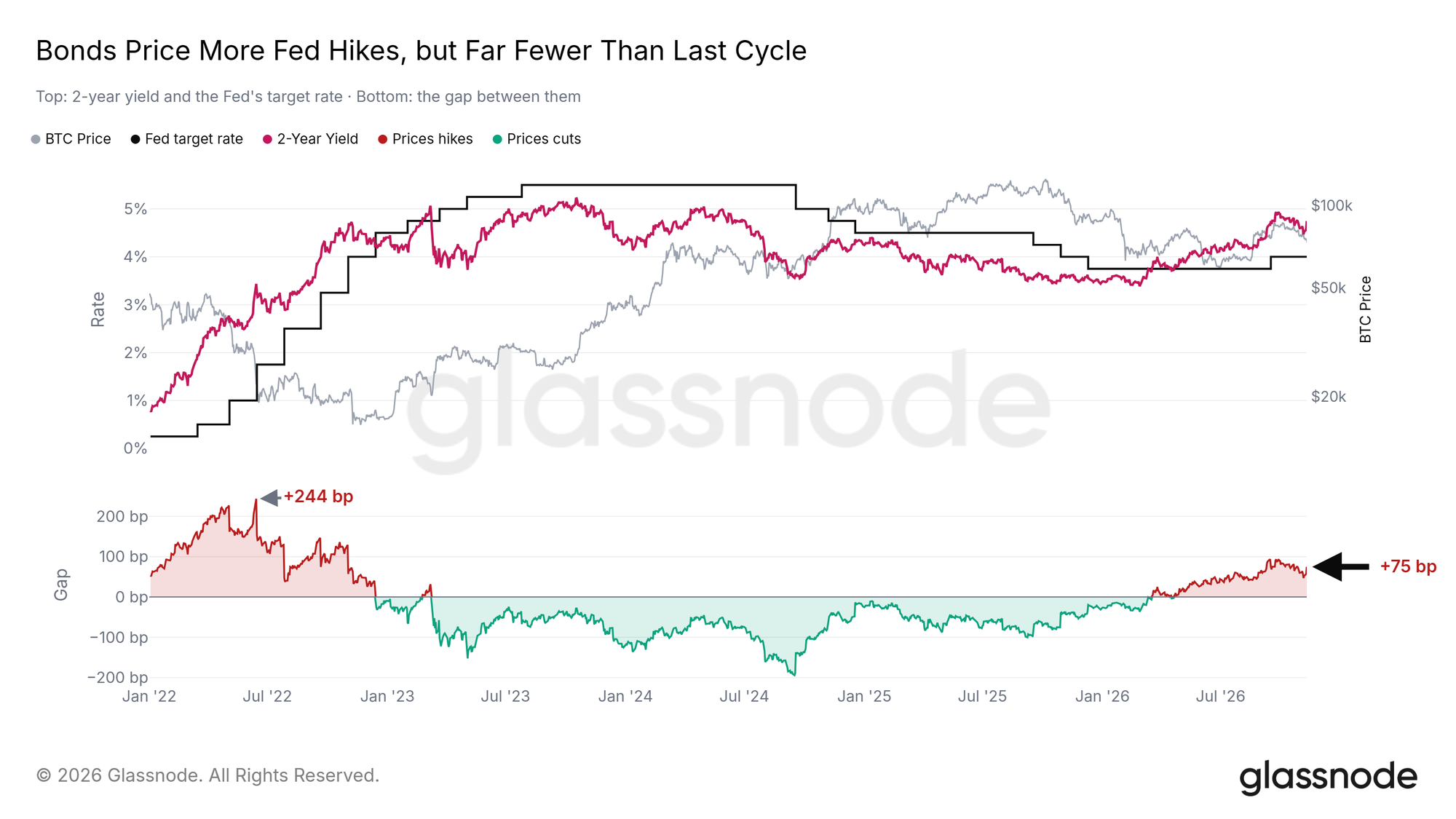
Rates presented a separate headwind. The two-year US Treasury yield was 4.75%, or 75 basis points above the 4% prevailing Federal Reserve benchmark rate. Glassnode interpreted the spread as reflecting expectations of further tightening, while stressing that it was far below the 244-basis-point spread recorded in June 2022 and had narrowed since late October.
Three measures point to weaker inflows
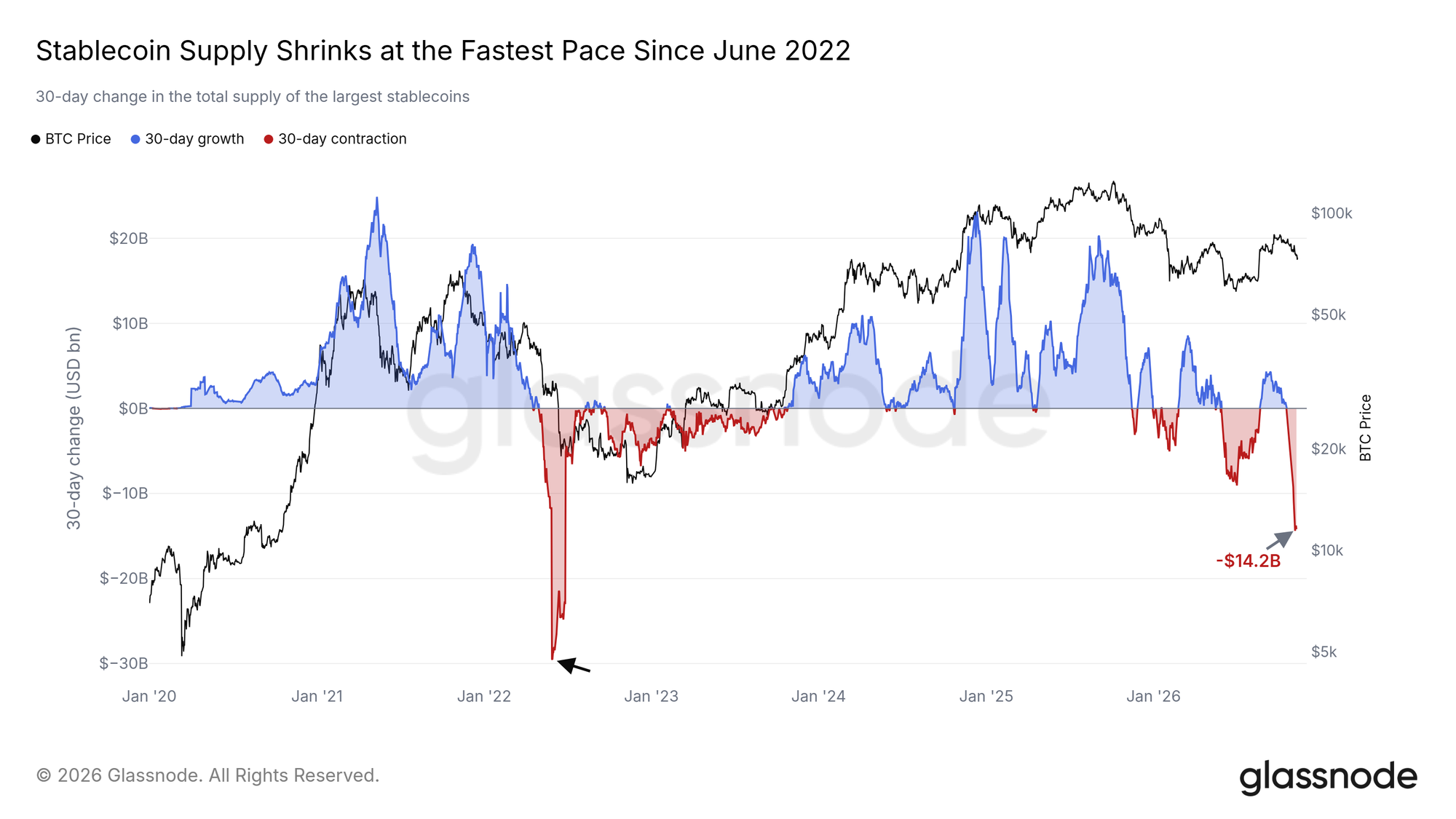
Stablecoins. Total stablecoin supply fell $14.2 billion over 30 days, the fastest contraction since June 2022, according to Glassnode. It interpreted the decline as a sign of capital leaving the crypto ecosystem. Tether’s slight discount to its $1 peg was another sign of pressure in its assessment; a return to positive 30-day supply growth would be a clearer indication of renewed inflows.
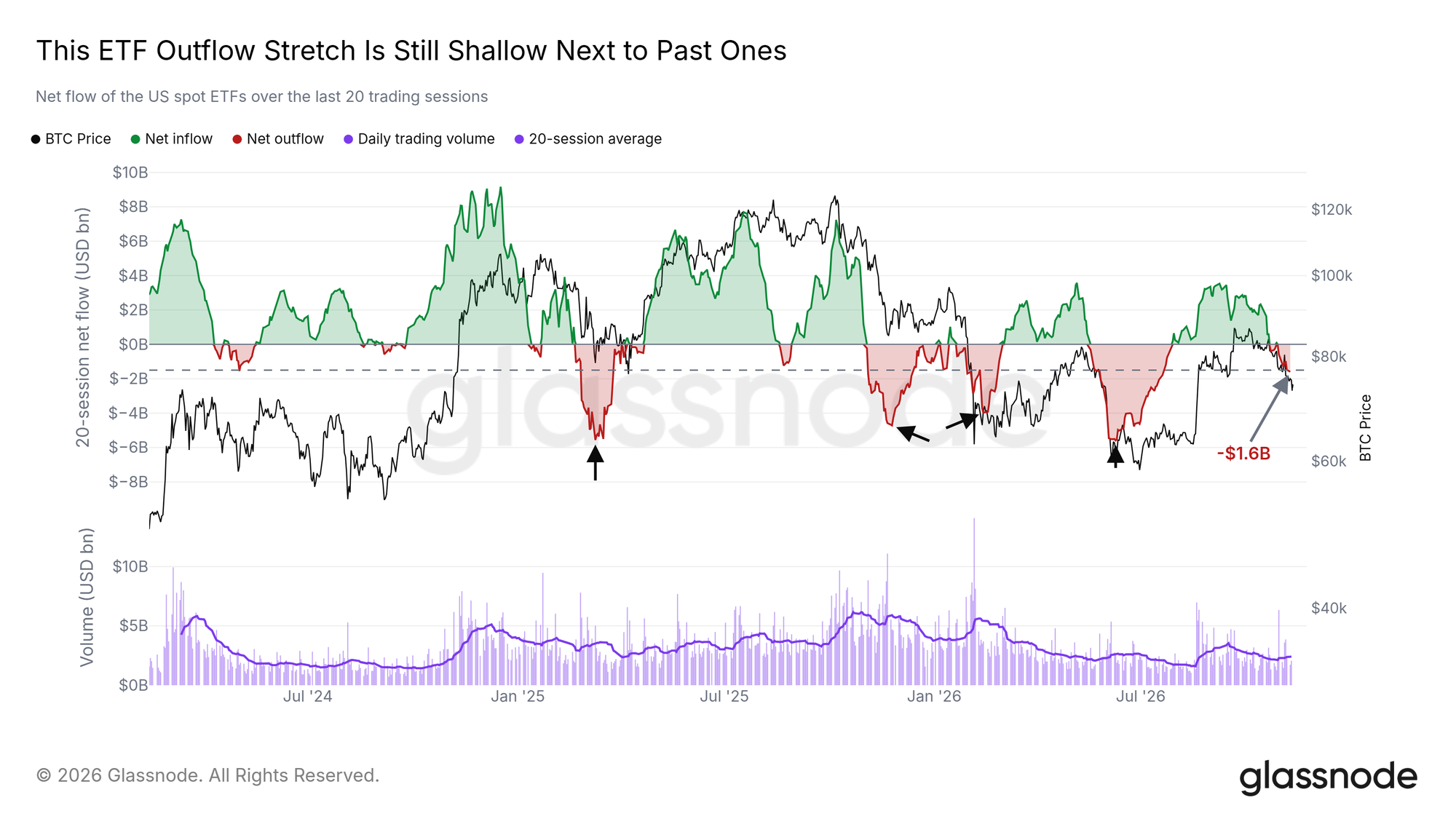
US spot Bitcoin ETFs. The funds recorded a cumulative $1.6 billion net outflow over 20 trading days. On November 9, outflows crossed Glassnode’s $1.5 billion threshold for what it calls a sustained outflow cycle. Glassnode cautioned that this episode remained shallower than most earlier ETF outflow periods it examined.
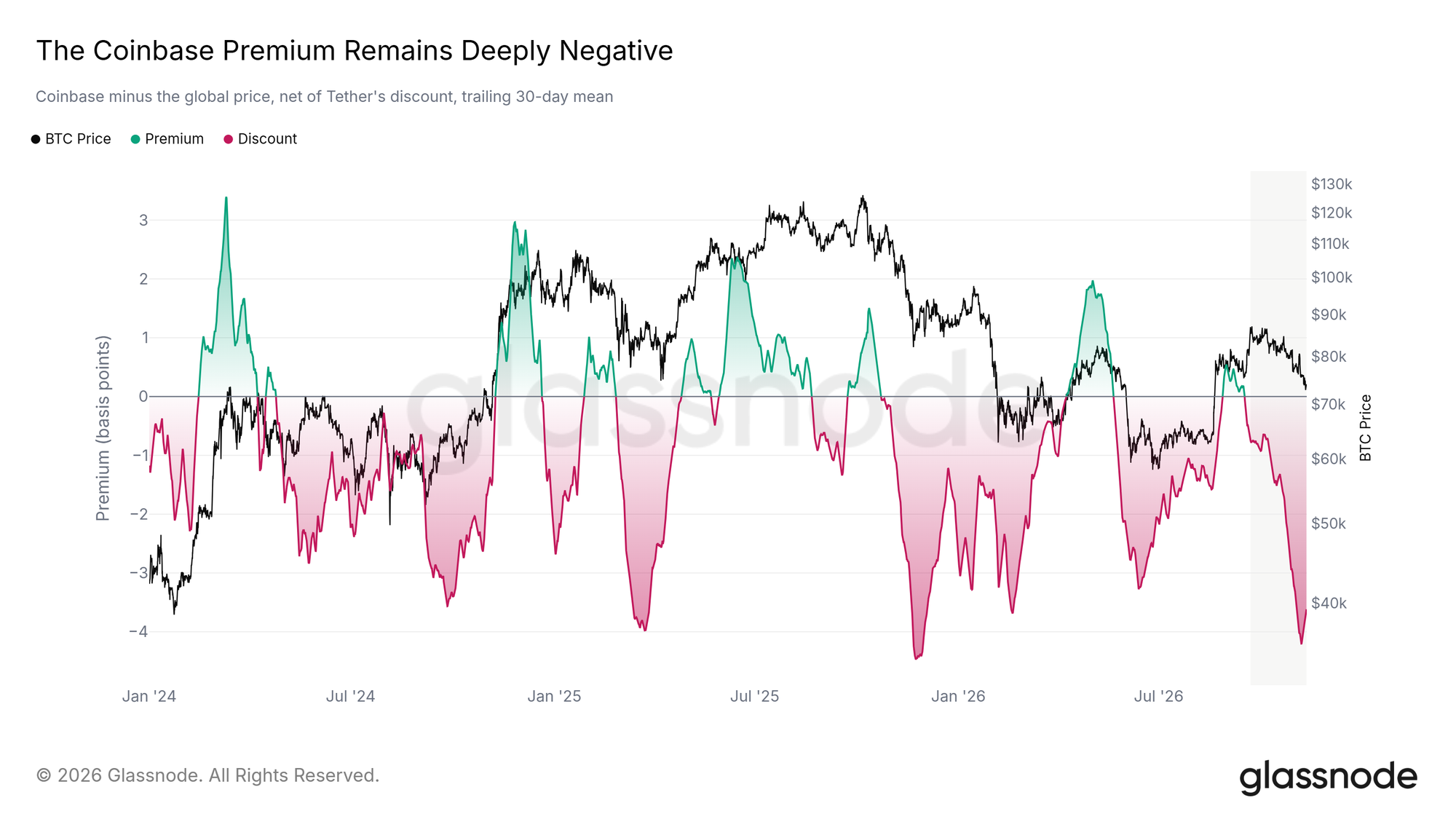
Coinbase premium. Glassnode’s 30-day average measure of Coinbase’s Bitcoin price relative to a global composite remained negative following the September high and reached its lowest reading since February 2026. Glassnode said it adjusted the measure to avoid overstating the discount because Tether had traded slightly below $1. A premium that turned positive and held for several weeks would offer stronger evidence of returning US demand than a brief change in sign.
Leverage, orders and wallet behavior
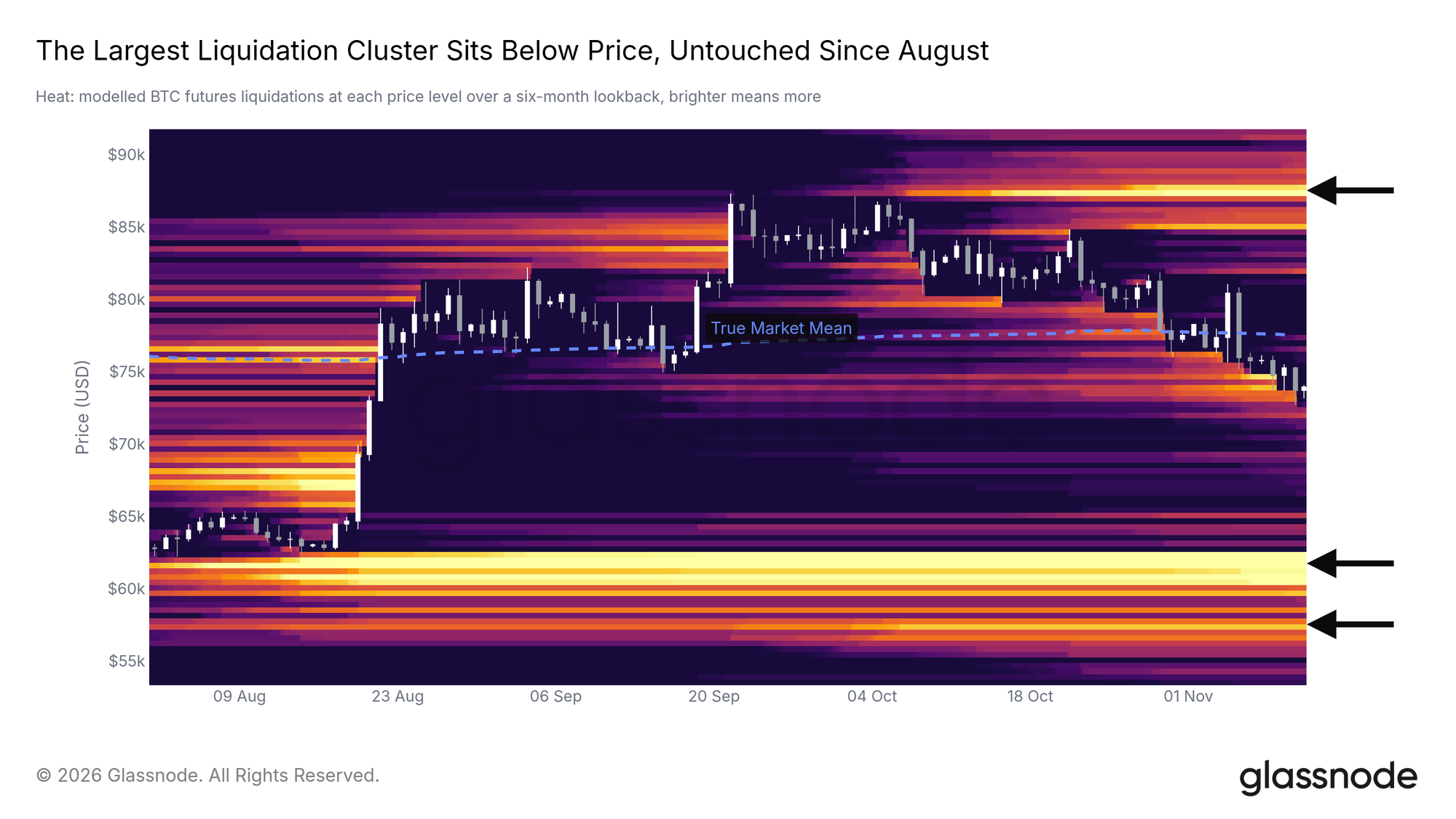
Glassnode’s liquidation heatmap suggested that much of the long-liquidation exposure near the prevailing price had been cleared during the decline from September. Its largest lower liquidation cluster over the preceding six months lay at $59,500–$62,600, with relatively little concentration between that zone and the market price. Open interest had nevertheless returned to its September-high level despite an approximately 15% price decline. Glassnode said this could indicate new short positions; it identified a major short-liquidation cluster near $87,500.
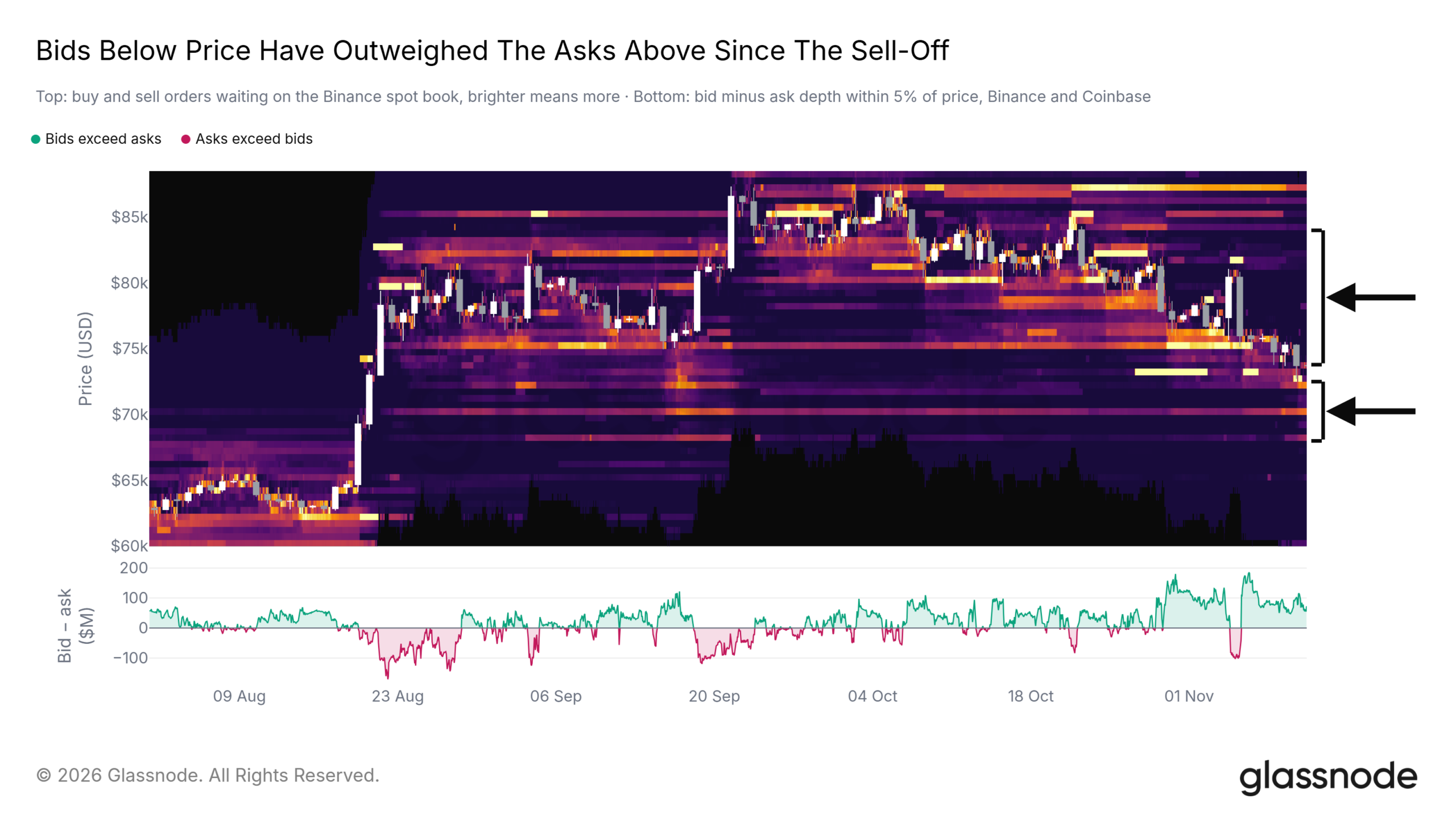
On Binance and Coinbase, bids within 5% of the prevailing price exceeded asks in every hourly interval measured since the November 5 sell-off. Concentrated bids lay around $68,000–$72,500, while Glassnode described a comparatively thin ask book beyond the nearest sell orders up to about $84,000. Those orders are not guaranteed support: some bids were temporarily withdrawn during the early-November decline before being reposted.
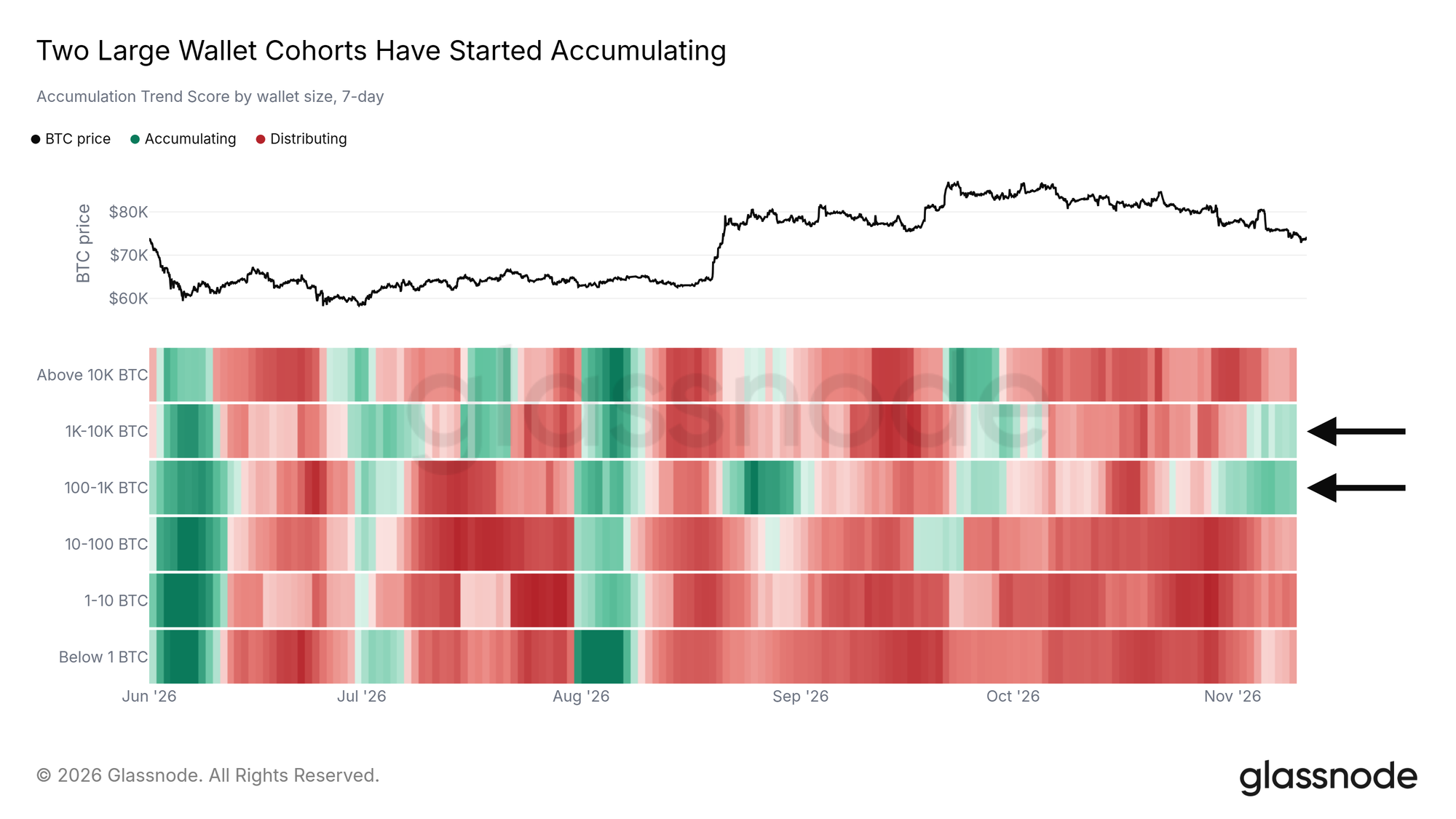
Finally, Glassnode’s volume-weighted Accumulation Trend Score rose above 0.5 over the preceding week for wallets holding 100–1,000 BTC and 1,000–10,000 BTC. Both groups had distributed coins through much of October, and a similar buying shift in late September had not lasted. Other wallet-size groups, from holders of less than 1 BTC to those above 10,000 BTC, still showed distribution. The wallet signal was therefore narrow rather than evidence of market-wide accumulation.
Taken together, the November measurements show why reduced nearby long leverage and stronger displayed bids did not, on their own, establish a recovery. Glassnode’s demand measures remained weak, and the short-term-holder cost basis at $75,600 still sat above the market. A sustained break below $73,000, the lower edge of its previously identified observation range, would instead point to a longer consolidation; a substantive close below $58,500 would negate its August reversal thesis.