In a report published on November 6, 2026, researcher tranks used data supplied by Bonanza Lab to examine listings on South Korea’s five won (KRW) exchanges: Upbit, Bithumb, Coinone, Korbit and Gopax. The central finding is a shift away from tokens first listed exclusively in Korea. The data show an association between that shift and fewer subsequent investment warnings or delistings, but do not establish that the listing approach caused the improvement.
How the listing mix changed
Tokens first listed exclusively in Korea accounted for 85% of new KRW trading pairs in 2019, according to the report, versus 9% in 2024. The number of such listings fell from 19 per quarter to three in the third quarter of 2021, when exchanges faced a registration deadline under South Korea’s revised financial-information reporting law. The law took effect in March 2021 and required exchanges to complete registration by September; KRW exchanges also needed bank-linked real-name accounts and anti-money-laundering controls.
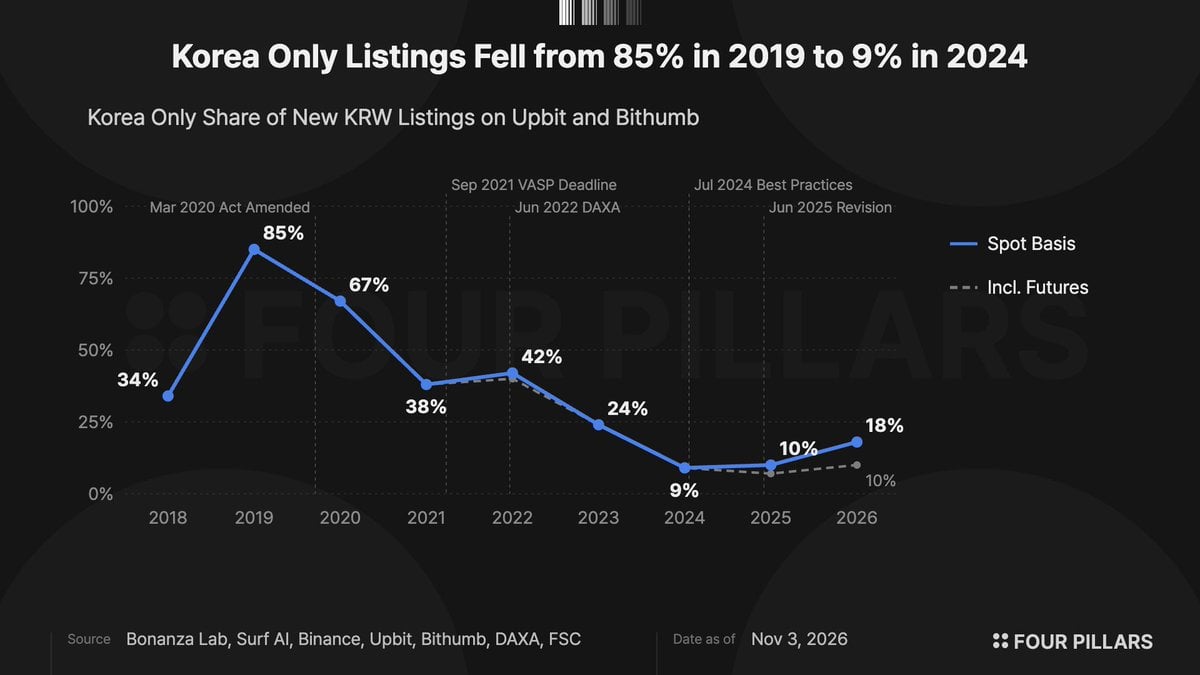
The five exchanges formed the Digital Asset eXchange Alliance (DAXA) in 2022. Its listing best-practice standards took effect in July 2024. Overseas listing is not an absolute requirement under those standards, but an asset traded for more than two years on a compliant overseas exchange can be treated as meeting baseline white-paper and disclosure review requirements.
By October 2026, Korea-only first listings had recovered to 18% of the reported total. Excluding assets that had already traded in overseas futures markets reduced the figure to 10%. Those two measures use different definitions and should not be read as an unqualified reversal of the earlier trend.
More listings, with different timing
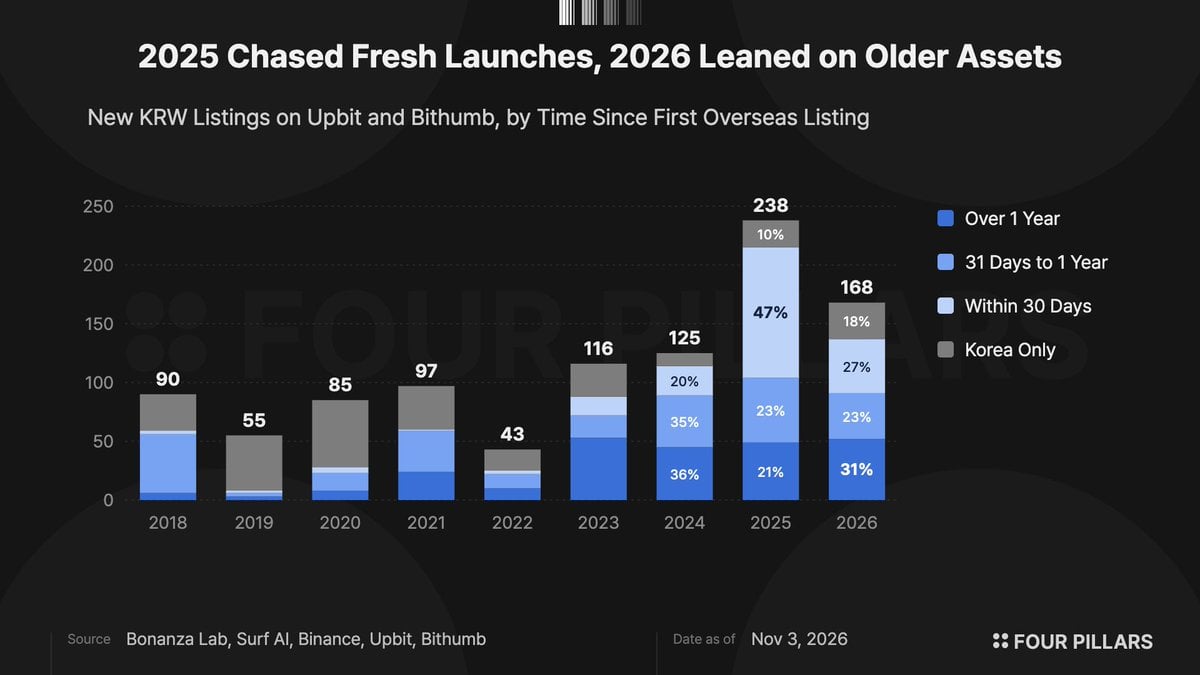
The shift did not mean fewer new listings. On Upbit and Bithumb, the reported number of new KRW listings rose from 43 in 2022 to 116 in 2023, 125 in 2024 and 238 in 2025. Of the 2025 listings, 111—or 47%—arrived within 30 days of beginning overseas trading, during a period when Bitcoin’s KRW price was near a historical high. In 2026, assets with more than a year of overseas trading history accounted for 52 listings, or 31% of the reported total. These included CRV and RSR, which had traded overseas for more than six years.
What the outcome data can—and cannot—show
Within two years of listing, 24% of the 2020 cohort received an investment warning or had trading terminated, compared with 10% of the 2024 cohort, according to Bonanza Lab’s figures. Across assets listed from 2020 through 2024, that outcome affected 44 of 148 Korea-only first listings (30%) and 26 of 279 assets previously traded overseas (9%).
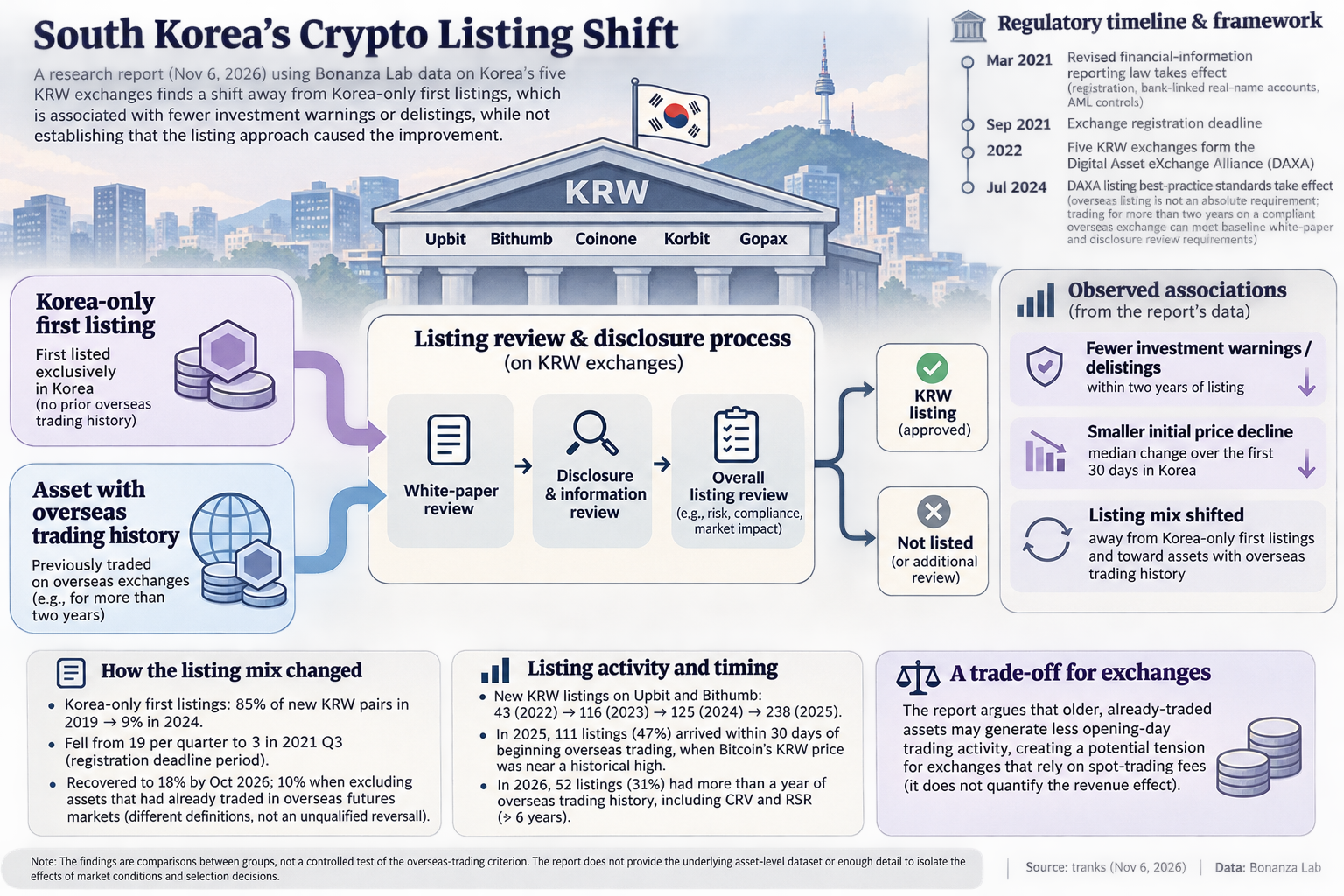
The report also finds a difference in initial price performance. For assets brought to Korea within 30 days of an overseas listing, the median price decline over their first 30 days in Korea was 39%. For assets with more than a year of overseas trading history, it was 7%.
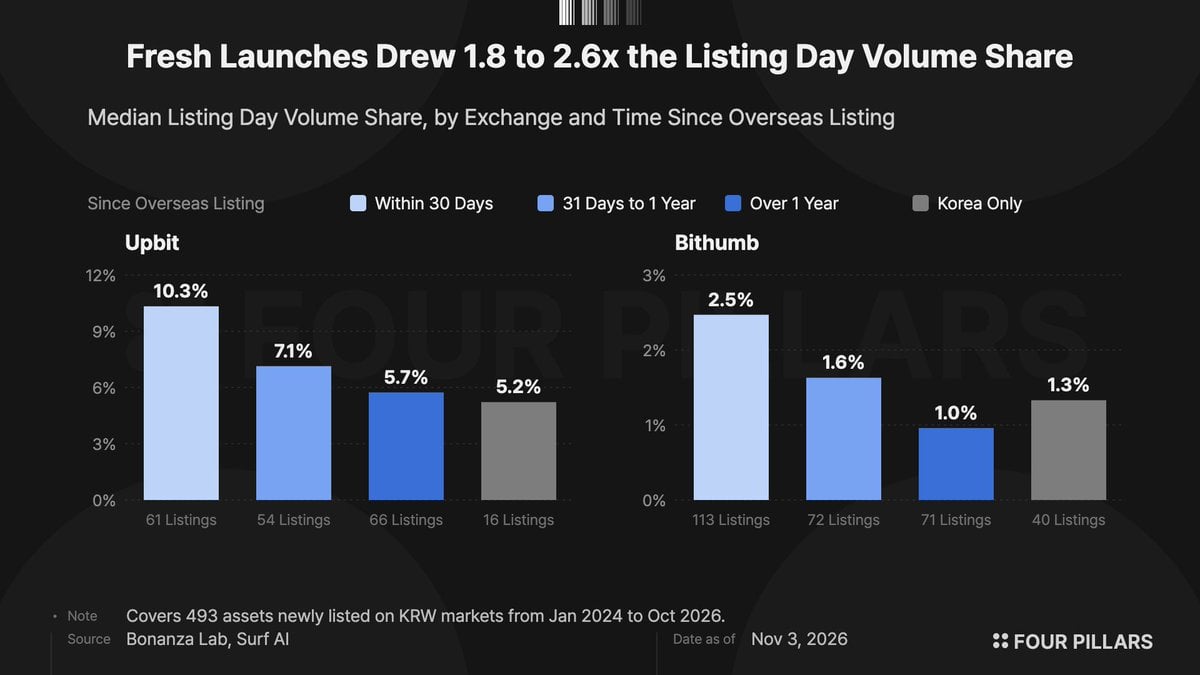
These are comparisons between groups, not a controlled test of the overseas-trading criterion. The supplied report does not provide the underlying asset-level dataset or enough detail to isolate the effects of market conditions and selection decisions. It argues that older, already-traded assets may generate less opening-day trading activity, creating a potential tension for exchanges reliant on spot-trading fees; it does not quantify the resulting revenue effect.