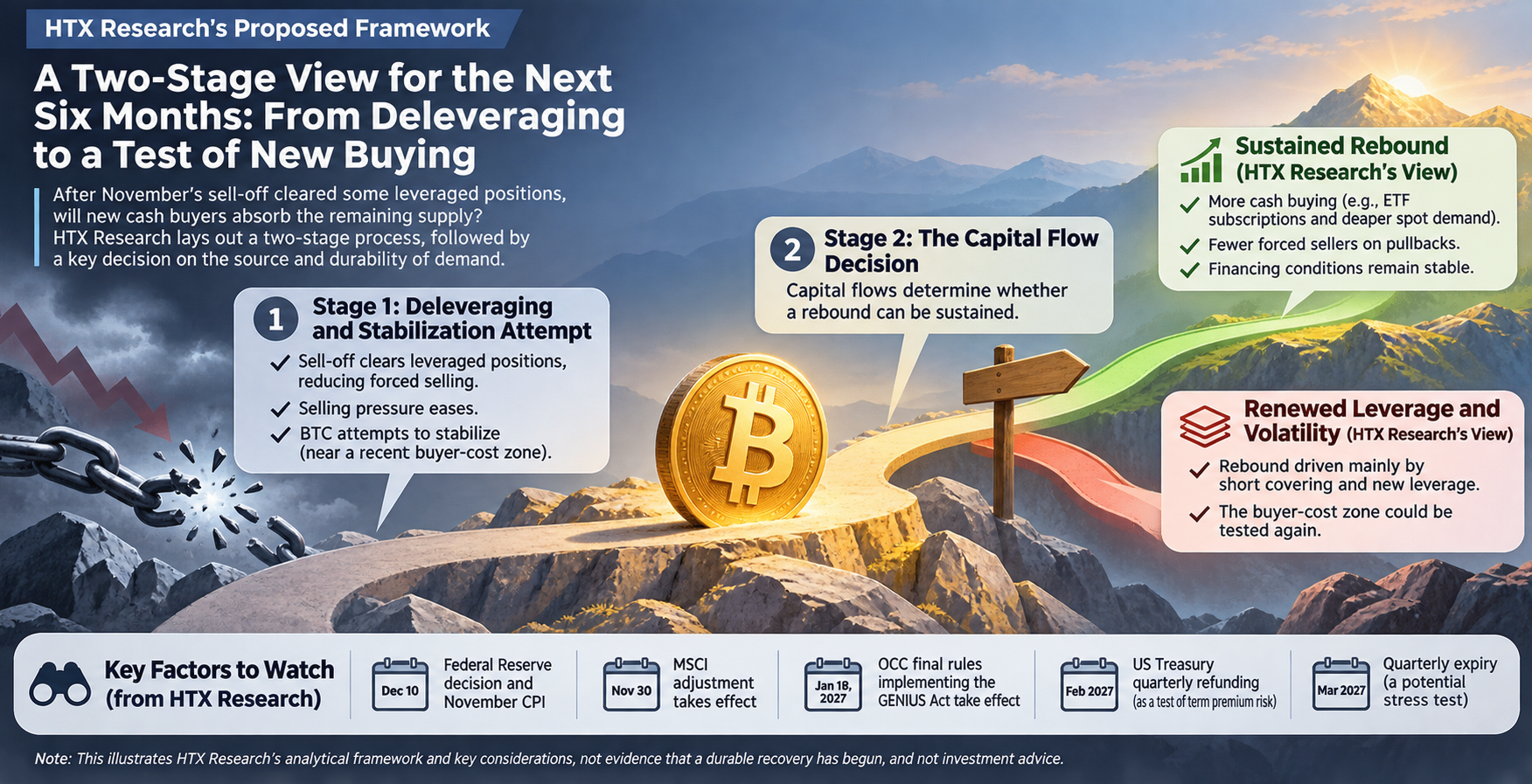
A November 20, 2026 account of an HTX Research report frames the next six months of the Bitcoin market around a question: after November’s sell-off cleared some leveraged positions, will new cash buyers absorb the remaining supply? The report’s base case is a two-stage process—selling pressure eases and BTC attempts to stabilize, then capital flows determine whether a rebound lasts. That is a forecast, not evidence that a durable recovery has begun.
Prices recovered faster than participation
The report says total crypto market capitalization rose 39.6% quarter over quarter in the third quarter of 2026, without a corresponding increase in spot trading. It cites Farside data showing $2.579 billion in cumulative net outflows from US spot Bitcoin ETFs from November 2–17. DeFiLlama data, it says, showed stablecoin market capitalization down 5.33% over the 30 days through November 18.
HTX Research identifies $62,000–$66,000 as a recent BTC buyer-cost zone. Its argument is that clearing leverage can reduce forced selling, but cannot by itself establish a new source of spot demand. A rapid bounce near that cost zone could also encounter selling from holders seeking to exit at break-even or take profits.
Financing conditions and institutional flows
HTX Research considers the duration of restrictive financial conditions more consequential over this window than the direction of any single rate decision. Even without another rate increase, delayed expectations of easing could raise the expected holding-period cost for financed investors. The report also distinguishes easing alongside stable incomes from rate cuts prompted by sharply weaker demand; it does not assume they would affect BTC in the same way.
The report cites a US Treasury estimate of $800 billion in net marketable borrowing from privately held investors in the first quarter of 2027. It argues that, if more issuance falls at longer maturities, a higher term premium could lift long-term yields. It treats the February 2027 quarterly refunding as a test of that possibility, not as a predetermined outcome.
Looking ahead from its November 2026 reporting date, the report points to the December 10 Federal Reserve decision and November CPI release as closely spaced opportunities for markets to reassess policy. It cautions that an initial relief rally might reflect position changes rather than fresh allocations, which can take longer to move through investment committees and product subscriptions. Conversely, BTC ceasing to make new lows after adverse policy news could, in its view, signal balance-sheet repair before a policy turn.
Institutional access can work in both directions. HTX Research argues that listed Bitcoin treasury companies might reduce prospective buying without selling existing BTC if their share-price premiums narrow and financing becomes more expensive. It proposes watching their ability to raise funds after an MSCI adjustment scheduled to take effect on November 30, 2026. For scale, the report compares roughly $240 million of ETF net outflows on November 17 with an estimated nominal value of daily new Bitcoin block subsidies about one-eighth as large. That comparison describes flow magnitude; it does not establish a direct price effect.
Growth does not necessarily reach token holders
The report separates the cycles for price, credit and industry activity. It suggests stablecoin payments could grow while crypto prices remain under pressure, and BTC could benefit from an easier institutional allocation route while revenue at many protocols remains weak.
HTX Research says final US Office of the Comptroller of the Currency rules implementing the GENIUS Act are due to take effect on January 18, 2027. Its forecast is that greater regulatory clarity would initially favor issuers with capital and distribution channels, while raising the relative fixed-cost burden for smaller participants. Scale alone would not ensure higher revenue: the report cites Circle’s third-quarter figures showing average USDC in circulation up 8% year over year while reserve revenue fell 8%.
For other tokens, the report argues that a broad market advance cannot be assumed from BTC’s performance. Projects would need demand sufficient to absorb supply from unlocks and incentives—and a way for growth to reach holders. Those are criteria in HTX Research’s analysis, not findings that particular tokens have met them.
The report’s proposed test comes during subsequent pullbacks: do they produce fewer forced sellers, and do rebounds attract more cash buying? It identifies the March 2027 quarterly expiry as one potential stress test. In its framework, ETF subscriptions, spot-market depth and financing conditions remaining stable through a drawdown would provide stronger evidence of repair than an uninterrupted price rise. If buying is instead driven chiefly by short covering and renewed leverage, HTX Research expects the buyer-cost zone could be tested again.