Originally reported by 深潮 TechFlow on November 11, 2026, at 10:31 a.m. UTC+8. The article is a translation of an essay by independent researcher hitesh.eth. The “human commitment market” described here is a proposed design, not a deployed system.
What would it take to make a promise to perform real-world work enforceable without giving a platform unrestricted control over participants? Hitesh.eth’s answer is to combine funded escrow, bounded obligations, independent dispute resolution and privacy-conscious credentials. The proposal starts with a service people want—not a token to trade.
The mechanism: fund the obligation first
Consider the essay’s illustrative repair job. A customer deposits 100 units of payment into escrow, while a technician posts a 20-unit performance bond. Before work begins, both parties agree on the deadline, quality criteria, acceptable evidence, dispute procedure and maximum penalty. The figures are examples, not pricing guidance or measured results.
If the customer accepts the repair, the contract releases the 100-unit payment and returns the bond. If the technician never starts and misses the deadline, the customer receives a refund and the previously specified compensation from the bond. A contested repair instead goes to an independent assessor, whose decision determines how escrowed funds are distributed within the agreed limits. The contract can execute that allocation; it cannot establish whether a physical repair was done well.
That distinction makes the assessor’s availability, appeal deadline and fallback settlement rule part of the design rather than administrative afterthoughts. Without them, escrow could leave funds locked indefinitely. The proposal also calls for encrypted, retrievable evidence during the dispute period. A public hash of predictable personal information—even without the underlying document—can leak information; a hash alone cannot resolve a factual dispute.
What the ERCs do, and do not, establish
The essay identifies possible Ethereum components, not a required or security-validated stack. According to its review of official standards pages on November 10, 2026, the standards discussed below were Final at that time. That designation applies to specifications, not to the safety of any implementation.
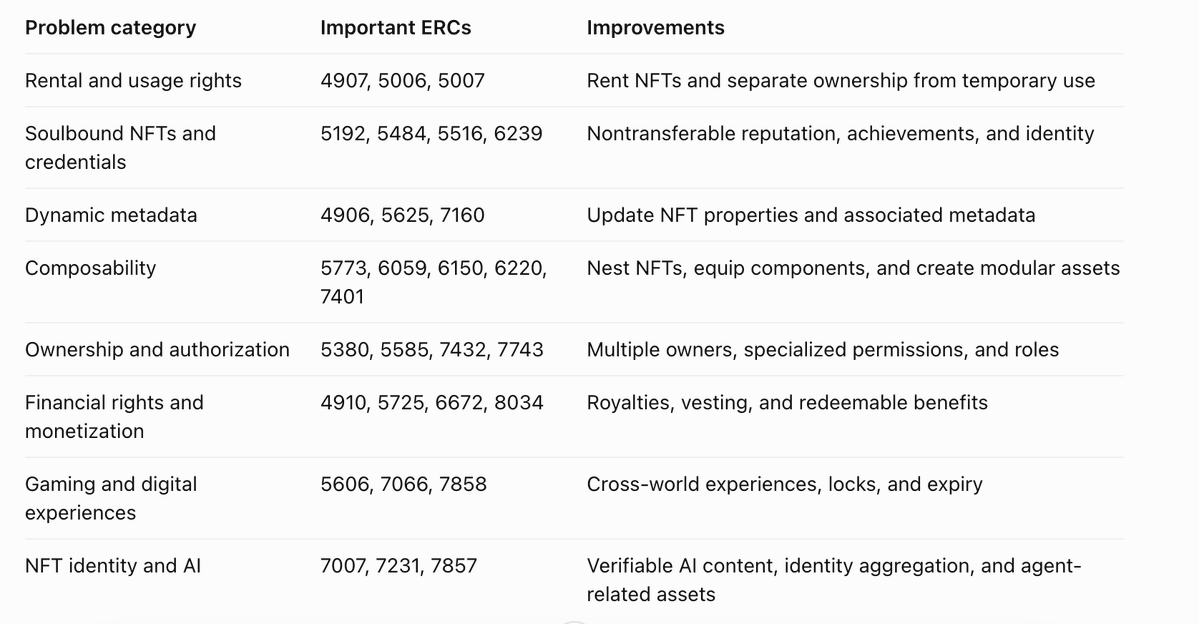
ERC-1155 and ERC-6909 offer different multi-token interfaces that could represent service entitlements. Neither proves that a provider has capacity to honor them. ERC-5484 could support a non-transferable credential issued with the recipient’s consent, but non-transferability does not establish skill, honesty or unique personhood—and public credentials can expose relationships. ERC-4337 concerns account abstraction; ERC-5564 concerns stealth addresses, which can reduce the visible link between a recipient’s public identity and an incoming payment. ERC-5564 does not hide payment amounts, make public escrow confidential or automatically protect later spending.
Hitesh.eth therefore argues for a separate confidential-credential layer that discloses only the claim needed for a particular interaction. A scoped nullifier could prevent one credential from being reused for the same reward claim; it would not prove that each participant is a unique human. Likewise, a proof drawn from selected positive reviews would not establish the absence of unresolved defaults. Credential validity depends on the underlying records, issuer rules and completeness of the claim being proved.
Reputation has to remain bounded
The proposed market draws on the privacy and pseudonymous-coordination ideas of Timothy C. May, Eric Hughes, David Chaum and Wei Dai. It also applies Elinor Ostrom’s work on polycentric governance to small communities that set their own rules. The essay explicitly does not present Ostrom as having proposed Ethereum governance.
In this design, a repair community might assess technicians, customers and dispute assessors against different obligations. A record in one field should not become a universal reputation score or confer authority in another. Disputed, resolved and expired claims need different treatment; a complaint alone should not become a permanent public verdict. Communities would publish how they weigh evidence, limit early exposure and preserve an exit route. Those choices still require human judgment. Self-dealing accounts, fabricated transactions and a provider who builds a good record before a large default remain risks; transaction counts alone cannot settle them.
A testable proposal, not evidence of deployment
The suggested first experiment is deliberately narrow: one community, one settlement asset, one type of work, a transparent dispute process and no speculative governance token. The essay proposes testing escrow and settlement paths on Sepolia—including cancellation, missed deadlines, assessor absence and appeal expiry—then checking that funds cannot be paid twice and every terminal state accounts for deposits. It calls for synthetic data in privacy tests and independent security review before a small real-money pilot.
The proposed measures of success are completed jobs, repeat customers, dispute-resolution time, bad-debt losses, privacy incidents and income earned after subsidies—not token price. No dataset or measured outcome for such a market is presented. The essay also mentions ERC-8004 as a possible framework for AI-agent identity, reputation and validation; it was Draft when the source checked it, and it is neither proof of an agent’s capabilities nor a payment system.
The central limitation is not merely technical. Escrow can constrain transfers, and cryptography can verify specific claims, but neither can independently judge physical work, eliminate coercion or guarantee a fair set of rules. The proposal’s contribution is a framework for specifying where those judgments and powers sit before participants commit funds.