Originally reported on November 11, 2026, at 09:53 UTC+8. This article describes the status reported at that time, not a current deployment check.
A shielded transaction can conceal activity on-chain while a wallet’s network connections still reveal information about its user. Mobile light wallets typically request blockchain data and broadcast transactions through remote servers. Those servers can observe the connecting IP address, the request and its timing. In Zcash, the relevant wallet service is lightwalletd.
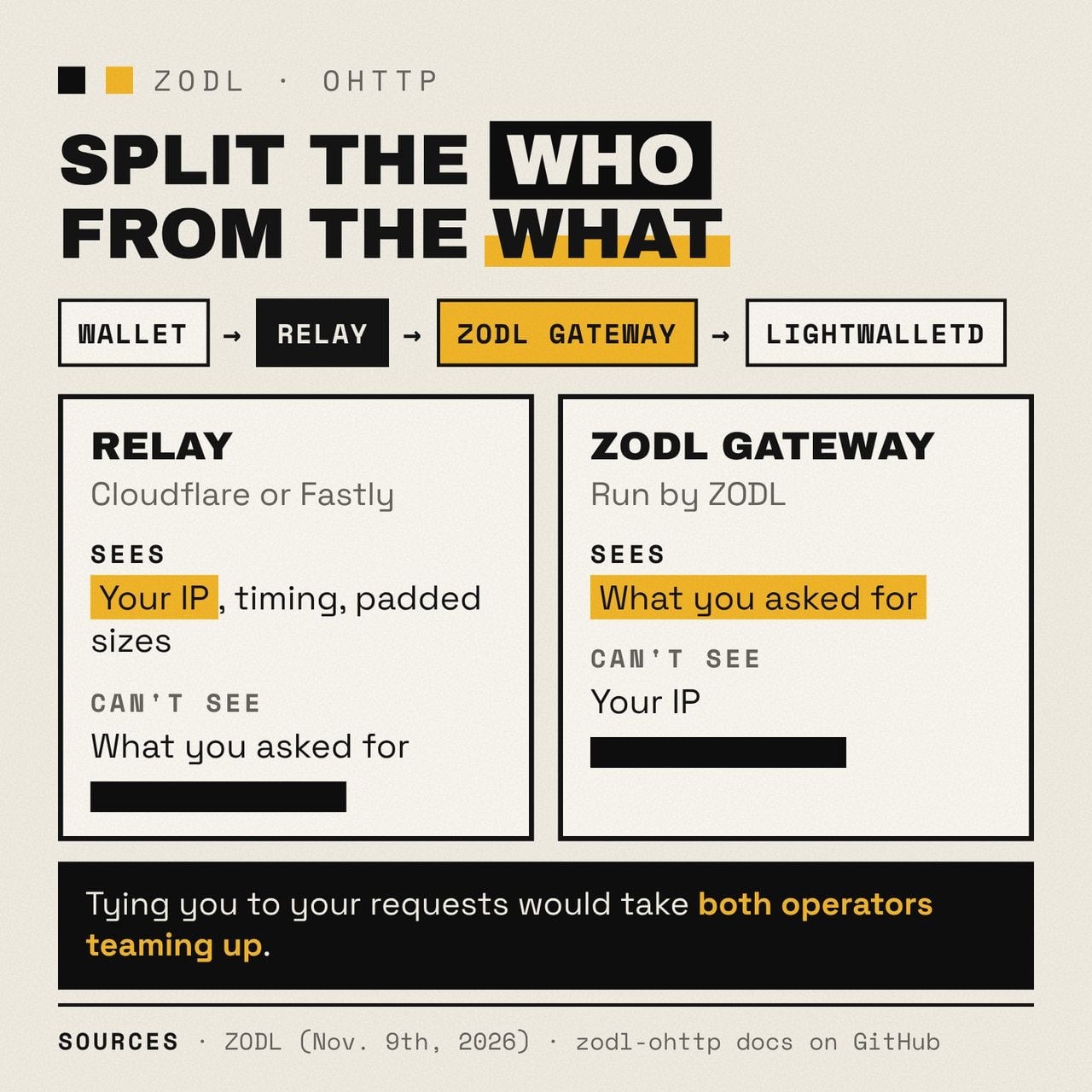
The privacy question behind Zodl’s version 3.20.0 is therefore narrower than whether Zcash transactions are shielded: can a wallet server answer a request without also learning the requester’s IP address? According to the Bankless article translated by TechFlow, Zodl made an Oblivious HTTP (OHTTP) routing design the default in that release and was rolling it out to users in batches at the time of reporting.
What the OHTTP route separates
The wallet encrypts each request so that only a Zodl gateway can open it, then sends the encrypted request through a relay operated by Cloudflare or Fastly. The relay sees the user’s IP address but cannot read the request. The gateway decrypts the request and passes it to lightwalletd, but sees the relay’s address rather than the user’s. The design aims to prevent either operator, acting alone, from joining an IP address to the content of a wallet request.
The source’s description of the published code also identifies two traffic-correlation defenses. Requests are padded in size bands of approximately 4 KB; transaction broadcasts are padded to at least 16 KB, and sensitive responses are padded too. At the gateway, relay request IDs are logged as HMAC-derived fingerprints rather than in plaintext, using a key held only in gateway memory and lost on restart. These measures address packet-size clues and later log matching, respectively; they do not establish that all forms of traffic correlation are impossible.
Where the protection stops
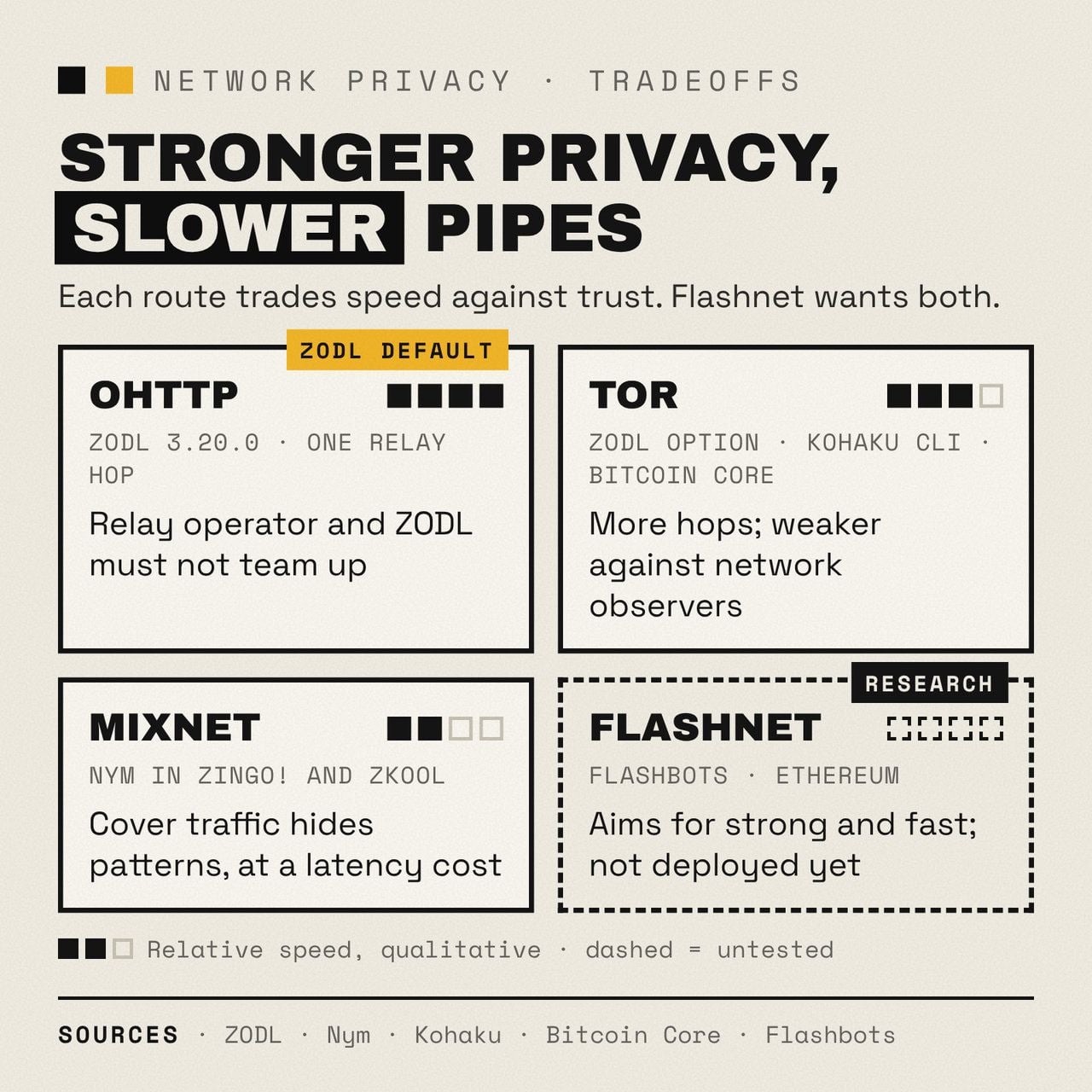
The separation depends on the relay operator and Zodl not colluding. A relay can still observe when a user connects and roughly how much traffic passes through it. Critics cited in the Zcash community forum also raised the risk that US-based relay operators Cloudflare and Fastly could face legal demands. Zodl core contributor y4ss acknowledged the limitation, describing OHTTP as a better default, not a replacement for Tor or Nym against a powerful state-level adversary. For users whose threat model includes pressure on cloud infrastructure, y4ss suggested enabling Zodl’s Tor option alongside OHTTP; the relay would then see a Tor exit IP rather than the user’s own address.
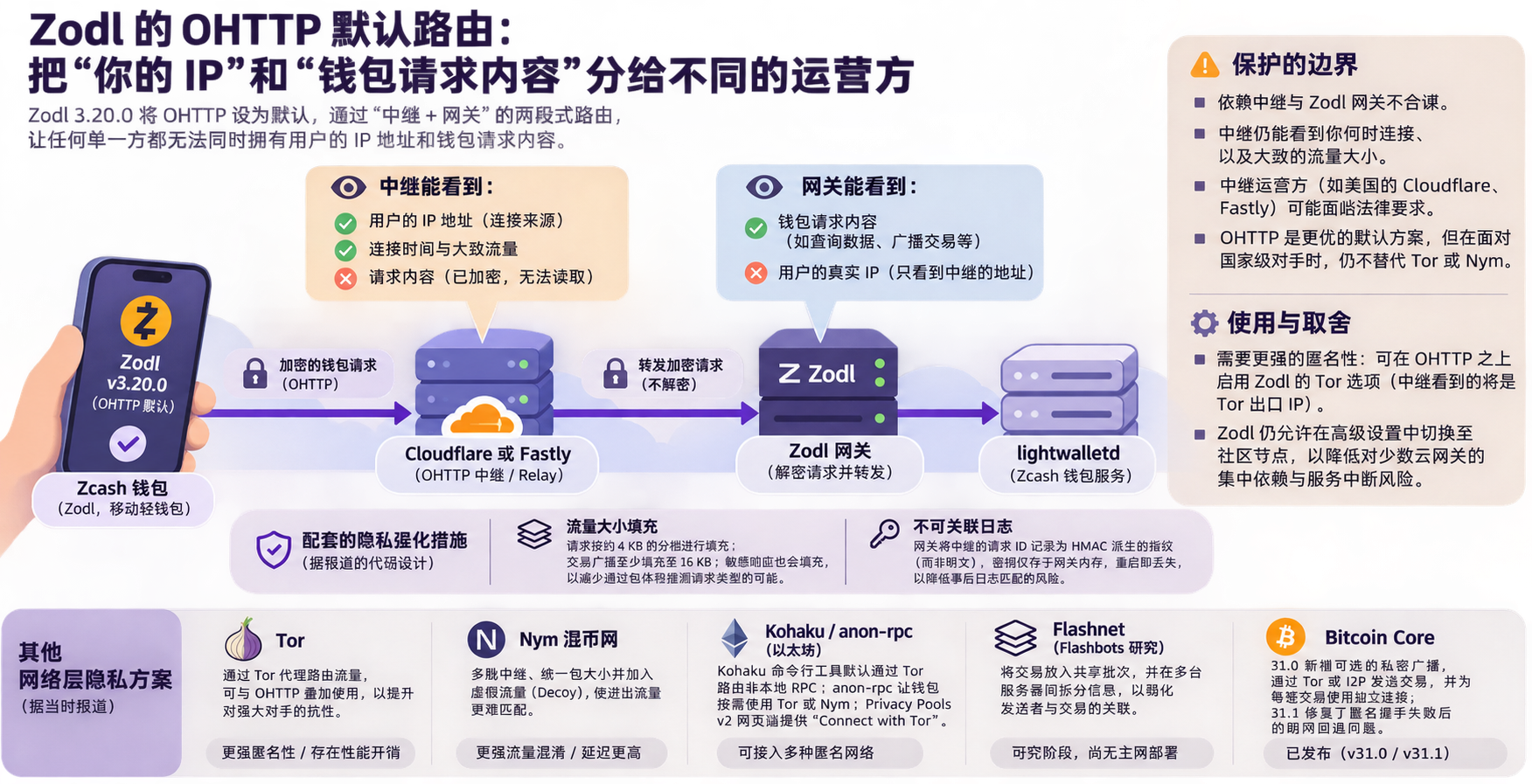
The trade-off is between a low-friction default and a stronger anonymity requirement. The source says Zodl still allowed users to switch to community nodes in advanced settings. That option matters for a separate concern: reliance on a small number of cloud gateways can create service-denial and concentration risks even when those gateways cannot read the requests they relay.
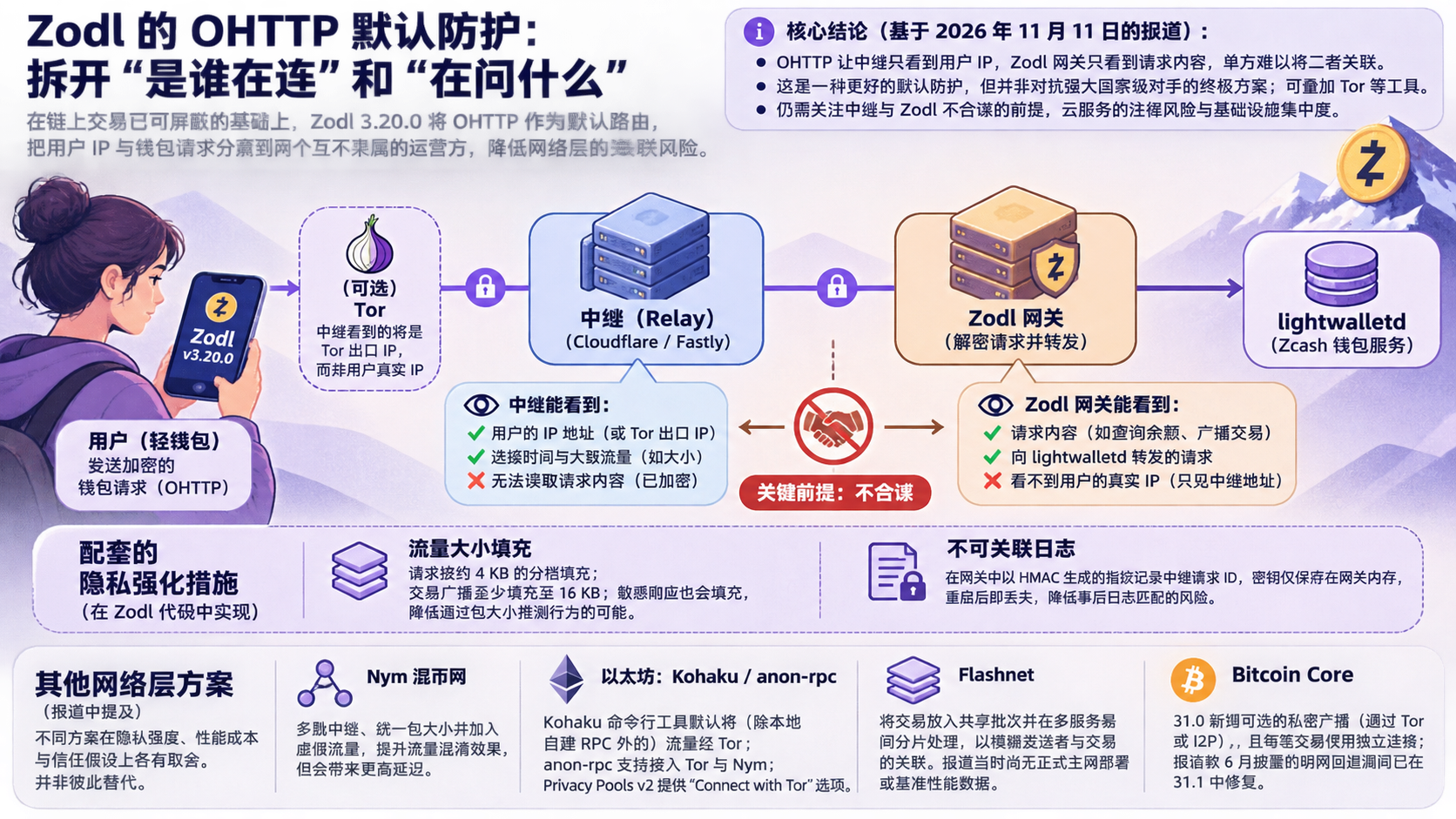
Other network-layer approaches reported at the time
The same November 2026 account described alternatives with different costs and maturity levels:
- Nym mixnet: Mixnets use multiple relays, uniform packet sizes and decoy traffic to make incoming and outgoing traffic harder to match, at a latency cost. Nym said in September that Zingo offered a mixnet switch and Zkool supported routing through a mixnet node; it also said it was in talks with Zodl. Nym announced a wallet and application SDK at Devcon 8 the week before the article.
- Ethereum tooling: The Ethereum Foundation’s Kohaku command-line tool was reported to route traffic other than self-hosted local RPC calls through Tor by default. Its separately proposed anon-rpc interface was intended to let wallets use anonymity networks; the source said Tor- and Nym-supporting versions were running on mainnet and that the Privacy Pools v2 web interface used a “Connect with Tor” option.
- Flashnet: Described as Flashbots research introduced in February 2026, it proposed placing transactions into shared batches and splitting information across servers to obscure the sender–transaction link. The source reported no formal mainnet deployment or benchmark results at publication.
- Bitcoin Core: The source said version 31.0, released in April 2026, added an optional private-broadcast feature using Tor or I2P and a separate connection for each transaction. It also reported that a clear-network fallback after a failed anonymous handshake, disclosed in June, was fixed in version 31.1.
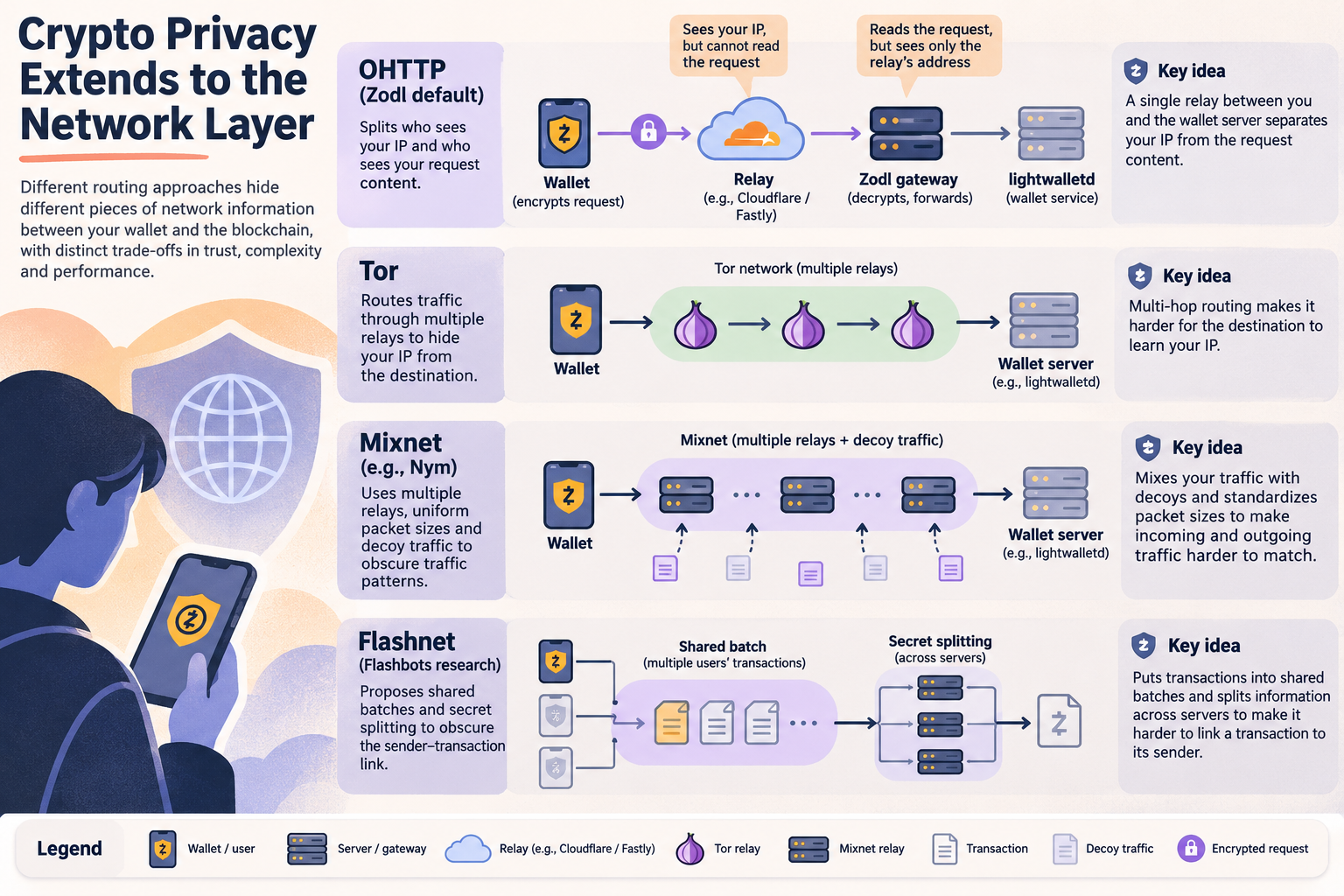
These are not interchangeable protections. Zodl’s reported change makes one separation of network information the wallet default, while stronger traffic-hiding methods impose different performance costs and trust assumptions. The deployment claims and project descriptions above are those reported in the original article; no independent traffic measurements or comparative benchmarks are supplied.
Source: techflowpost.com (originally published 2026-11-11 09:53 UTC+8)