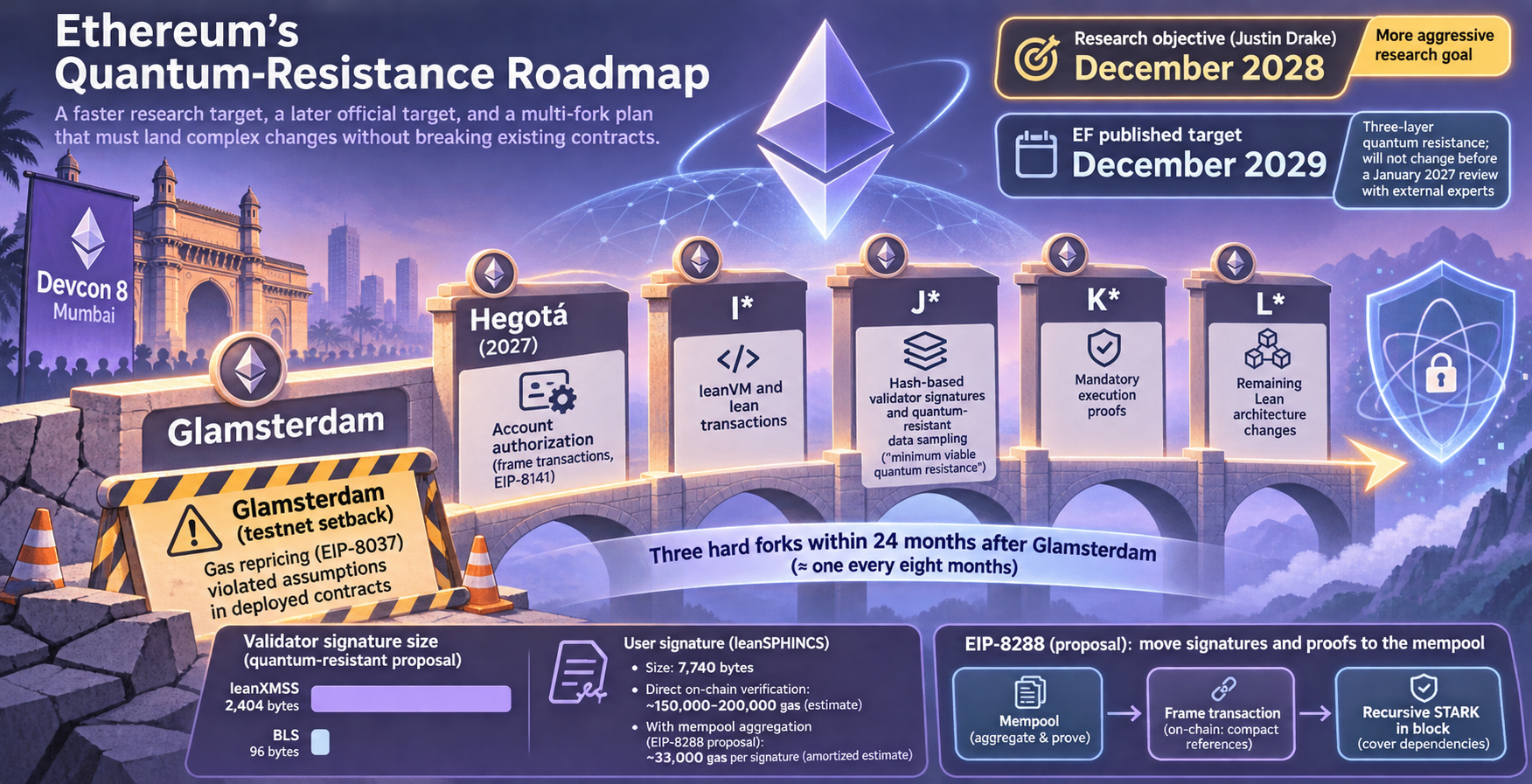
As reported on November 10, 2026, Ethereum researchers were working toward a December 2028 quantum-resistant transition—an ambition one year ahead of the Ethereum Foundation’s published December 2029 target. At Devcon 8 in Mumbai, EF researcher Justin Drake described a path that would require three hard forks within 24 months after Glamsterdam. The question is not only whether the cryptography works, but whether the changes can be deployed without breaking assumptions embedded in existing contracts.
Two dates, different levels of commitment
The EF’s September priorities article set out a three-layer quantum-resistance goal for December 2029 and said that date would not change before a review with external experts in January 2027. Drake’s December 2028 date was a more aggressive research objective, not a replacement for that published target.
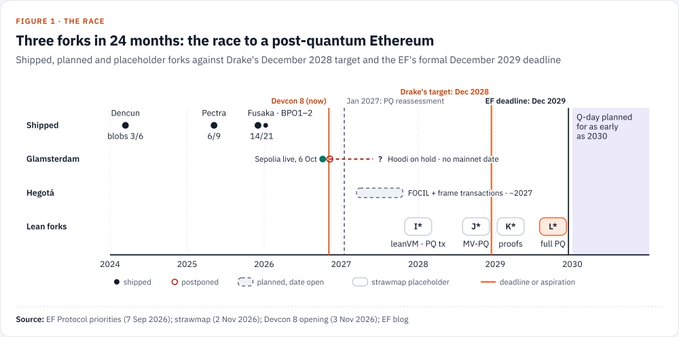
The roadmap draft sequences the work across provisional forks. Hegotá, planned for 2027, would introduce frame transactions so accounts can choose their own authorization schemes; it would not itself be the quantum-resistance fork. A subsequent I* fork would introduce the leanVM proof virtual machine and quantum-resistant “lean” transactions. J* would add hash-based validator signatures and quantum-resistant data sampling, reaching what the EF calls “minimum viable quantum resistance.” K* and L* would bring mandatory execution proofs and the remaining Lean architecture changes.
Three forks in 24 months implies roughly one every eight months. The source contrasts that pace with recent Ethereum fork intervals of 11, 14 and seven months. It also reports an EF calculation that reaching L* by December 2029 would require an average interval of 7.2 months. These are scheduling requirements, not delivery forecasts.
Why a gas change matters to the roadmap
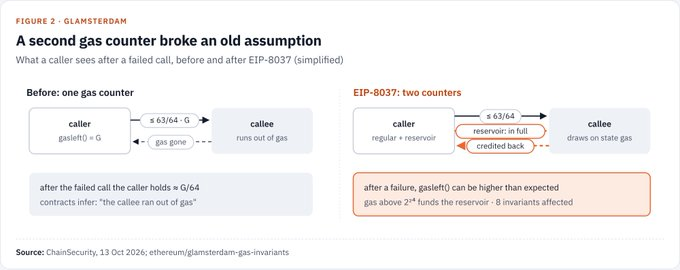
Glamsterdam provides a concrete example of deployment risk. It had run on the Sepolia testnet since October 6, but was withdrawn from a second testnet on October 22. The EF later attributed the problem to a proposed gas repricing that violated assumptions used by deployed contracts.
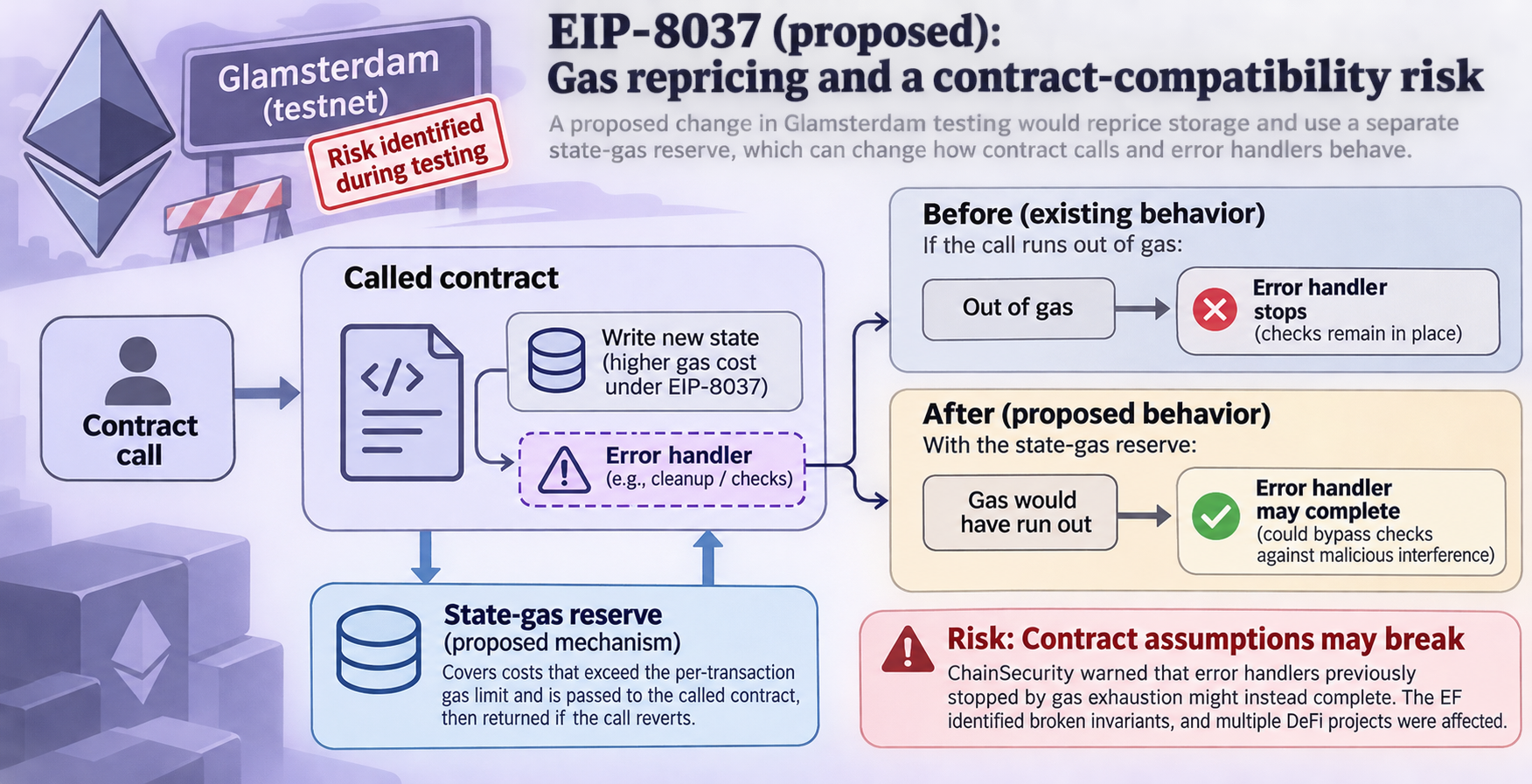
Under EIP-8037, new state would cost 1,530 gas per byte. The source reports that writing a new storage slot would rise from 22,100 to 110,020 gas, while deploying a 24 kB contract would cost about eight times as much. A separate state-gas mechanism intended to accommodate those costs could also change how calls behave when gas runs out. ChainSecurity warned that error handlers previously stopped by gas exhaustion might instead complete, bypassing checks against malicious interference. The EF identified eight broken invariants, and an AllCoreDevs summary counted 13 affected DeFi projects. Hoodi testing was postponed without a new testnet or mainnet date; All Core Devs coordinator Nixo wrote that Glamsterdam’s mainnet launch would likely move to 2027.
That matters beyond Glamsterdam because the Hegotá frame-transaction proposal, EIP-8141, lists EIP-8037 as a requirement. A delay or redesign at one fork can therefore affect the sequence proposed for later forks.
Moving signatures and proofs out of block payloads
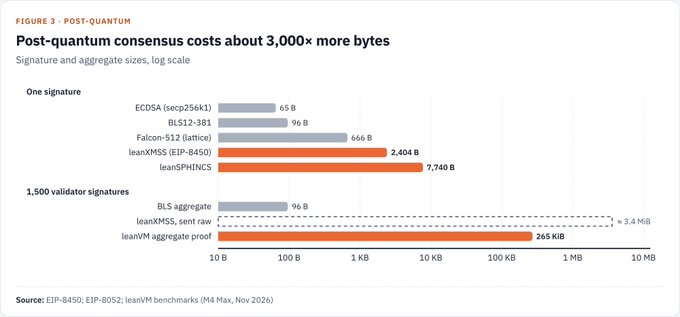
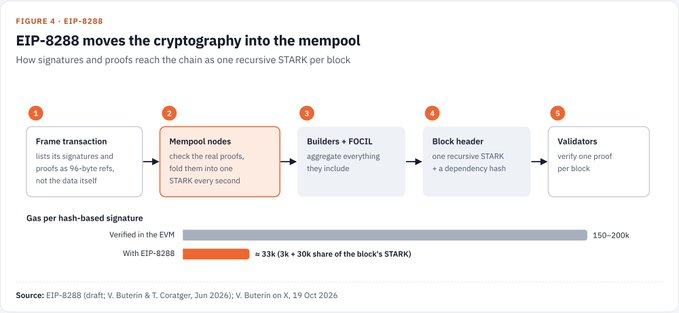
The proposed quantum-resistant schemes have a size problem. The source lists a leanXMSS validator signature at 2,404 bytes, against 96 bytes for BLS. Hash-based signatures cannot be added together in the same way as BLS signatures; the proposed alternative is for an aggregator to prove that it checked them. For users, the source lists a 7,740-byte leanSPHINCS signature, with direct on-chain verification costing an estimated 150,000–200,000 gas.

EIP-8288, a draft co-authored by Vitalik Buterin and Thomas Coratger, proposes aggregating signatures and proofs in the mempool instead. A frame transaction would declare dependencies through compact references rather than carry the full data on-chain. Nodes, builders and inclusion-list participants would check the underlying material; a recursive STARK in the block would cover the dependencies. The source estimates an amortized cost of about 33,000 gas per leanSPHINCS signature under this design.
Those figures describe a proposal, not a deployed fee schedule. The draft leaves aggregation keys and dependency hashes undecided, reserves rather than enables STARK dependencies, and acknowledges added mempool denial-of-service risk. The source also distinguishes leanVM’s formal work on instruction semantics and constraints from production readiness: its Rust implementation had undergone differential testing, while recursive-proof soundness remained an open question.
The test is integration, not a single primitive
The source cites a March 2026 paper by researchers from Google Quantum AI, UC Berkeley, the EF and Stanford estimating that an attack on Ethereum’s elliptic-curve signatures could require fewer than 1,200 logical qubits and fewer than 500,000 physical qubits, with a runtime measured in minutes. Those are research estimates, not a report of a working attack. It also cites Anthropic’s July report of an AI-assisted reduction in the estimated work to recover a HAWK-256 key, from roughly 2^64 to 2^38 operations.
As of the November 10, 2026 report, the immediate checkpoints were discussions scheduled for November 12 and 19 on fixes to EIP-8037/8038 and a new Hoodi date, followed by the EF’s January 2027 review of its quantum-resistance deadline. The open engineering question is whether Ethereum can integrate account authorization, validator signatures, data availability and proof systems at the required fork cadence while preserving existing contract behavior.
Source: panewslab.com (originally published 2026-11-10 10:59 UTC+8)