Bittensor’s TAO traded at $172.36, down 6.16% over 24 hours, according to Cryptopolitan’s analysis published on November 25, 2026, at 22:07 UTC+8. The report put circulating supply at 11.73 million TAO, market capitalization at $2.01 billion and 24-hour trading volume at $107.98 million.
Cryptopolitan also projected that TAO could reach $465 by the end of December. The distinction is important: the market figures describe trading on November 25, while the report gives no valuation model showing how it arrived at the December target.
What the November 25 charts showed
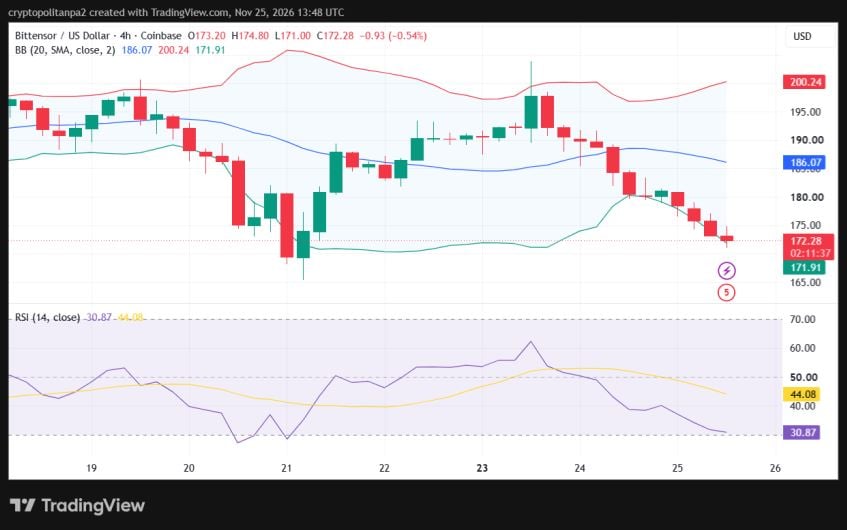
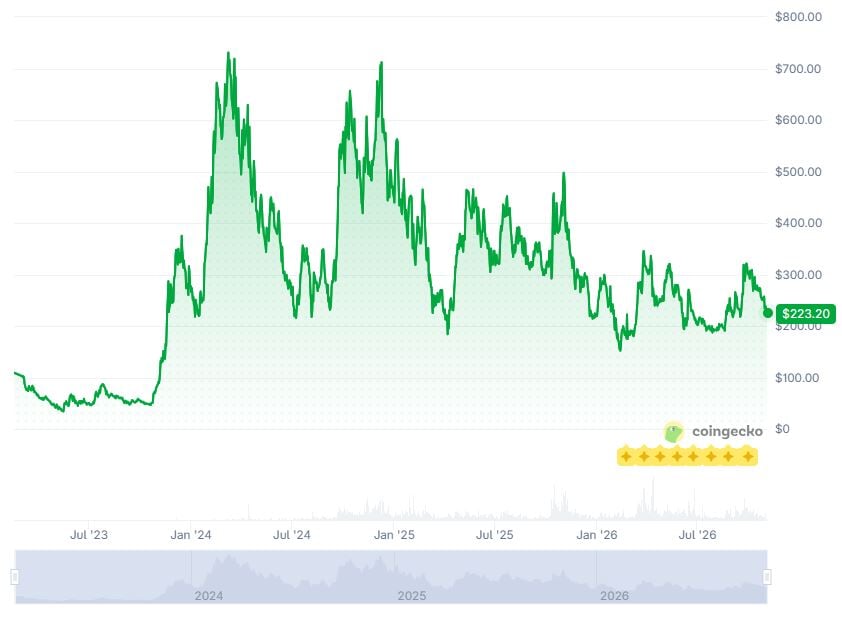
TAO had traded near $223 at the start of November. Cryptopolitan identified $191, a level the token touched on November 22, as resistance. By November 25, TAO was below both its 50-day simple moving average of $238.39 and its 200-day average of $235.92.
On the daily TAO/USD chart attributed to TradingView, TAO was near the lower Bollinger Band of $167; the upper band was $232. The four-hour chart showed a price of $172.28 against a lower band of $171 and an upper band of $200. Both charts placed TAO near the low end of their respective volatility ranges. Neither established that the lower band would hold as support. Cryptopolitan identified $160 as a possible further decline, not a price the token had reached.
The report’s 24-hour range cannot be reconciled with its quoted price: it lists $184.63 as the low and $173.18 as the high, both above $172.36. Simply swapping the labels would not resolve the discrepancy.
Cryptopolitan’s TAO price projections
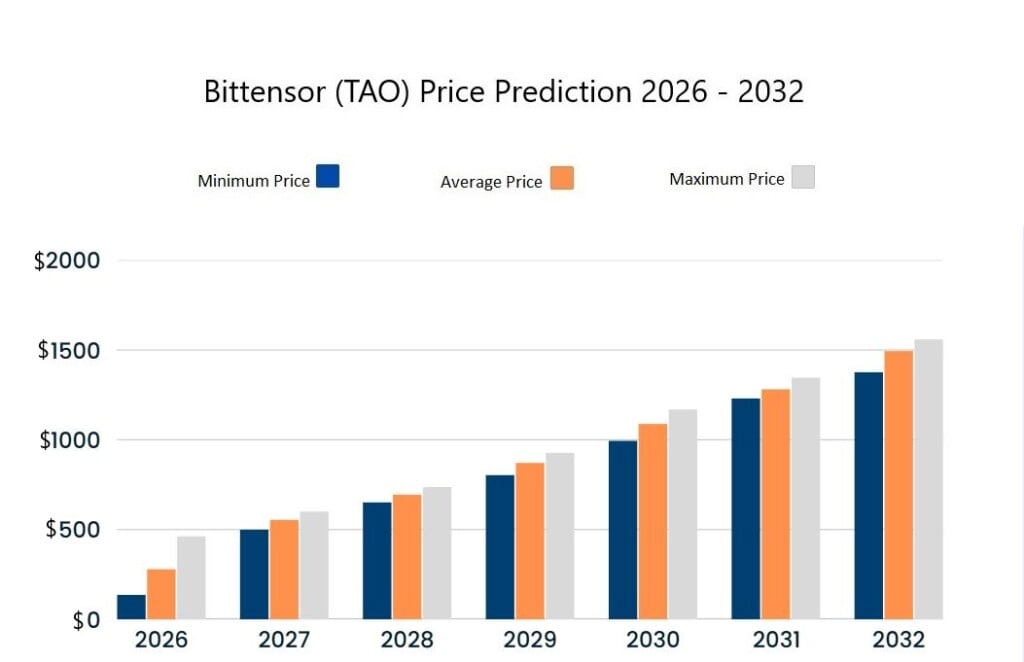
| Year | Projected low | Projected average | Projected high |
|---|---|---|---|
| 2026 | $136 | $279 | $465 |
| 2027 | $499 | $554 | $600 |
| 2028 | $651 | $694 | $737 |
| 2029 | $803 | $871 | $927 |
| 2030 | $994 | $1,088 | $1,169 |
| 2031 | $1,230 | $1,281 | $1,346 |
| 2032 | $1,376 | $1,494 | $1,559 |
The forecasts differ substantially across publishers. Cryptopolitan’s projected low for 2027, for example, was $499, above both the $253.30 forecast it attributed to DigitalCoinPrice and the $424.33 figure it attributed to CoinCodex. The report did not specify whether those two figures represented annual averages or year-end targets. Its separate November 2026 projection also contains an unresolved inconsistency: the stated average of $353 exceeds the stated high of $329.

What network activity tells us about valuation
Bittensor uses TAO to reward node operators and AI developers. The token has a maximum supply of 21 million. Cryptopolitan reported that more than 70% of circulating TAO was locked in staking and subnet validation, but did not identify an on-chain dataset or measurement date for that share. It also reported $43 million in AI usage revenue for the first quarter of 2026 without explaining how that revenue was measured or how much, if any, accrued to TAO holders.
One technical claim was narrower: IOTA, the training system developed by Macrocosmos that runs on Bittensor’s Subnet 9, reported a fivefold increase in model-merging speed. The team described merging as its training pipeline’s largest bottleneck. That claim concerns one step in training; it does not measure demand for TAO. Without a quantified link between network use and token demand, neither the reported speed improvement nor the revenue figure establishes the projected price range.