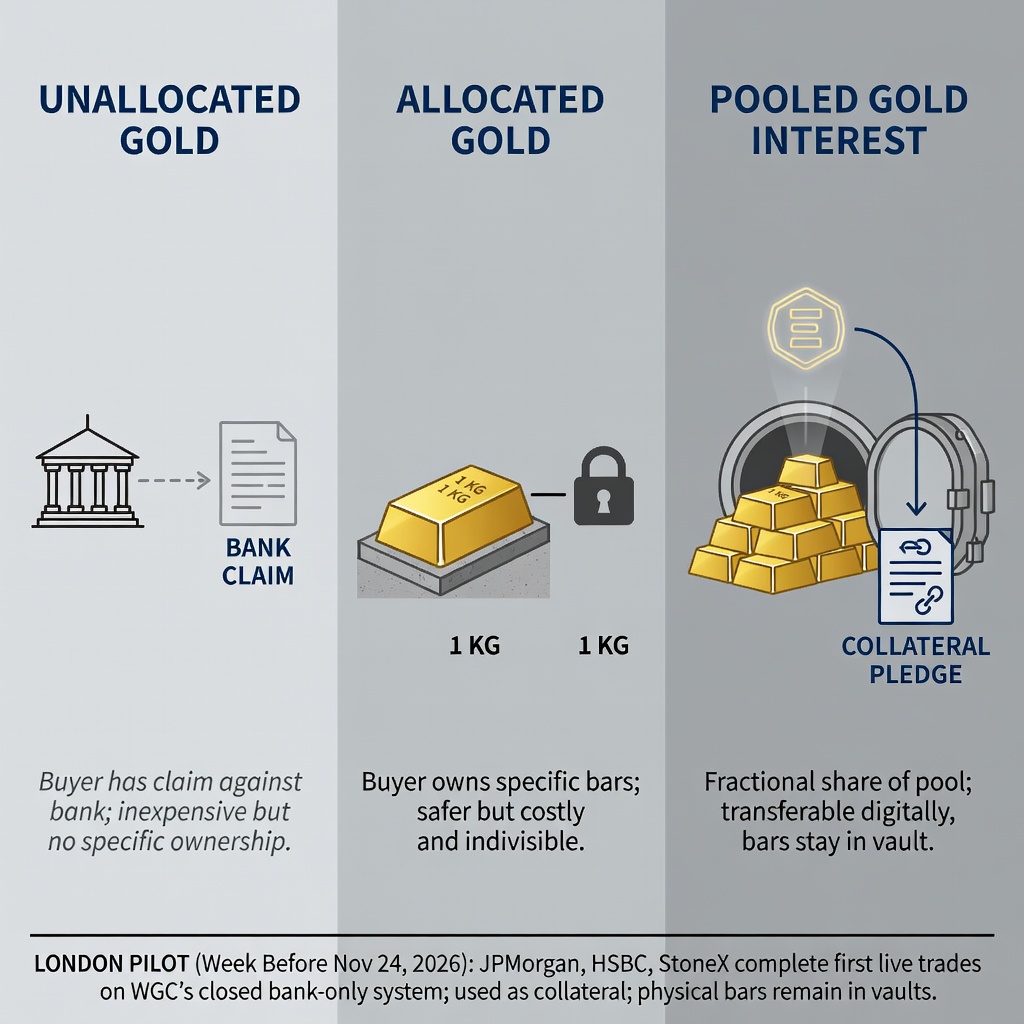
JPMorgan, HSBC and StoneX completed London’s first live wholesale trades in fractional tokenized gold in the week before November 24, 2026, Bloomberg reported that day. The three firms also used the gold interests as collateral. The physical bars stayed in their London vaults throughout the test.
The firms did not disclose how much gold changed hands. The World Gold Council (WGC), which built the closed, bank-only system, had yet to settle its governance rules or set a date for a wider launch. The trades demonstrated that the participants could transfer and pledge fractional interests, but not at what scale.
What changes hands in the London pilot?
The WGC calls the instrument a pooled gold interest: an electronically transferable fraction of a pool of physical bars held in approved London vaults. The WGC and law firm Linklaters proposed the model in September 2025 as an alternative to two existing ways of holding gold.
Most London trades use unallocated gold. It is inexpensive to hold, but the buyer has a claim against the bank rather than ownership of particular bars. If the bank fails, the buyer is a creditor. With allocated gold, the buyer owns specific bars, which are costlier to hold and difficult to divide. A pooled interest instead lets a holder transfer a share of the gold without splitting or delivering an individual bar. For banks, the intended use extends beyond trading: they could pledge those interests for loans or to meet margin requirements, much as they post bonds.
London’s over-the-counter gold market handled more than $180 billion in trades a day, and its vaults held $1.4 trillion in gold in August 2026. The pilot is part of an effort to maintain London’s position as the largest gold market as Asian rivals develop their own infrastructure. Hong Kong began testing a gold clearing system with the Shanghai Gold Exchange in July 2026.
What Ethereum token supplies measure
The London pilot disclosed no volume, but Ethereum contracts provide a supply measure for two existing gold tokens. Coinspeaker read the contracts for Tether Gold (XAUT) and PAX Gold (PAXG) for its November 24 report and compared the results with CoinGecko’s figures from a year earlier. Each token represents one troy ounce of gold.
| Token | Ounces represented, November 24, 2026 | Approximate ounces a year earlier | Reported growth |
|---|---|---|---|
| Tether Gold | 827,418 | 522,000 | 58% |
| PAX Gold | 442,957 | 334,000 | 33% |
Together, the tokens represented 1.27 million ounces, or 39.5 tonnes, up 48% in a year. The increase was in ounces, not in the price of gold. At about $3,626 an ounce, gold was 11% below its price a year earlier and 32% below its January record. The two token supplies were worth about $4.6 billion at the November price, roughly 0.33% of the value of London’s vault holdings reported in August.
Turnover is a separate measure. CoinGecko recorded about $329 million in trading across the entire tokenized-gold category in the 24 hours covered by the report. London’s daily figure of more than $180 billion covers its broader over-the-counter gold market, not trades on the WGC system.
PAXG on Binance
PAXG traded at $3,637 on Binance on November 24, below its 50-day and 200-day exponential moving averages of $3,945 and $4,195. It had touched $3,491 on November 21, its lowest price in 300 days. Over the seven days covered by the report, seller-initiated spot trades on Binance exceeded buyer-initiated trades by $13.4 million.
Coinspeaker’s price analysis used the November 21 low and the November 23 high of $3,681 to define a possible trading range. It identified $3,887, the November 15–17 ceiling, as a level to watch if PAXG closed above $3,681, and $3,400 as a round-number reference if it closed below $3,491. Those were conditional scenarios for PAXG, not outcomes of the London collateral test.