As reported on November 10, 2026, the Solana Foundation is narrowing its validator delegation program (SFDP). The central change is from broad support for newer validators toward a smaller, time-limited program that prioritizes network contributions. The trade-off is clear: fewer validators may receive foundation support, but validator count alone does not establish how resilient the network will be.
What changes for validators
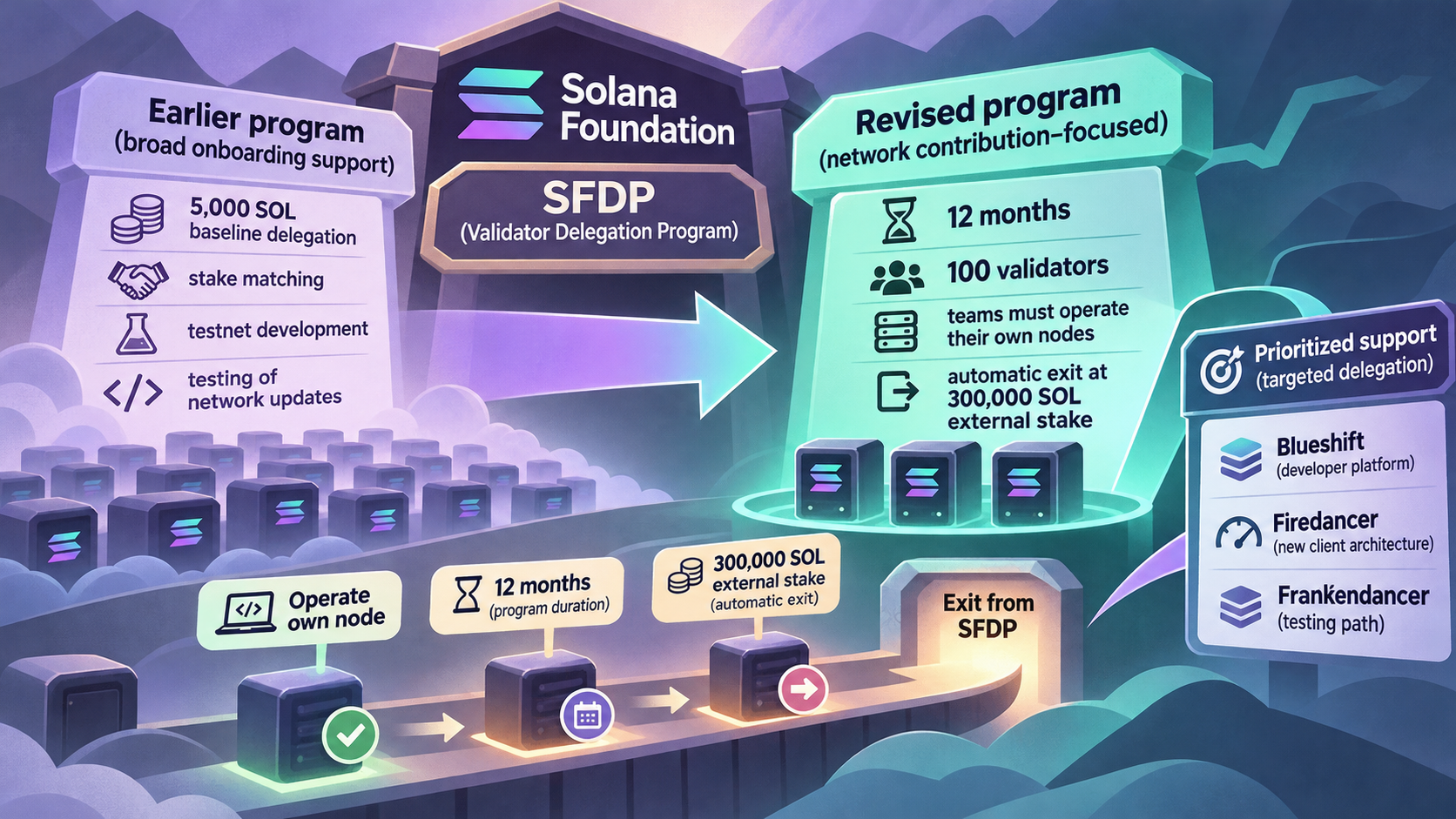
Solana Foundation technology vice president Jacob Creech responded on November 10 to community discussion of the changes. Under the revised terms described in the report, SFDP participation is limited to 12 months and 100 validators, and teams must operate their own nodes. A validator exits the program automatically when it reaches 300,000 SOL in external stake. Crypto Briefing reported that the previous exit threshold was 1 million SOL—a 70% reduction. The foundation’s voting-cost subsidy has also been phased out gradually, while delegation to validators outside the new limits is being reduced in weekly batches.
The earlier program offered a 5,000 SOL baseline delegation and stake matching to help validators get started. Creech said it had also supported testnet development and the testing of network updates. His stated rationale for changing it is that continued support for validators unable to operate independently diverts resources from stronger contributors. The report also alleges that some operators used rented cloud infrastructure to collect subsidies; it does not quantify that group.
Scale and the decentralization question
Solana Compass data cited for November 4, 2026 (Epoch 1077) put the network at 693 active validators, 434.3 million SOL staked and a Nakamoto coefficient of 18. Of those validators, 337—about 48.6%—were receiving program support, with 23.74 million SOL delegated to them through the program. Against a 100-validator cap, the report says 237 of the previously supported validators, or 70.3%, face losing their protected places. More than 100 validators had submitted materials seeking continued foundation delegation under the new assessment framework.
Creech acknowledged that a decline in validator numbers would be an acceptable consequence, though not the foundation’s objective, if there are too few sufficiently strong contributors. The November 4 figures provide a baseline, not a measurement of the policy’s effect. They cannot by themselves show whether the revised program will improve network resilience or how the validator set will ultimately change.
The foundation is not ending all targeted delegation. The report points to delegation to developer platform Blueshift and priority for early validator teams helping test newer client architecture, including work associated with Jump Crypto’s Firedancer and its Frankendancer testing path. Those examples indicate where support is being directed; the report does not provide a comparative measure of their contribution to network health.