In a report published on November 19, 2026, TechFlow described an attack on K3 Capital’s Ethereum sBOLD savings vault. It reported that roughly $3.4 million in liquidity was drained through 97 transactions over about eight minutes—an average of approximately $425,000 per minute. The reported sequence points to two distinct questions: how the vault valued its shares, and who captured the proceeds once the withdrawal transactions became visible.
The reported accounting failure
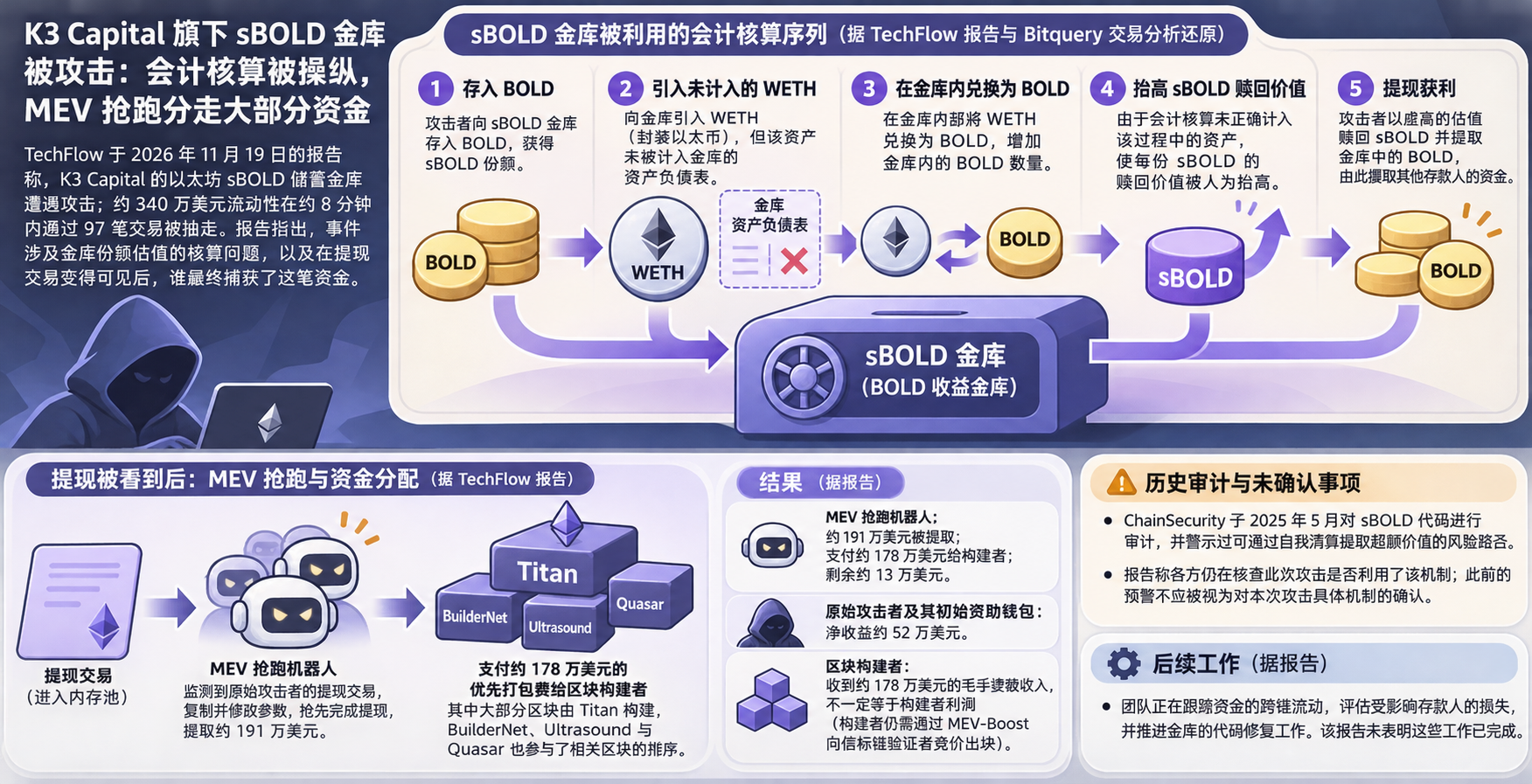
sBOLD is a yield-generating vault for BOLD, a stablecoin associated with Liquity. Citing Bitquery’s transaction analysis, TechFlow said the attacker repeatedly deposited BOLD, introduced wrapped ether (WETH) that was not accounted for on the vault’s balance sheet, and swapped it internally for BOLD. According to that reconstruction, the sequence inflated the redemption value of each sBOLD share, allowing withdrawals at an overstated value at other depositors’ expense.
Who captured the proceeds?
TechFlow reported that automated MEV bots observed the original attacker’s withdrawal transaction in the mempool, copied and changed its parameters, and withdrew about $1.91 million first—56.18% of the reported $3.4 million loss. The bots paid approximately $1.78 million to block builders for transaction priority, leaving about $130,000, or 6.81% of what they withdrew, before any other costs described in the report.
The report named Titan as the builder of most blocks containing the front-running transactions, with BuilderNet, Ultrasound and Quasar also involved in ordering relevant blocks. It cautioned that the $1.78 million was gross builder fee revenue, not necessarily builder profit: builders still had to bid for blocks through MEV-Boost. TechFlow put the original attacker’s and initial funding wallet’s combined net proceeds at approximately $520,000.
What remains unconfirmed
ChainSecurity audited sBOLD’s code in May 2025 and warned of a path to extract excess value through self-liquidation. The report said parties were still checking whether this attack used that mechanism; the earlier warning should not be treated as confirmation of an exact match. It also said the team was tracking cross-chain fund movements, assessing depositor losses and working on vault code fixes. The account does not establish that those efforts had concluded.