As reported on November 19, 2026, a federal judge had acquitted Anton and James Peraire-Bueno in a case arising from an April 2023 Ethereum block proposal. Prosecutors alleged that the brothers obtained roughly $25 million by turning the strategies of three professional “sandwich” traders against them. The ruling addressed whether prosecutors had proved fraud—not whether every form of maximal extractable value, or MEV, is lawful.
How the block proposal became the opening
A sandwich trader places a purchase before a target transaction and a sale after it, seeking to profit from the resulting price change. According to the court record, the three traders in this case operated bots looking for such opportunities. Their losses do not erase the costs that sandwich trading can impose on other users.
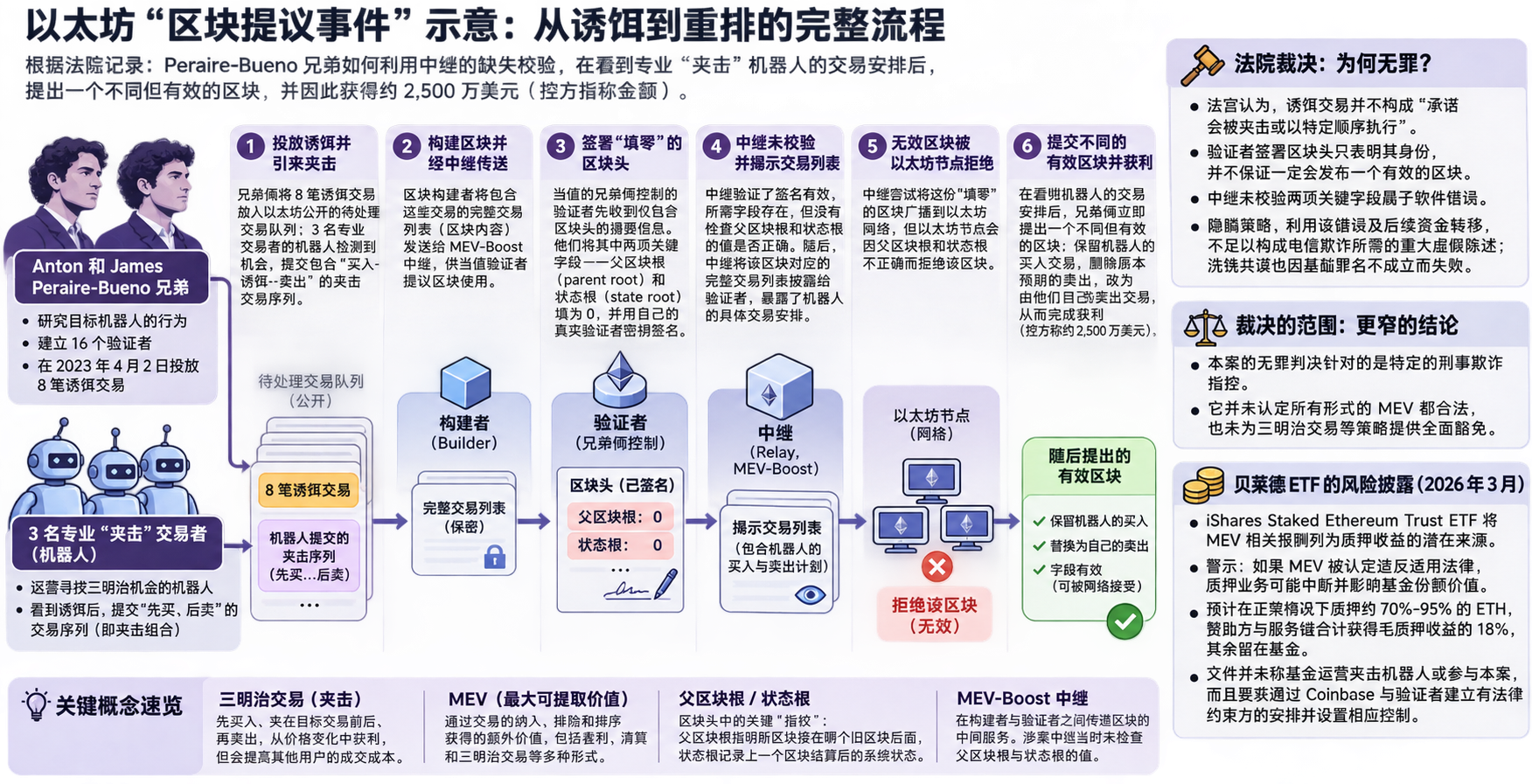
The court record says the brothers had studied the bots, established 16 validators and tested transactions that might attract them. On April 2, 2023, when a validator they controlled was due to propose a block, they placed eight bait transactions in Ethereum’s public pending-transaction queue. The bots submitted transaction sequences intended to buy before the bait trades and sell afterward.
The opening lay in a relay used to pass blocks from builders to validators. A validator initially received a block header rather than the full transaction list. The relay checked that the proposer’s signature was valid and that required fields were present, but did not check the values of two fields: the parent-block root and state root. The brothers signed a header with zeros in those fields using their real validator key. Ethereum nodes would reject that block, but the relay disclosed its transaction list. Having seen the bots’ planned trades, the brothers proposed a different, valid block that retained the bots’ purchases while replacing the expected follow-on trades with their own sales. The approximately $25 million figure comes from the prosecution’s account, not an independent civil accounting of each loss.
Why the fraud charges failed
Federal prosecutors charged the brothers in May 2024 with wire fraud, conspiracy to commit wire fraud and conspiracy to commit money laundering. A nearly four-week trial ended with a hung jury in 2025. Following a trial without a jury, the judge acquitted them on November 16, 2026.
The prosecution argued that the bait transactions implied a promise to execute the bots’ sequences and that signing the header promised publication of the original block. The judge rejected both proposed representations: a pending transaction did not promise to be sandwiched or included in a particular sequence, while the signature identified the validator but did not guarantee a valid block would be published. The relay operator acknowledged that its failure to validate the two fields was a software error. The judge found that concealment, exploitation of that error and subsequent fund transfers did not substitute for the material false representation required for wire fraud. The money-laundering conspiracy charge depended on the alleged fraud proceeds and failed with the underlying charge.
That is a narrower conclusion than approval of the brothers’ conduct or of MEV generally. It distinguishes a protocol’s intended behavior—and a relay’s missing check—from a legally provable promise made to another party.

Why a staking fund disclosed the risk
BlackRock’s March 2026 prospectus for the iShares Staked Ethereum Trust ETF identifies MEV-related compensation as a potential component of staking returns. It warns that a determination that MEV violates applicable law could disrupt staking and affect share value. The prospectus anticipates staking roughly 70%–95% of the fund’s ETH under normal circumstances and says the sponsor and service chain together receive 18% of gross staking rewards, with the remainder retained by the fund.
That disclosure does not say the fund operates sandwich bots or participated in this case. Nor does the acquittal establish the origin or legal status of every MEV payment a validator might receive. The prospectus also describes legally binding arrangements through Coinbase that require validators to maintain specified controls, while warning that failures and recovery costs may still fall on the fund and its holders.
The case leaves two separate questions for protocol and fund analysis: what revenue a particular ordering strategy generates, and which checks or enforceable obligations govern the parties handling it. This verdict answered a specific criminal-fraud allegation; it did not answer either question for the wider MEV market.