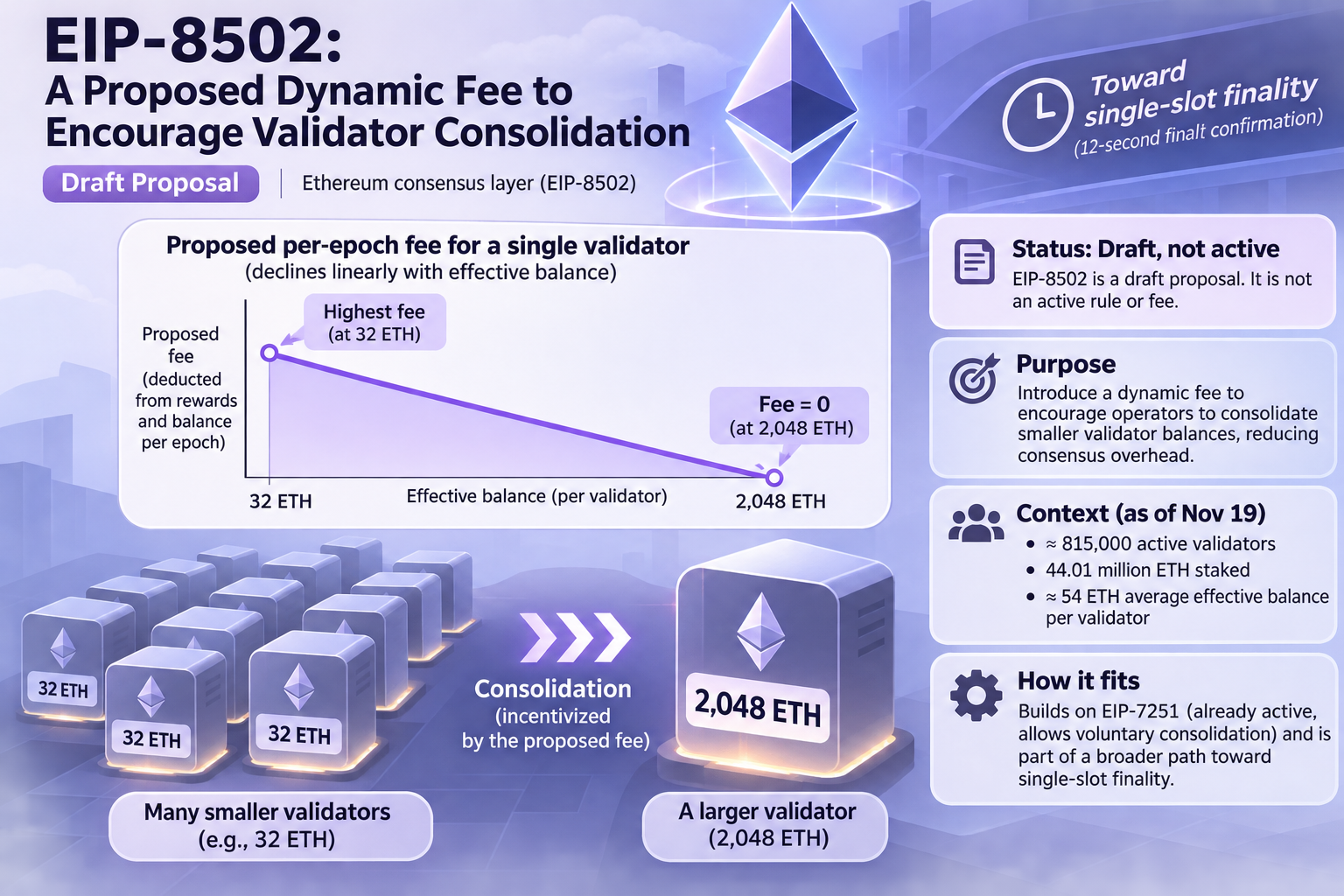
As reported on November 19, 2026, Anders Elowsson had submitted EIP-8502 as a draft proposal for Ethereum’s consensus layer. It would introduce a dynamic fee intended to encourage operators to consolidate smaller validator balances. The fee is a proposal, not an active rule.
Why validator count matters
The proposal’s premise is that finality-related signature and communication costs depend on the number of active validators, not simply the total ETH staked. TechFlow reported approximately 815,000 active validators and 44.01 million ETH staked as of November 19, with an average effective balance of about 54 ETH per validator. The report argues that EIP-7251, which already permits voluntary consolidation, has not provided enough incentive to reduce validator count.
How the proposed fee would work
Under EIP-8502, a validator’s balance would be debited each epoch according to its effective balance and how far the network’s active-validator count exceeded a changing target. The proposed fee would be highest for a validator at 32 ETH—potentially consuming its entire attestation reward in an extreme case—and decline linearly to zero at the 2,048 ETH maximum effective balance. That is a proposed deduction from rewards and balance, not a claim that smaller validators are already being charged.
The draft describes an illustrative target that falls from roughly 524,000 active validators to 131,000 over about 1.5 years, then stays constant. Those example targets should not be confused with the reported count of 815,000 validators. If the network stayed on the proposed consolidation schedule, the fee would remain zero. Above target, it would rise gradually; below target, it would fall at roughly ten times the rate. The report estimates an eventual 83.9% reduction in active validator count relative to its reported November 19 level.
What remains unresolved
The stated motivation is to reduce consensus overhead on a path toward single-slot finality—final confirmation within Ethereum’s 12-second slot. EIP-8502 does not itself deliver that outcome. It remains a draft dependent on the already activated EIP-7251 mechanism. TechFlow identified review of activation parameters by all-core-developer consensus meetings, client-specification benchmarking and consolidation exercises by large liquid-staking protocols as subsequent work, rather than completed steps.