In a market report published on November 17, 2026, Wintermute OTC trader Jjay_dm argued that rising interest-rate expectations and weakening capital flows had left Bitcoin vulnerable after it closed below its 200-week moving average. The report presents a bearish interpretation of those signals—not proof that further losses will follow.
The macro case
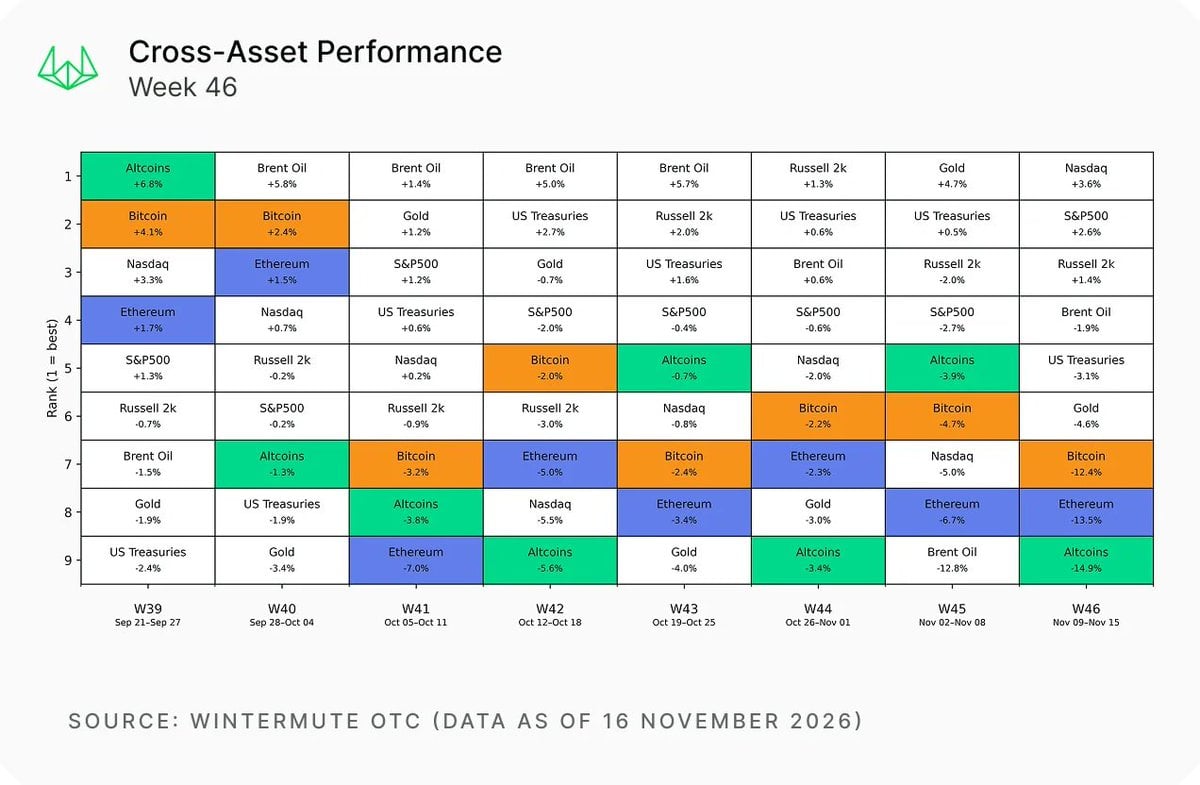
Wintermute reported that Bitcoin fell 12.7% over the week to $65,400, while the S&P 500 rose 2.5%. It said the US 10-year Treasury yield climbed about 30 basis points to 5.15%, following a third consecutive monthly 0.3% increase in core CPI. According to the report, markets assigned roughly 92% probability to a Federal Reserve rate increase in December.
Wintermute’s explanation is that higher yields put pressure on assets that do not generate cash flow, including Bitcoin. That is its assessment of the sell-off, rather than a measured breakdown of every cause. The report also placed Ether near $1,800, gold at $3,900 after a roughly 5% decline, and Brent crude at $96.
What the flow and positioning figures show
Wintermute said US spot Bitcoin ETFs had recorded approximately $1.9 billion in net outflows in 2026 through the report date, versus net inflows of $21 billion in 2025 and $35 billion in 2024. It also estimated that stablecoin supply had contracted by $14 billion–$16 billion over the preceding 30 days. Those figures support its concern about weaker funding channels, but the report does not provide a separate measurement establishing that no new dollars entered the market.
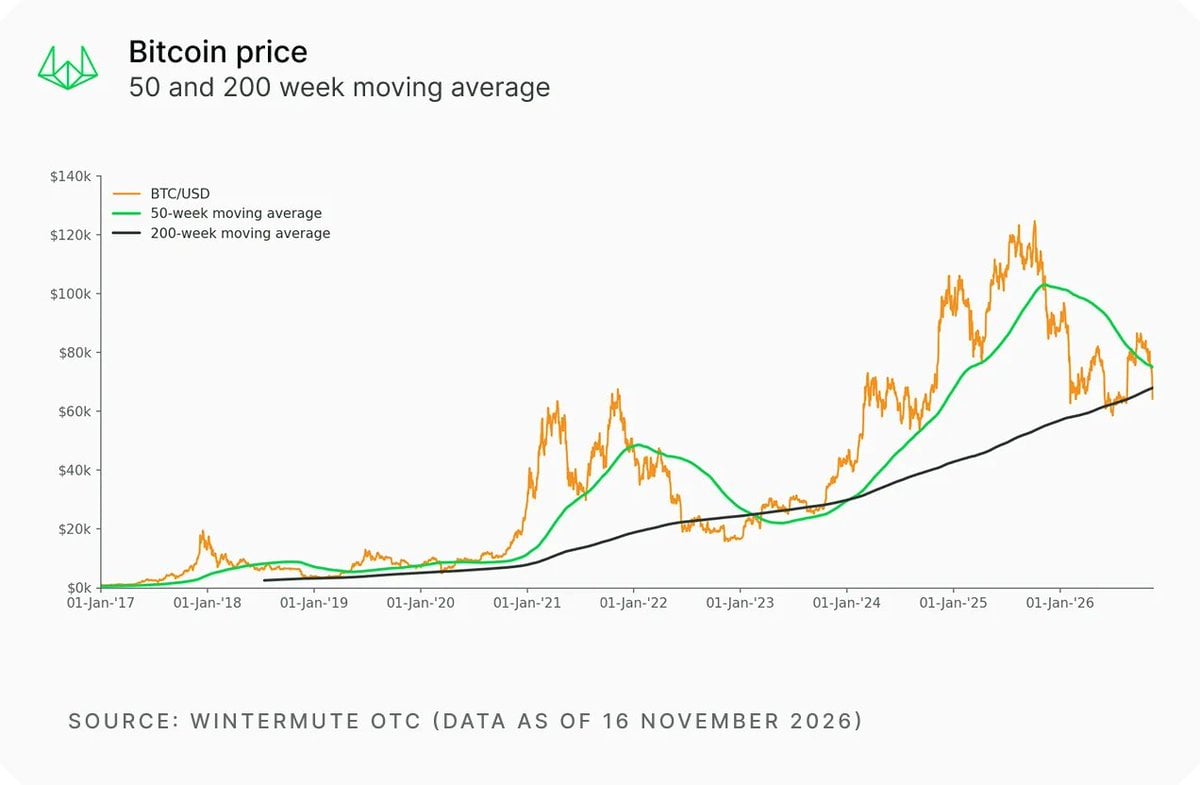
On price, Wintermute placed the 200-week moving average near $68,000 and said Bitcoin had closed below it on a weekly basis. It reported a Saturday low of $62,000, the lowest since July. For the 24 hours ending Sunday, it put crypto liquidations near $170 million, approximately 80% of them long positions, and said funding rates across major venues had turned negative. It interpreted the subsequent bounce as short covering rather than evidence of fresh buying.
The report also said altcoin open interest remained nearly twice Bitcoin’s. That comparison is part of Wintermute’s case that leverage may not yet have been fully cleared; it does not, by itself, establish when altcoins or Bitcoin will bottom.
What would change the assessment?
Wintermute expected Bitcoin could fall into the $50,000s, identifying $62,000 as an initial test and concentrated $60,000 put positions on Deribit as another level to watch. These are forecasts and positioning observations, not price targets established by a valuation model.
The desk said it would reconsider its short-term defensive stance if Bitcoin reclaimed the roughly $68,000 200-week average on a daily close and spot ETFs showed clear net inflows that day. Alternatively, it pointed to Federal Reserve minutes or October PCE data dispelling expectations of another rate increase in January. Until then, its central claim rests on the combined reading of rates, flows and leverage—not on any one indicator alone.