In a community proposal reported on November 12, 2026, nonprofit Ethereum research lab Ethlabs proposed 2027 as a target, not an agreed deadline, for making Ethereum resistant to quantum and AI-related threats. The proposal, called pqai27, remains subject to discussion among Ethereum’s core developers.
The proposal sets out two stages. Its baseline, “pqai-ready,” calls for a quantum-resistant consensus layer and a way for users to move to quantum-resistant accounts through the proposed Frames account-abstraction mechanism, EIP-8141. Ethlabs also proposes a calldata-based fallback to keep the network operating if existing cryptography fails sooner than expected. Its more ambitious “pqai-scaled” stage aims to maintain normal throughput under full load, using proposed quantum-resistant signature aggregation under EIP-8288 and quantum-resistant data availability under EIP-8479 for transactions and blobs.
Meeting the target would require choices that have not been settled. Ethlabs recommends revisiting the scope of the Hegotá fork, including the scheduling and compatibility implications of the FOCIL censorship-resistance proposal, EIP-7805. It says Frames could ship separately if execution-layer work is decoupled from consensus-layer changes. Developers would also need to choose between adapting the existing Gasper consensus design and moving to a decoupled approach. Ethlabs said it was withdrawing its Quick Slots proposal, EIP-8198, from Hegotá and would pursue it in 2028 instead; the report said Glamsterdam and its scaling plans would continue.
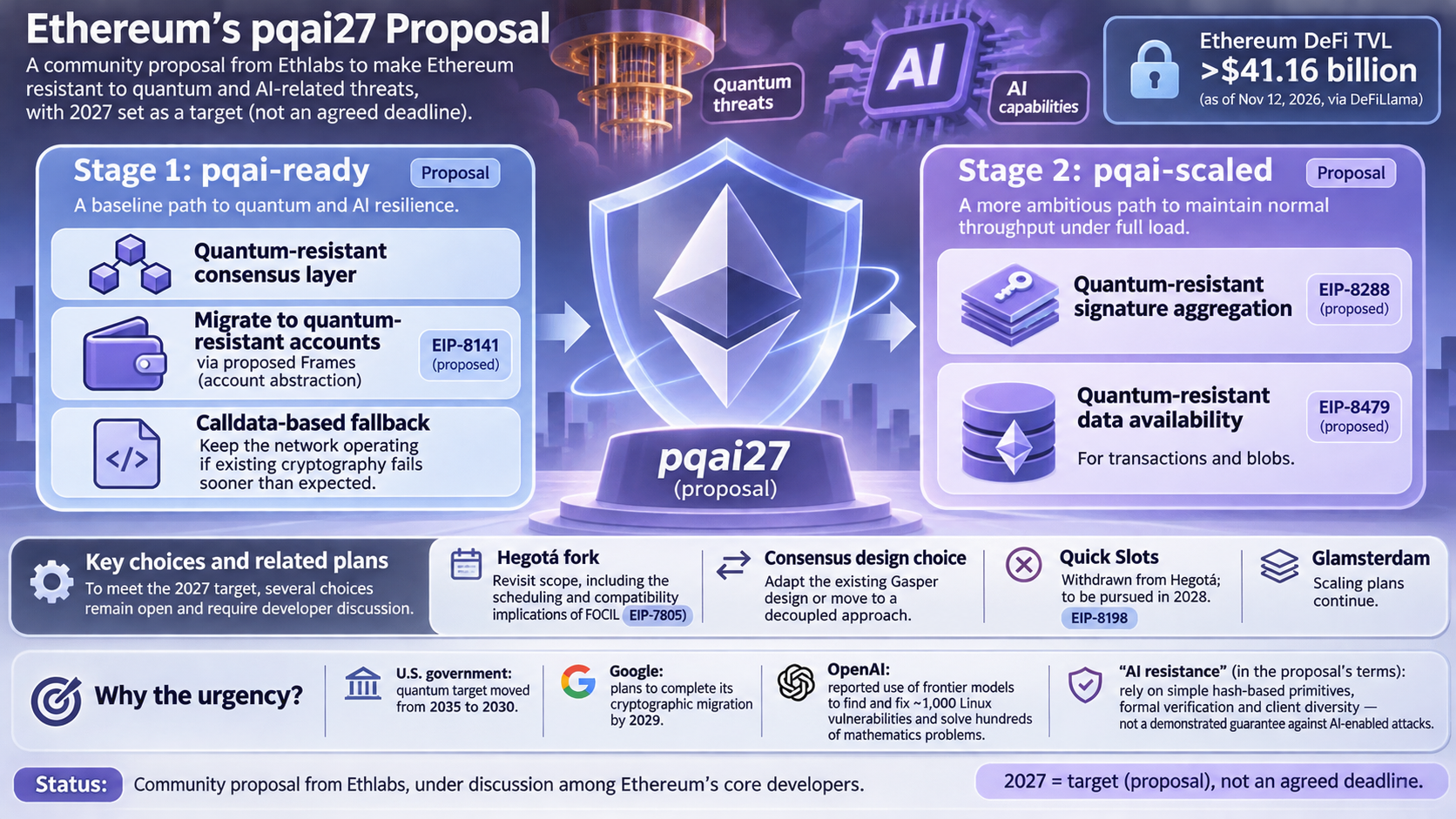
Ethlabs frames the urgency around shorter quantum-migration timelines and growing AI capabilities. The November 12 report cited a US government target moved from 2035 to 2030 and Google’s plan to complete its cryptographic migration by 2029. It also cited OpenAI’s reported use of frontier models to find and fix roughly 1,000 Linux vulnerabilities and solve hundreds of mathematics problems. In the proposal’s terms, “AI resistance” means relying on simple hash-based primitives, formal verification and client diversity—not a demonstrated guarantee against AI-enabled attacks.
For scale, the report cited DeFiLlama data showing more than $41.16 billion in Ethereum total value locked as of November 12, 2026. That figure provides context for the value the proposal seeks to protect; it does not establish that the proposed mechanisms are ready or that developers will adopt the roadmap.