Compound is committing a reported $52 million over two years to pursue institutional lending. In reporting published on August 18, 2026, PANews described the move as a shift away from competing primarily for retail deposits. Its account dates the DAO’s approval of the budget proposal to May 2026, with 1.88 million votes in favor and none against. Although the report also refers to an August 17 approval announcement, it does not reconcile that reference with the May vote.
The scale of the challenge is clear in the figures the report cites: Compound held about $1.2 billion in deposits, down nearly 90% from a historical peak it places at $12 billion. It puts Aave’s deposits near $15 billion and Morpho’s above $8 billion. The report does not identify a dataset or measurement date for those comparisons, so they should be read as its reported figures rather than a current market snapshot. It also says COMP briefly rose more than 10% after news of the shift.
How the budget is meant to work
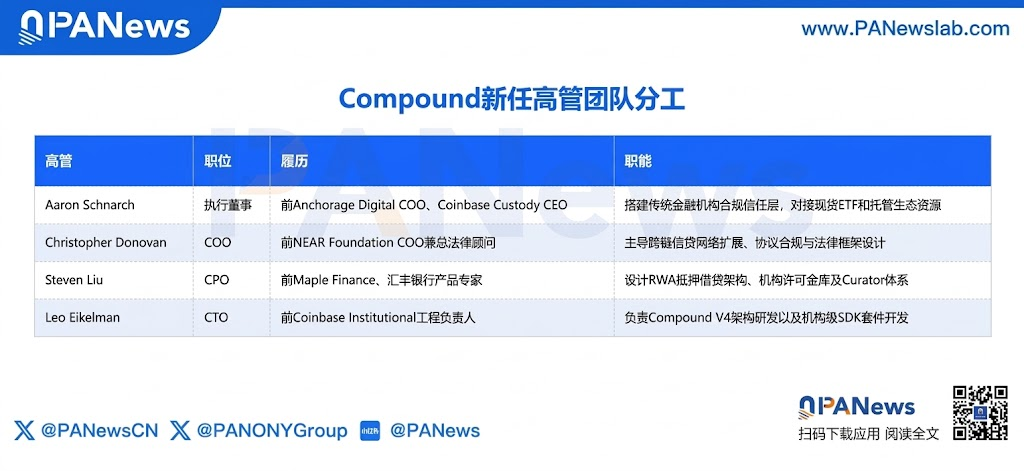
According to the report, $14 million of the approved budget is initially allocated to a Foundation multisignature wallet. The remaining $38 million is to stay in a project reserve overseen by a seven-member treasury committee requiring five approvals. Further releases are tied to specified deliverables: a production-grade V3 integration kit for a subsequent operating allocation, and both Tier-1 institutional curators and a Compound V4 public testnet for a growth allocation. The report also says the DAO consolidated more than $57 million in previously dispersed assets into a custody pool.
Those conditions make delivery a prerequisite for later funding, but they do not establish that institutional demand will follow. The report identifies a long sales cycle and the potential strain of a $52 million, two-year budget if inflows fall short as central risks.
V4 is a plan, not an operating result
The proposed V4 architecture addresses four barriers the report identifies for institutional borrowers and intermediaries:
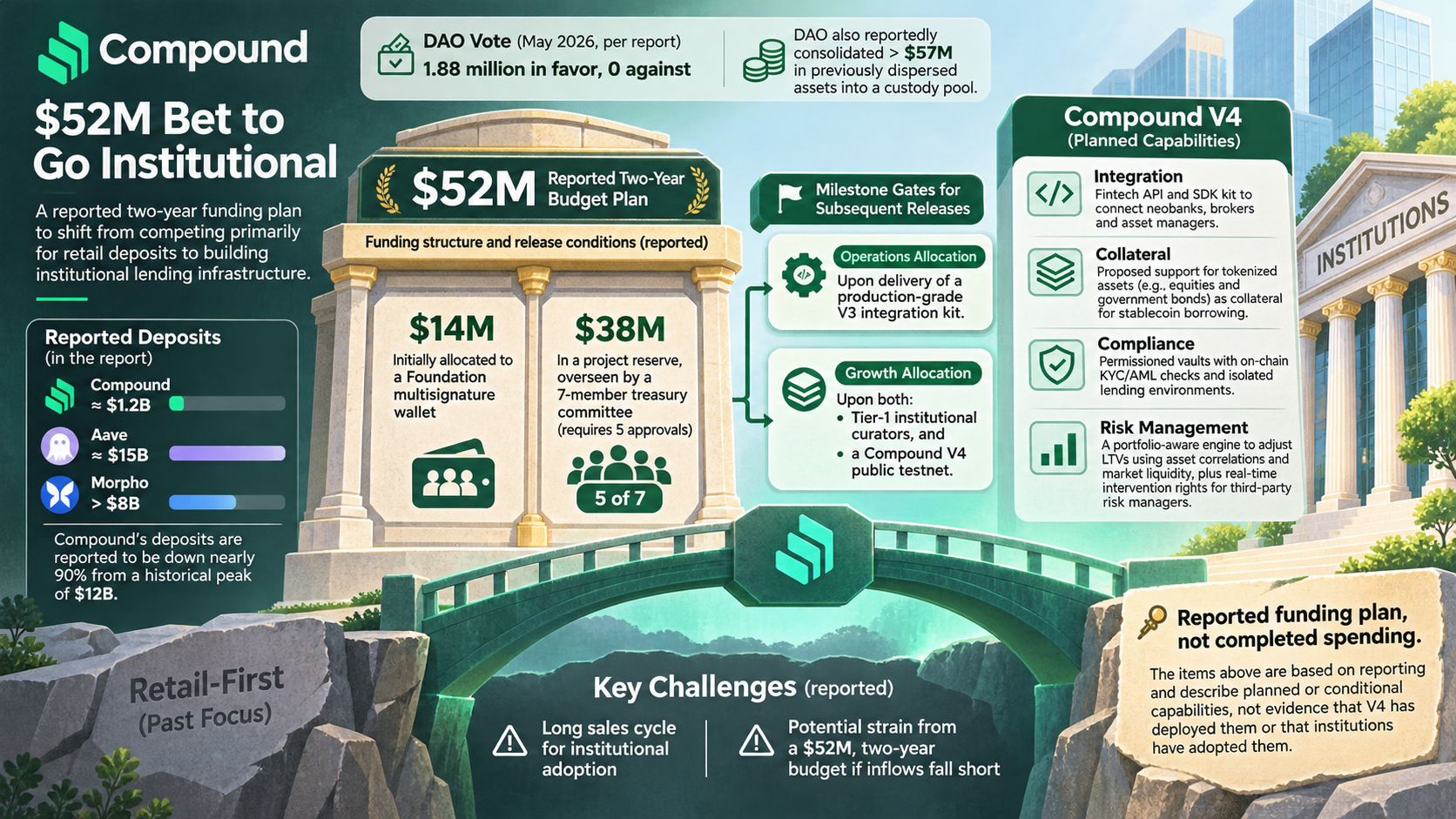
- Integration: a fintech API and SDK kit intended to connect neobanks, brokers and asset managers to Compound lending pools.
- Collateral: proposed support for tokenized assets, including equities and government bonds, as collateral for stablecoin borrowing.
- Compliance: permissioned vaults with on-chain KYC/AML checks and isolated lending environments.
- Risk management: a portfolio-aware engine intended to adjust loan-to-value limits using asset correlations and market liquidity, alongside real-time intervention rights for third-party risk managers.
These are described as planned capabilities, not evidence that V4 has deployed them or that institutions have adopted them. Permissioned access and third-party intervention could also change the trade-off for users who value unrestricted participation.
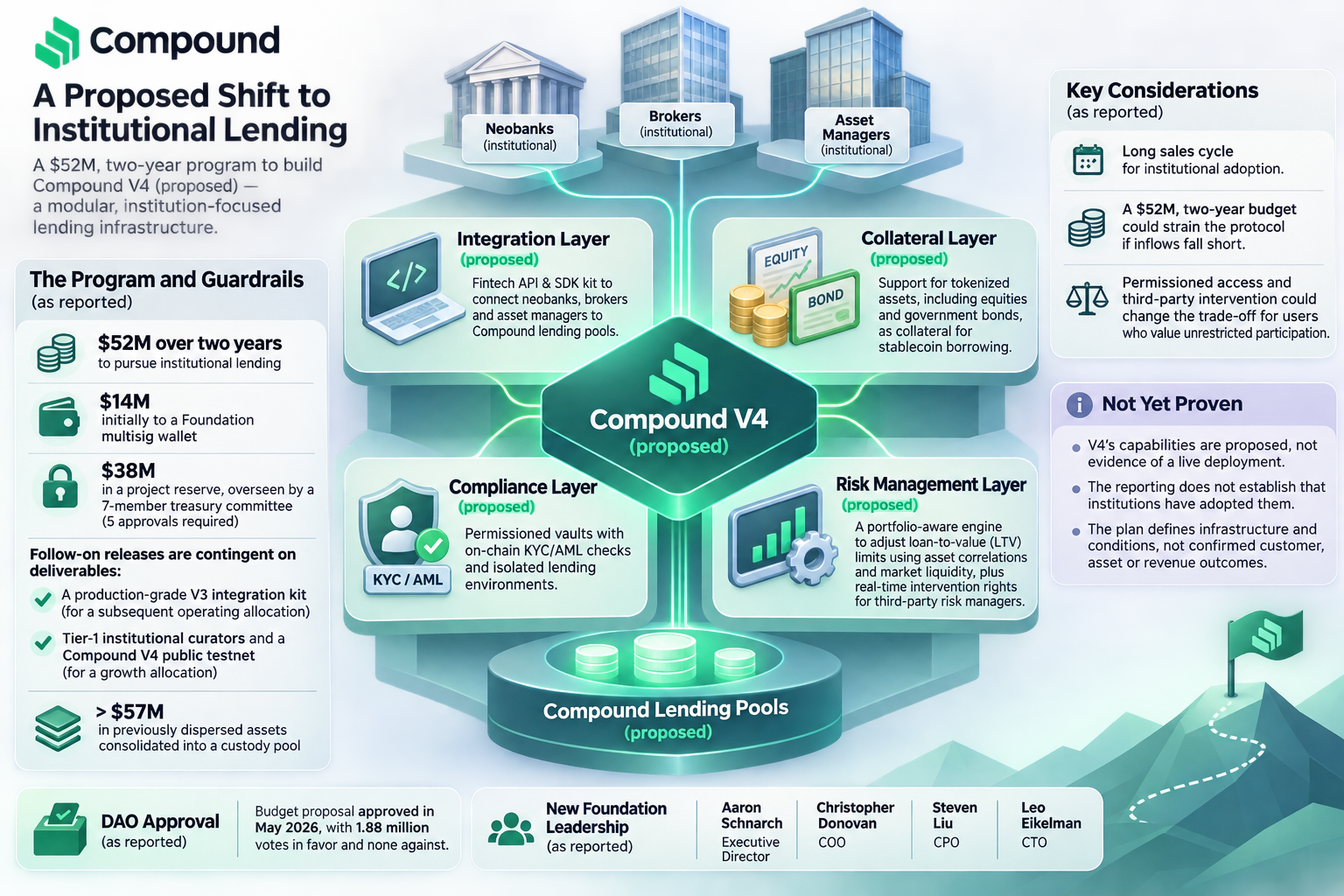
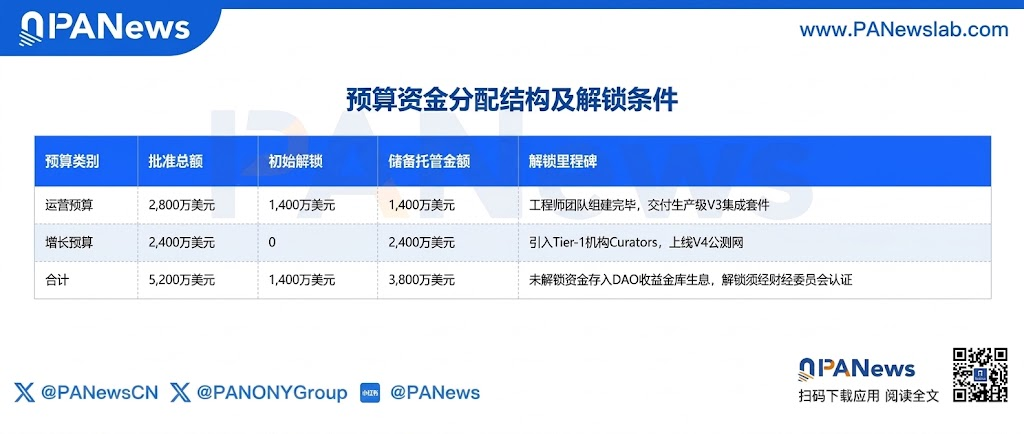
The Compound Foundation’s new leadership reflects the intended market: the report names Aaron Schnarch as executive director, Christopher Donovan as COO, Steven Liu as CPO and Leo Eikelman as CTO, citing their prior work across custody, legal and protocol operations, institutional lending products, and engineering. Their backgrounds may help explain the strategy, but do not validate its projected outcomes.
The test is whether Compound can deliver the specified infrastructure and turn it into customers, assets and revenue. The approved budget defines the size and conditions of the effort; the reporting does not yet establish that the proposed institutional credit system works at scale.