A Curve proposal to grant 17 million CRV to development team Swiss Stake AG was rejected in the days before the original report of December 25, 2025. According to the report, Convex and Yearn voted against it, with enough voting power to affect the outcome. The report does not provide vote totals or a valuation of the proposed CRV grant; its token amount should not be read as a dollar figure.
Curve founder Mich proposed the grant. Swiss Stake AG, described in the report as one of the teams maintaining Curve’s core codebase since 2020, outlined work on LlamaLend—including support for PTs and LPs—an on-chain foreign-exchange market, and crvUSD expansion. Those plans describe proposed work, not a demonstrated return on the grant.
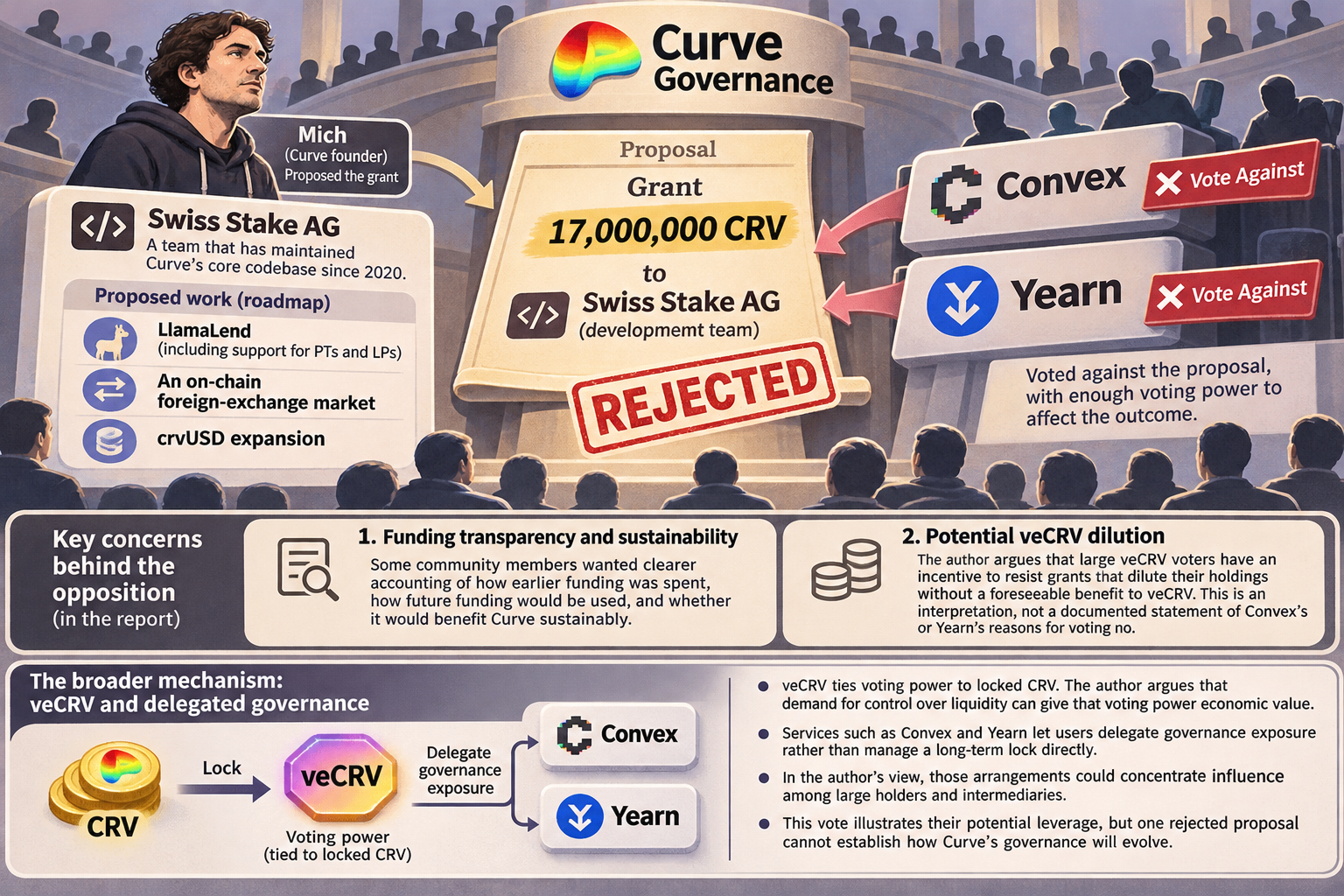
The report identifies two concerns behind the opposition. Some community members wanted clearer accounting of how earlier funding was spent, how future funding would be used, and whether it would benefit Curve sustainably. The author also argues that large veCRV voters have an incentive to resist grants that dilute their holdings without a foreseeable benefit to veCRV. That incentive is an interpretation, not a documented statement of Convex’s or Yearn’s reasons for voting no.
The broader mechanism matters: veCRV ties voting power to locked CRV. The author argues that demand for control over liquidity can give that voting power economic value, while services such as Convex and Yearn let users delegate governance exposure rather than manage a long-term lock directly. In the author’s view, those arrangements could concentrate influence among large holders and intermediaries. This vote illustrates their potential leverage, but one rejected proposal cannot establish how Curve’s governance will evolve.