As of February 26, 2026, Aave’s governance debate centered on two linked questions: how much funding Aave Labs should receive, and who should control the protocol’s transition from V3 to V4. The dispute matters because Aave relies on independent service providers as well as its founding company to develop and maintain the protocol.
What the proposal would change
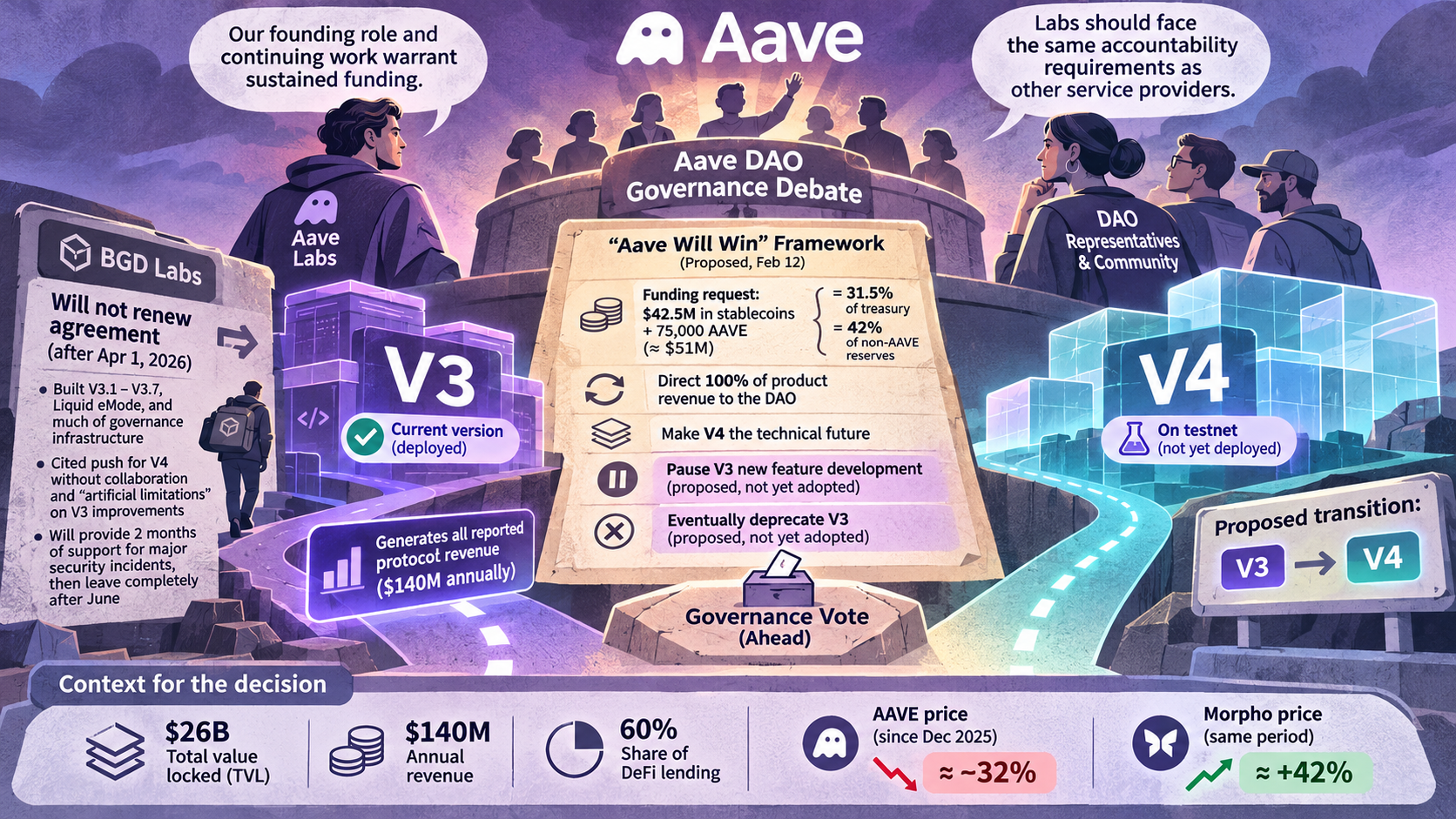
On February 12, Aave Labs published its “Aave Will Win” framework. It proposed directing 100% of product revenue to the DAO while requesting $42.5 million in stablecoins and 75,000 AAVE for its first year—approximately $51 million in total. The reported amount equaled 31.5% of the treasury and 42% of its non-AAVE reserves.
The framework also proposed making V4 Aave’s technical future, stopping new V3 feature development and eventually deprecating V3. At the time of the February 26 report, V4 remained on testnet, while all reported protocol revenue came from V3. Before a Snapshot vote, community members sought wallet disclosures, a foundation structure before funds were distributed, and V3 deprecation tied to V4 adoption milestones. The proposal did not make those requests enforceable commitments.
Competing accounts of contribution and cost
In separate governance-forum posts on February 25, Aave Labs and ACI founder Marc Zeller presented conflicting accounts. Labs’ contribution report covered V1 through V4, flash loans, eMode, the Safety Module, GHO, the front end and branding. Labs said it had written more than 570,000 lines of code since 2017 and argued that attributing revenue to any one contributor misrepresents how the protocol’s layers were built.
Zeller’s financial analysis claimed Labs had received a cumulative $86 million from sources including the 2017 ICO, venture funding and DAO payments. That total also included fee-sharing payments he alleged were taken from the DAO without a governance vote. He traced 23% of the token supply to 52 wallets he linked to founding infrastructure; the supplied account does not establish what those wallet links imply about current ownership or control.
Zeller further calculated that the DAO spent roughly $24 for every $1 of revenue generated by Labs’ institutional real-world-asset product, Horizon. His figures included $4.2 million in Merkl incentives against $216,000 in revenue. He identified six other products he considered unsuccessful or still loss-making, and claimed that 98% of V3 revenue came from code supplied directly by BGD Labs and other DAO service providers rather than Labs. These are Zeller’s assessments, not independently established findings in the supplied account. Both Labs and Zeller have stakes in the governance outcome.
The immediate contributor risk
Eight days after the framework appeared, BGD Labs announced that it would not renew its agreement when it expired on April 1, 2026. BGD had built V3.1 through V3.7, Liquid eMode and much of Aave’s governance infrastructure. It said Labs was pressing for V4 without collaborating with BGD on its development and had placed what BGD called “artificial limitations” on V3 improvements. BGD offered two months of support for major security incidents and said it would leave completely after June. Those reasons are BGD’s account of its decision.
The governance question is therefore not simply which team deserves credit for Aave’s revenue. Labs argues that its founding role and continuing work warrant sustained funding; opposing DAO representatives argue that it should face the same accountability requirements as other service providers. BGD’s planned departure gives that disagreement an operational consequence: a V4 transition must be assessed alongside the loss of a major V3 and governance-infrastructure contributor.
The February 26 account described Aave as having $26 billion in total value locked, $140 million in annual revenue and a 60% share of DeFi lending. It also reported an approximately 32% decline in AAVE’s price since a December 2025 brand-ownership dispute, versus an approximately 42% rise in Morpho’s price over the same period. Those price moves do not establish that governance uncertainty caused the divergence; the account explicitly left that question unresolved.