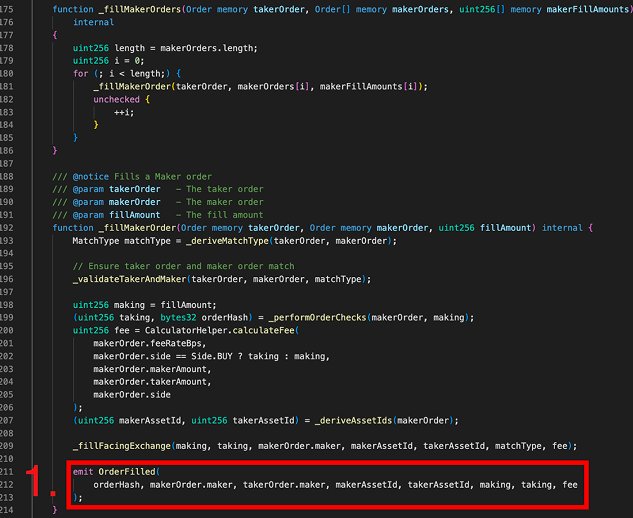
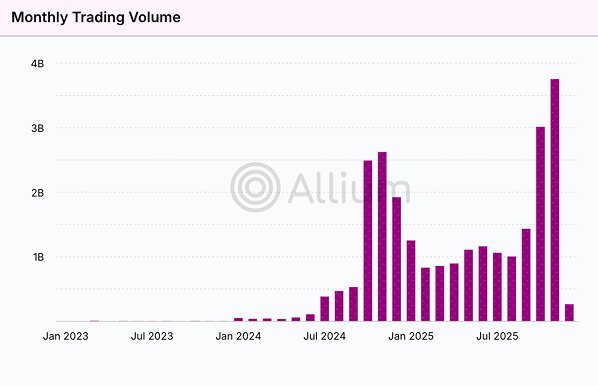
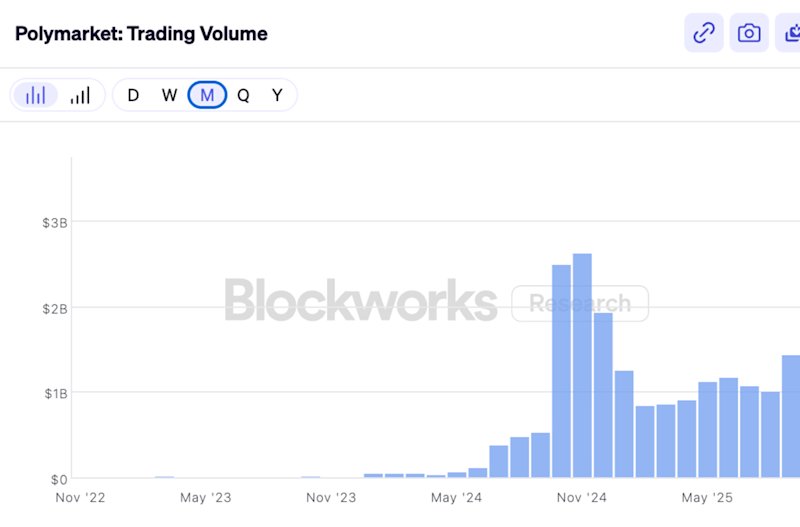
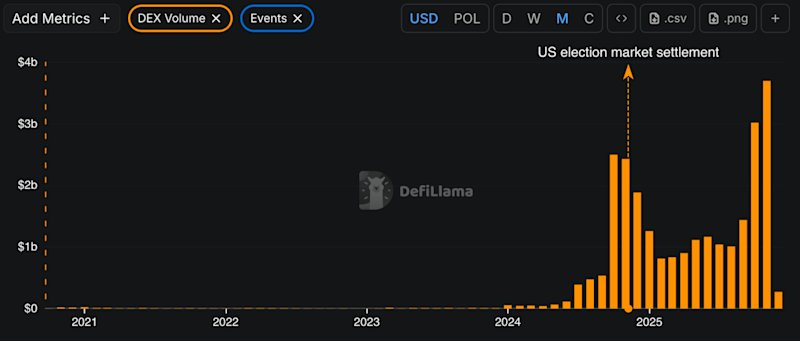
In an analysis published on December 9, 2025, Paradigm argued that a common method for calculating Polymarket volume counts each trade twice. The issue is not an erroneous onchain event: Polymarket’s exchange contracts emit separate OrderFilled records for the maker and taker sides of the same matched trade. Adding every record together treats those two views as separate economic activity.
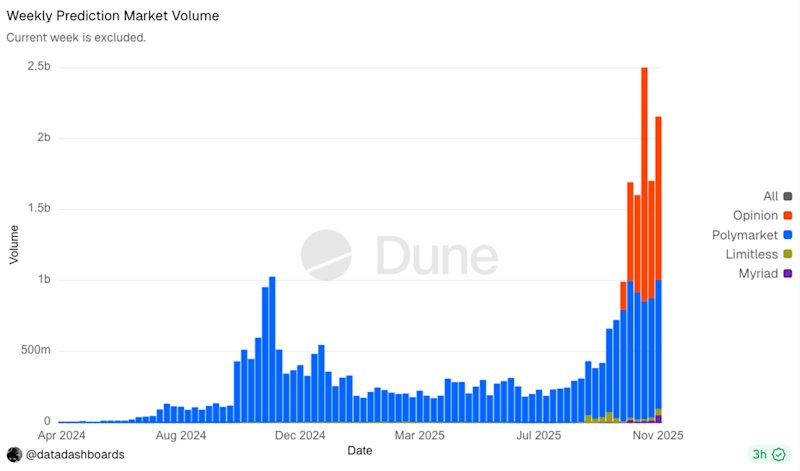
Paradigm’s finding concerns raw volume measurement, not whether trades constitute wash trading. It also matters when comparing Polymarket with other prediction markets: a metric built from both sides of each match is not comparable to a one-sided volume metric.
Where the duplicate count enters
According to Paradigm’s examination of Polymarket’s CTF and NegRisk CTF exchange contracts, a trade transaction contains one OrderFilled event for each maker, followed by an OrderFilled event covering the taker’s fills and an OrdersMatched event. The exchange contract routes the token transfers, but Paradigm says it does not take a position or become an additional trading counterparty. The taker-focused OrderFilled event therefore describes the same underlying matches already represented by the maker-focused events.
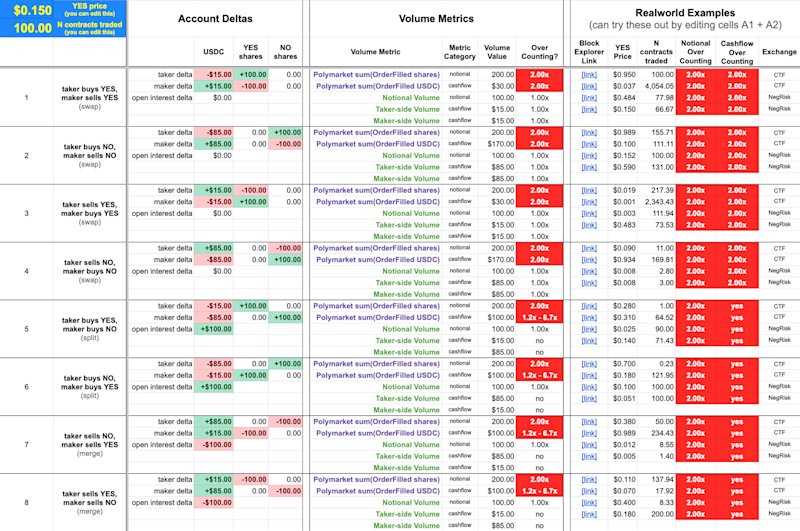
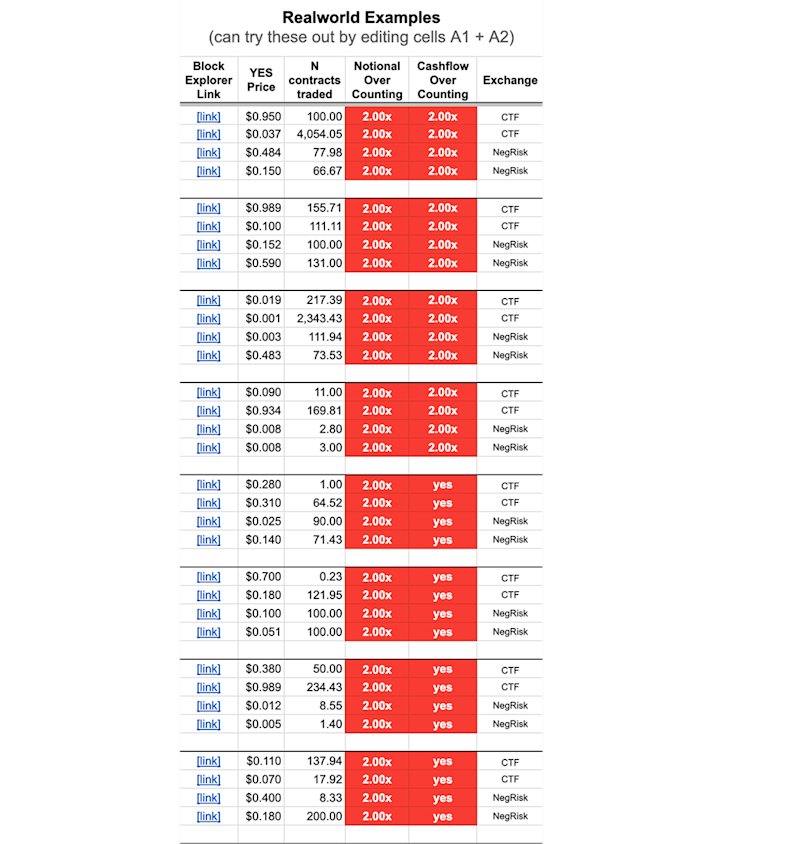
For a straightforward sale of YES tokens for $4.13, summing both sides reports $8.26. Paradigm says this method doubles both contract counts and cash-flow volume for conventional swap matches.
Why split and merge trades complicate the calculation
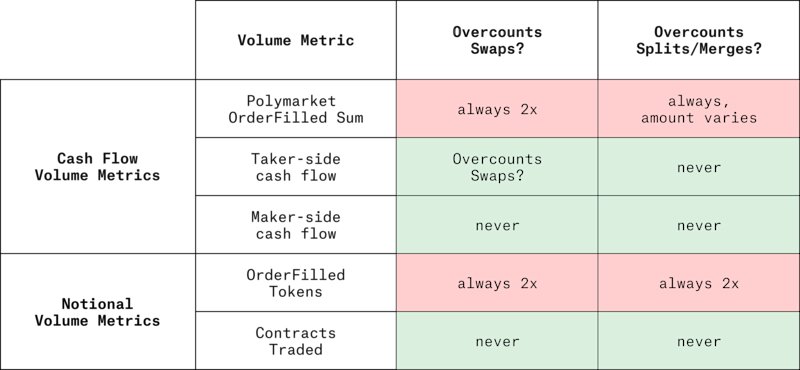
Polymarket can also match orders across YES and NO order books. A split exchanges $1 for one YES and one NO token; a merge exchanges that pair of tokens for $1. Unlike a conventional swap, a split or merge can leave the maker and taker with different USDC cash flows even though the number of contracts on each side is the same. Splits increase open interest, merges decrease it, and swaps leave it unchanged.
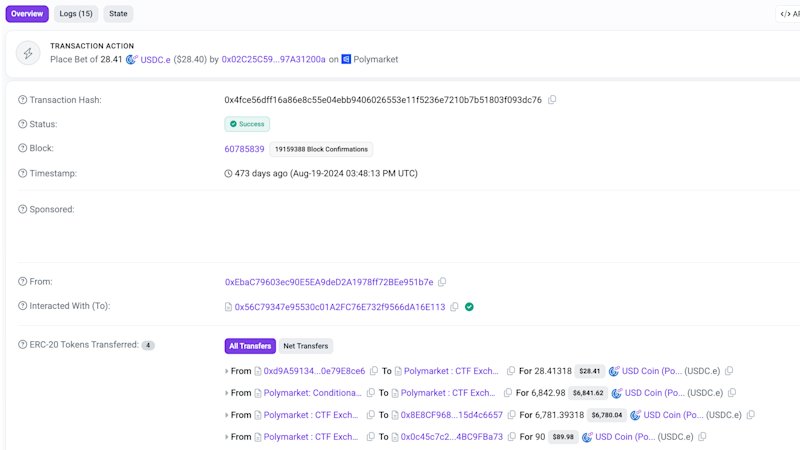
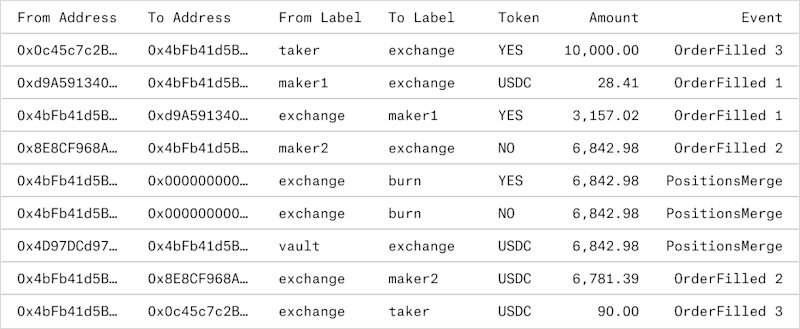
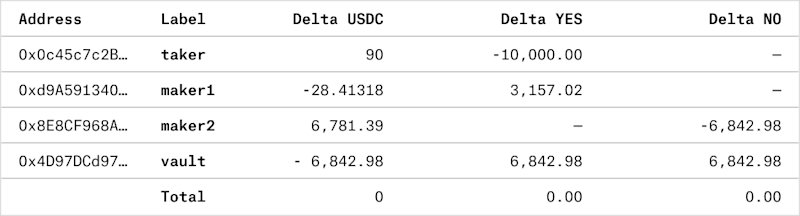
Paradigm illustrates the distinction with a two-leg transaction. Its first leg swapped 3,157.02 YES tokens for $28.41. In the second, a merge matched the taker’s 6,842.98 YES tokens, for which the taker received $61.59, against a maker’s 6,842.98 NO tokens, for which the maker received $6,781.39. Summing the maker- and taker-side OrderFilled records yields 20,000 contracts and $6,899.80 in USDC volume. Paradigm’s point is not that the two sides must have identical cash flow; it is that adding them is not a one-sided measure of the match.
What a comparable metric requires
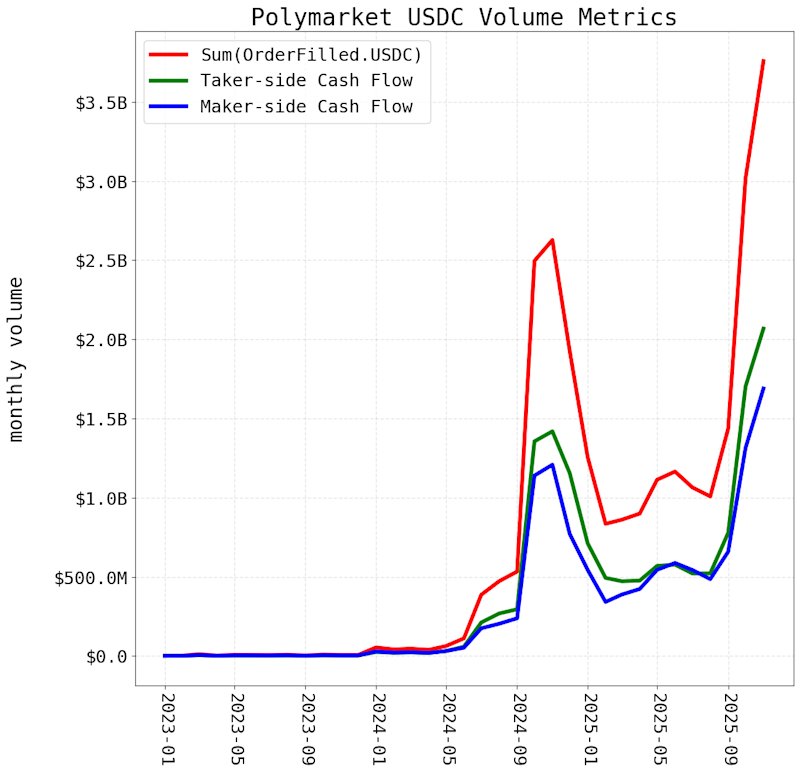
For notional volume, Paradigm recommends counting the contracts traded once. For cash-flow volume, it says analysts can use the maker side, the taker side, an average, or another clearly defined measure. Those choices can differ for an individual split or merge. In Paradigm’s monthly comparison, however, maker-side, taker-side and share-priced volume were each around half the sum of all OrderFilled events.
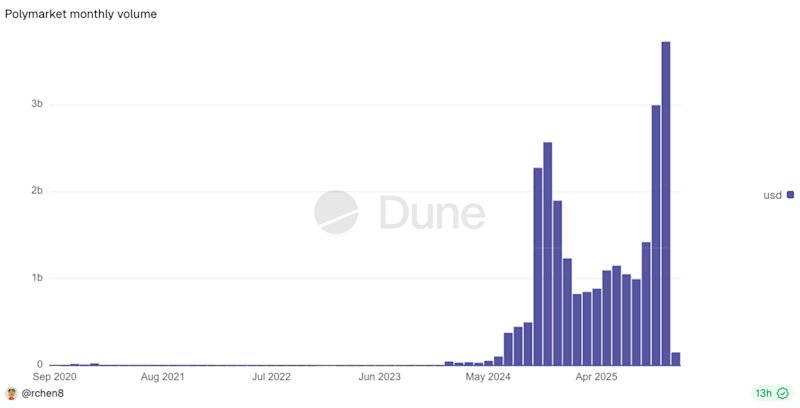
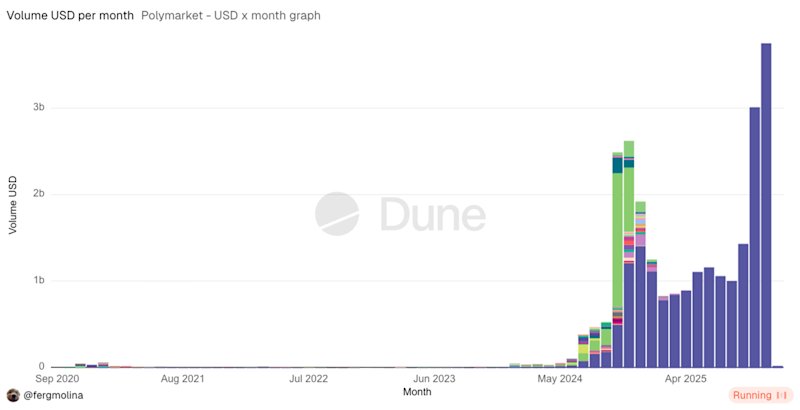
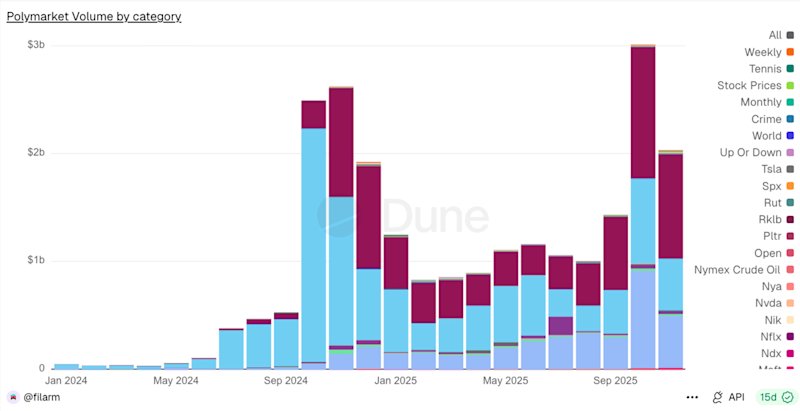
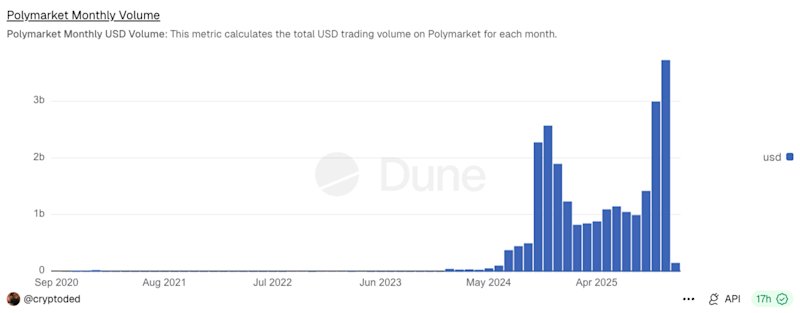
Paradigm specifies an onchain filter for reproducing a one-sided measure: taker-side OrderFilled events have a taker field equal to either the CTF exchange contract (0x4bfb41d5b3570defd03c39a9a4d8de6bd8b8982e) or the NegRisk exchange contract (0xc5d563a36ae78145c45a50134d48a1215220f80a). Maker-side volume uses events whose taker field is neither contract. Its analysis identifies monthly figures around $2.5 billion in October and November 2024 as a possible sign that a chart sums all OrderFilled events—not, by itself, proof of how any particular dashboard was built.
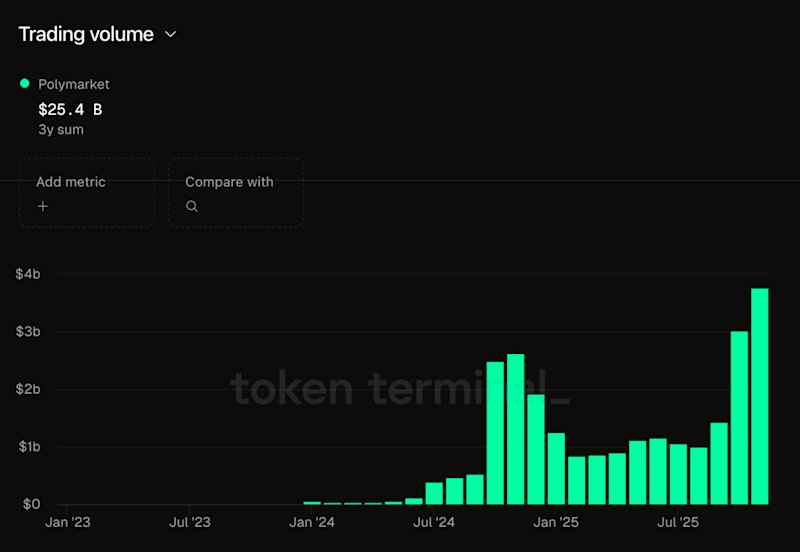
The methodological limit is important: this correction addresses duplicate representations of matches, not the classification of trading activity or the choice of a universally preferred cash-flow definition. Paradigm disclosed that it is an investor in Kalshi, a Polymarket competitor.