As reported on August 7, 2026, Upbit said it would end trading support for BONK at 15:00 Korea Standard Time on September 7, affecting the BONK/KRW and BONK/USDT pairs. Withdrawals would remain available until October 7.
Upbit said its review identified shortcomings that could cause user losses. Its stated concerns included unresolved or unexplained security incidents involving distributed ledgers used to issue, transfer or store virtual assets, and failures by an issuer or operator to disclose important information promptly through appropriate electronic channels. Those are Upbit’s assessment findings; the announcement, as reported, does not establish that the July BonkDAO incident involved a token-contract exploit.
Following the announcement, BONK fell from about $0.0000028 to $0.0000025, roughly 10%, according to the August 7 report. It put BONK’s market capitalization at $222.26 million at the time.
How the treasury transfer happened
The delisting followed a July governance incident in which approximately 4.426 trillion BONK—worth about $20 million at the time—left the BonkDAO treasury. Bonk confirmed that a malicious governance proposal had caused the transfer. The reported mechanism was a vote and automatic execution under the DAO’s existing rules, rather than a reported private-key compromise or token-contract exploit.
On June 30, the actor submitted proposal BIP #76, titled “Sowellian BonkDAO,” through Solana’s Realms governance platform. Although presented as a governance improvement, the proposal instructed the treasury to transfer the tokens to an address controlled by the actor. With roughly 88 trillion BONK in circulation at the time, the reported 1% voting threshold was about 880 billion tokens. Between July 4 and 5, the actor accumulated approximately 882.285 billion BONK through purchases on exchanges including Binance and Bybit, alongside some DeFi borrowing, at an estimated cost of $4.4 million.
Voting began on July 6. Only seven addresses participated, and addresses controlled by the actor supplied 99.878% of the votes in favor, according to the report. Once the proposal passed, the transfer executed automatically. The process reportedly had no timelock, additional multisignature approval or manual review. The critical design issue was therefore not just the voting threshold: treasury execution also lacked a delay in which an abnormal proposal could be challenged.
Fund movements and recovery limits
The report says about $190,000 in BONK moved to OKX within nine hours of the treasury transfer. Roughly $19 million went to a newly created multisignature wallet that Chainalysis described as a “BONK 2.0” shadow DAO. The report also describes sales and exchange deposits involving tokens the actor had accumulated for voting. These movements should not be treated as separate amounts recovered or added together as a total loss.
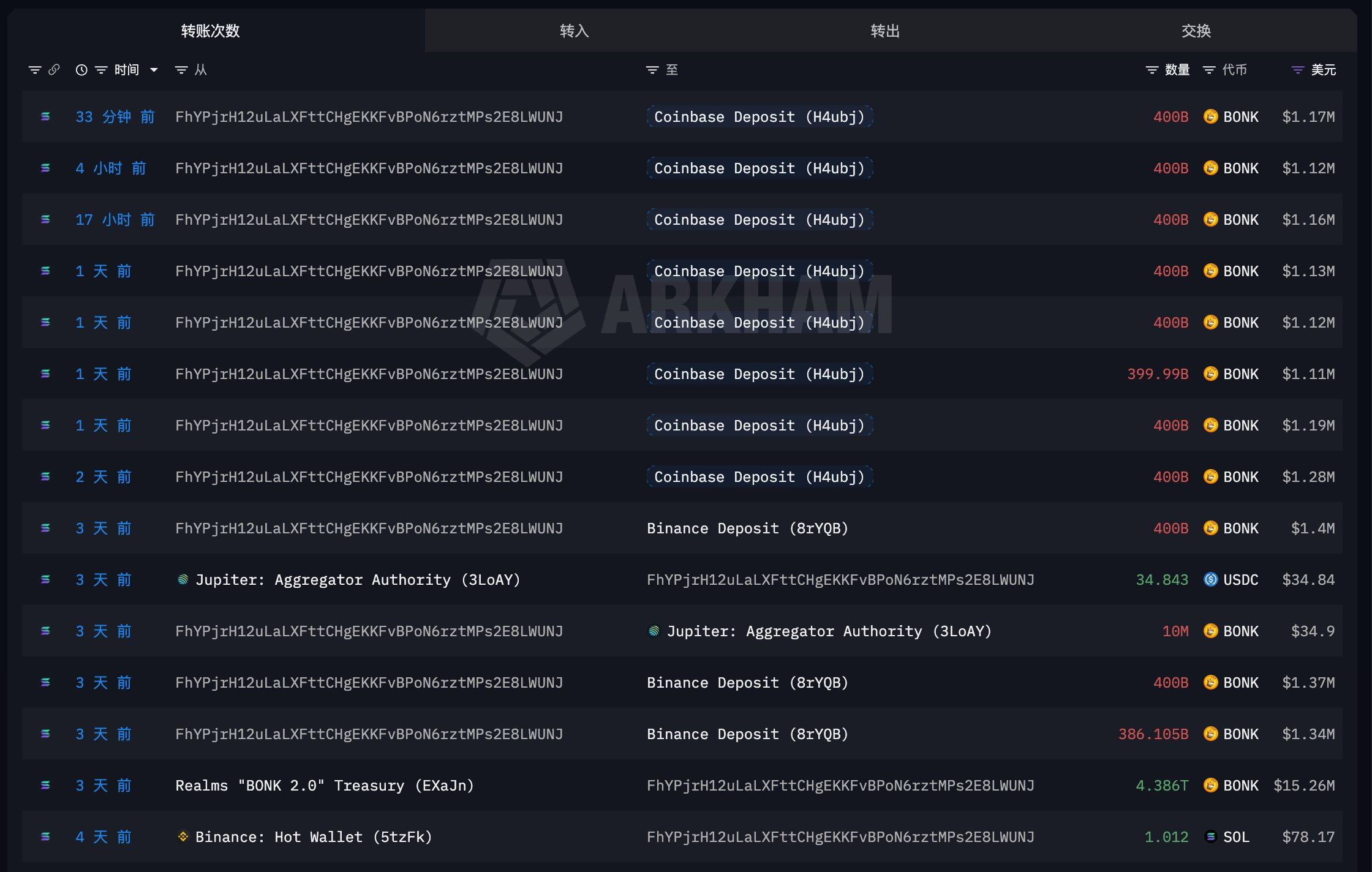
On July 17, the actor deposited 1.186 trillion BONK, then valued at about $4.11 million, to Binance. Citing on-chain analyst Ember, the report says 400 billion BONK, valued at about $1.11 million, went to Coinbase on July 19. It separately reports a final 400-billion-BONK Coinbase deposit, valued at $1.17 million, on July 20. The report’s stated cumulative amount cashed out was approximately $13.58 million; it does not provide a transaction-level reconciliation of that figure. Over the 12 days following the treasury transfer, BONK reportedly fell from $0.0000047 to $0.0000027, about 41%.
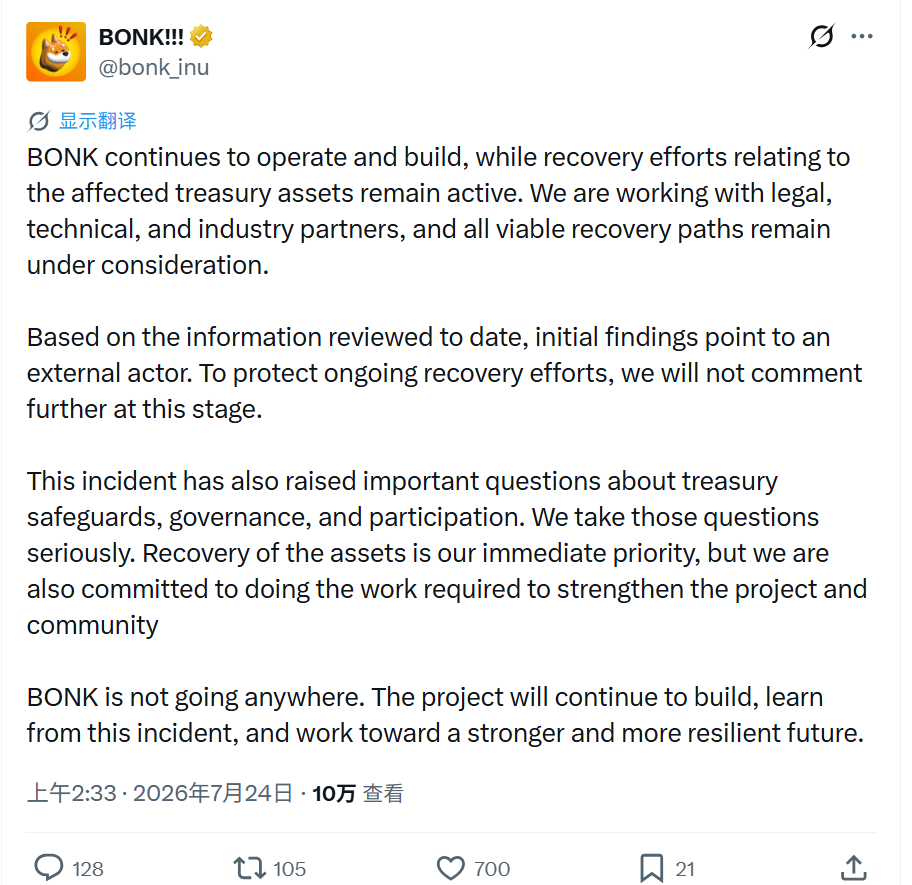
Bonk said it had identified exchange wallets used to build the voting position, notified law enforcement and contacted exchanges, bridges and the Solana Foundation in pursuit of recovery. In a July 13 update, BonkDAO said relevant wallets had been flagged and were being monitored. It said the BONK token contract and users’ personal assets were unaffected and planned a postmortem. On July 23, the project said recovery efforts continued. As of the August 7 report, there was no official confirmation of a substantial return to the treasury or a large-scale freeze or recovery of the funds.
The case illustrates a specific governance risk: when voting power can be assembled at a cost below the value of an executable treasury proposal, low participation and immediate execution can leave little opportunity to intervene. Higher thresholds, an execution delay or additional approval for large transfers are possible safeguards—not measures the report says BonkDAO had implemented. Whether any of them would have stopped this particular proposal remains untested.