On November 8, Ethereum co-founder Vitalik Buterin wrote on X that he would rather position ETH as a store of value than anchor it to the idea that fee destruction supports its price. In a report by Jae, published by PANews at 15:55 on November 10, 2026 (UTC+8), that comment is treated as a public revision of the “ultrasound money” narrative, which for about five years had tied ETH’s appeal to net supply contraction.
The report describes a split outcome. Ethereum was processing more activity at a lower cost to users, while fee revenue and the amount of ETH burned were shrinking. With ETH’s market capitalization put at about $260 billion, the open question is what can replace fee burn as a valuation anchor—and whether “store of value” names a mechanism or only a preference.
Two accounts of why ETH would be held
The older account, as the article reconstructs it, is a scarcity loop. Users pay transaction fees, the protocol burns ETH, and holders benefit indirectly if supply grows more slowly or shrinks.
The account Buterin is reported to prefer is infrastructural. Ethereum would be secure, neutral, and reliable enough that the ecosystem chooses to hold, stake, and use ETH for long periods. Value would rest on ETH as base capital, not on each transaction destroying part of the supply.
Tom Lee, chairman of Bitmine, is cited as agreeing with that distinction. In his framing, ETH is not a cash-flow token on the model of HYPE or LIT. It is collateral that is held because the asset itself is trusted. The uses named are ordinary ones: staking ETH for rewards, posting it as collateral in lending markets such as Aave, and allowing related staked positions into other DeFi applications. On this view, ETH is not only a wallet balance. It is an asset against which other financial activity is secured.
Those are design intentions and commentator claims. They do not, by themselves, show that more use of Ethereum produces more net buying of ETH.
What the named datasets measured
The article cites four snapshots. They are measurements as of that November 2026 report, not a later update, and the piece does not present them as an original experiment.
Stake committed to validation. The Block is cited for staked ETH at 36.36% of circulating supply, compared with 29.91% a year earlier. The article reads the lockup as evidence that a large share of supply was assigned to network security rather than short-term trading. The percentages do not show whether those coins were bought in order to stake, or were already held and then staked.
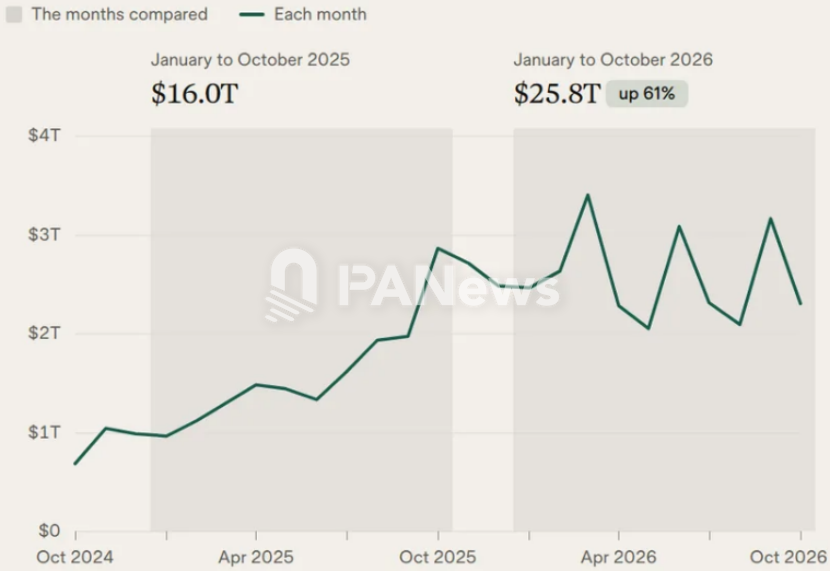
Stablecoin settlement. Research attributed to Ethereum Institutional is cited for Ethereum mainnet stablecoin transfer volume of $25.8 trillion in the first ten months of the year, up 61% year over year.
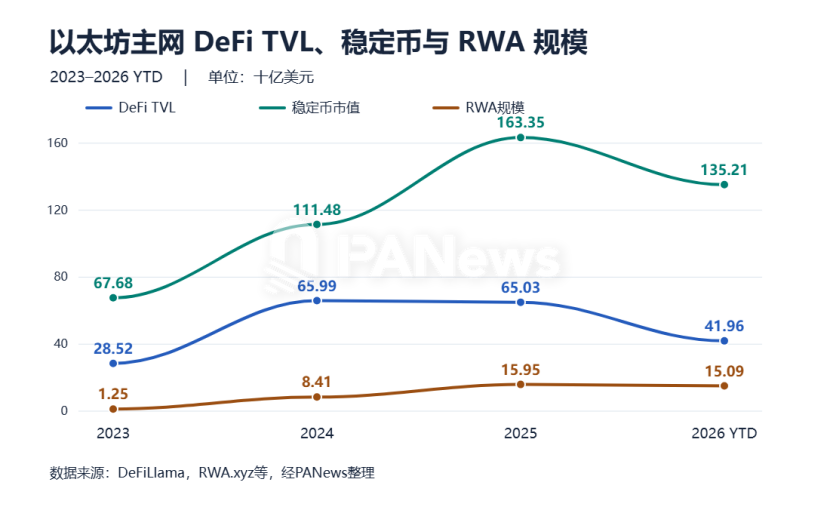
Balances on mainnet. DeFiLlama is cited for mainnet DeFi total value locked of about $42 billion, stablecoin market capitalization above $135 billion, and real-world-asset scale of $15 billion.
Those figures support a narrower claim than “ETH must be bought.” At the time of reporting, mainnet was settling very large stablecoin flows and hosting substantial DeFi, stablecoin, and tokenized-asset balances. The article’s own example shows why that is not the same as net demand for ETH. An institution can issue $1 billion of tokenized Treasuries on Ethereum while the collateral is actual Treasuries, the yield is the coupon, settlement is in USDC, and ETH appears only as a small gas payment. Assets carried on the chain can grow without a matching bid for the native token.
That gap is the test the article sets for the store-of-value thesis. The role is not established by announcing it. ETH would have to function as base capital that on-chain finance does not simply route around, rather than as fuel bought only when someone needs to send a transaction.
The burn arithmetic and the broken deflation claim
Buterin’s reported illustration separates a fee-burn valuation from the market capitalization then observed. If a token burned $1 billion of fees a year, and that stream were discounted at 4%, the theoretical present value would be about $25 billion. The article stresses that trading fees are not a stable cash flow, so treating a peak as a permanent annuity does not survive a cycle.
Applying the same 4% rate to an ETH market cap of about $260 billion implies that Ethereum would need to burn about $10.4 billion of fees every year for a pure discounted-burn model to support that capitalization. The article says this requirement was already far from observed conditions.
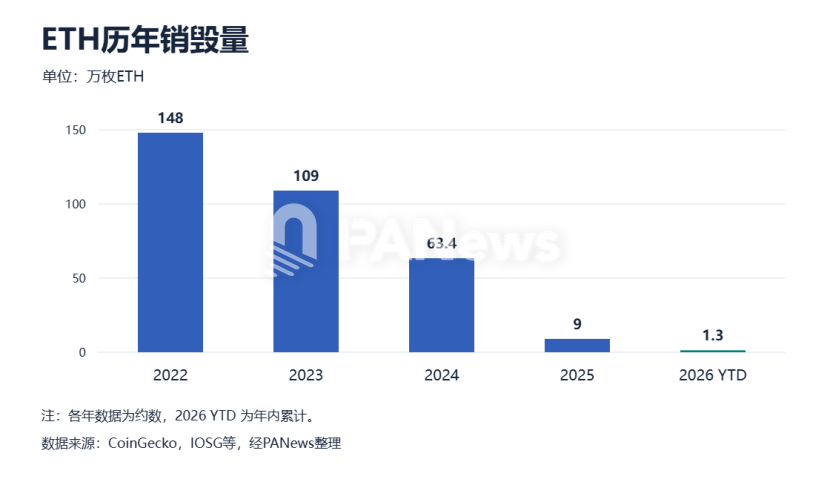
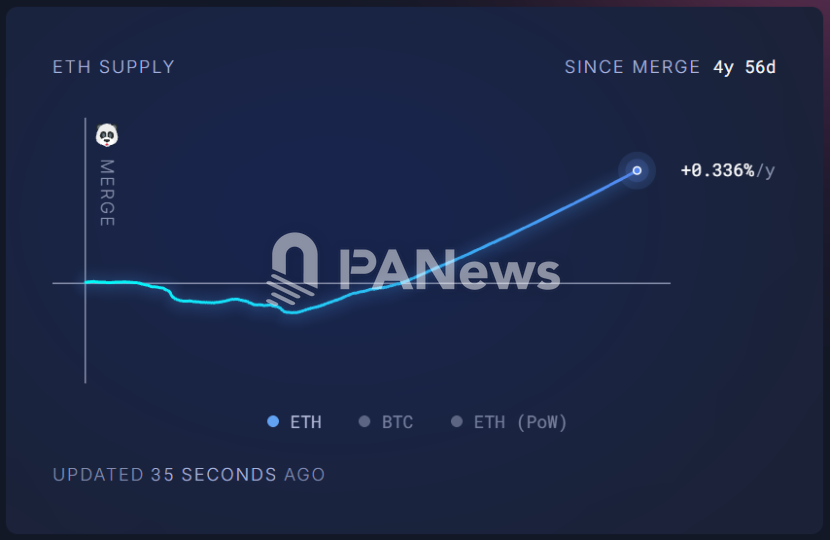
Burn quantities make the scale of the break explicit. The system burned about 1.48 million ETH in 2022. Year to date at the time of the November 2026 report, it had burned about 13,000 ETH, with a stated market value of about $27.3 million—a decline of more than 99% by coin count. The article also says ETH had already returned from net deflation to net inflation in February of the previous year, February 2025 relative to that dateline, and that the inflation rate was still rising. On the article’s reading, the deflationary promise associated with ultrasound money had already failed.
The 4% figure is an assumption inside the illustration and the reverse calculation, not a cost of capital estimated in the piece. The burn comparison also pairs a 2022 coin count with a later year-to-date coin count, and gives a dollar value only for the smaller, later burn. It shows direction and magnitude. It does not itself produce a fair value.
Where fee value was retained
The article still treats gas burn as a pillar of the valuation framework, and argues that the break in transmission was already visible in the collapse in burn.
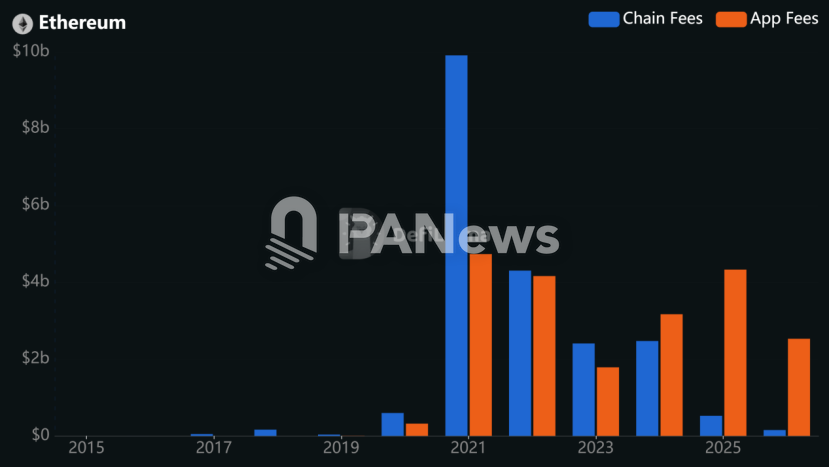
DeFiLlama is cited for an earlier split: fees in the Ethereum setting were overtaken by the application layer on mainnet as early as 2024. Year to date in the report, mainnet fee revenue was about $152 million, while application-layer fees were about $2.529 billion, more than sixteen times as large.
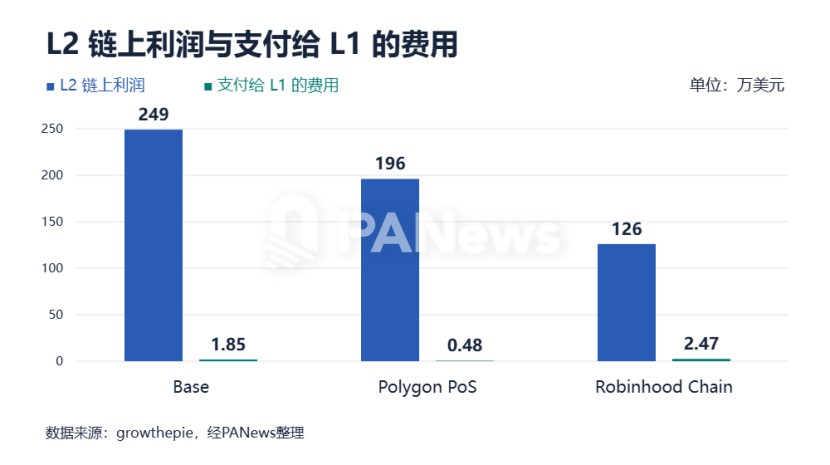
Layer 2 networks are presented as the clearest diversion of value away from the base layer. Base is the worked example. It relies on Ethereum for settlement and security, runs its own execution environment and user entry point, charges end users, and pays Ethereum for data publication and settlement. The spread is its on-chain gross profit.
growthepie is cited for the 30 days before the report. The top three Ethereum L2s together recorded about $5.71 million of on-chain profit, of which Base accounted for $2.49 million. Over the same window, their combined settlement payments to Ethereum mainnet were only about $48,000. Base’s payment was $18,500, which the article says was even lower than Robinhood Chain’s. Most fee value stayed on the L2. It did not become mainnet revenue, and it did not become a return to ETH holders.
A slower risk is about recognition rather than fees. If users finish their activity on Base, Arbitrum, and similar networks and rarely touch Ethereum directly, the service they recognize belongs to the L2 and the front end. Security inherited from Ethereum is not the same as a user relationship with ETH.
Lower fees open uses; they do not close the valuation gap
The article does not treat cheaper transactions as pure damage. Scaling cuts the cost of a unit of activity. When a transfer costs several dollars, many high-frequency and small-value uses are hard to justify. At a few cents or less, the uses listed as newly plausible are high-frequency payments by AI agents, microtransactions, and automated strategies.
Whether that added demand becomes large enough, in total fees, to offset the fall in fee per transaction is left unresolved. The November 2026 report does not show that it has.
Lee’s further claim—that a turn toward store of value lets ETH capture value in a coming tokenization and AI supercycle—is reported as his view. The datasets above cover usage, stake share, where fees landed, and how much was burned. They do not measure that capture.
What was documented, and what was still assumed
As of the PANews report, with the sources and windows above, the documented points are these:
- Buterin publicly preferred a store-of-value framing to a fee-burn anchor.
- The staked share of circulating supply was 36.36%, versus 29.91% a year earlier.
- Cited snapshots showed very large mainnet stablecoin transfer volume and substantial DeFi TVL, stablecoin capitalization, and RWA scale.
- A 4% discount applied to a market cap of about $260 billion implied about $10.4 billion of fee burn a year, far above observed burn. Coin burn had fallen from about 1.48 million ETH in 2022 to about 13,000 ETH year to date, worth about $27.3 million at the stated price.
- Application-layer fees, and L2 margins, were far larger than what was paid back to mainnet. In the cited 30-day window, top-three L2 on-chain profit was about $5.71 million against about $48,000 paid to mainnet for settlement.
Not shown:
- That the rise in staking equals new net buying of ETH.
- That growth in stablecoins, DeFi, or tokenized assets requires holding ETH beyond gas.
- That a later surge in volume restores burn economics.
- That users who never deal with mainnet will still treat ETH as the asset in which they store value.
The report’s closing reading is expectation management, not a completed revaluation. The old task was to show that Ethereum could collect enough fees to sustain burn. The new task is to show that ETH is still worth holding after fees become cheap. On the evidence gathered in the article, that second showing was still outstanding.
This is a reading of the reported comments and the named datasets. It is not a valuation, a price target, or investment advice.
Source: Jae, PANews, published November 10, 2026, 15:55 (UTC+8). Original article: https://www.panewslab.com/zh/articles/01a1c472-fa20-71cc-8de7-1175c01c5791