Bitcoin made it possible to verify payments without relying on a bank, but its public ledger introduced a different cost: transaction details are visible to anyone. In a review published on November 16, 2026, the source traces how privacy designs have moved beyond Bitcoin’s original reliance on pseudonymous keys. The useful question is not whether a system is simply “private,” but which information it conceals, from whom, and under what assumptions.
Bitcoin’s original trade-off
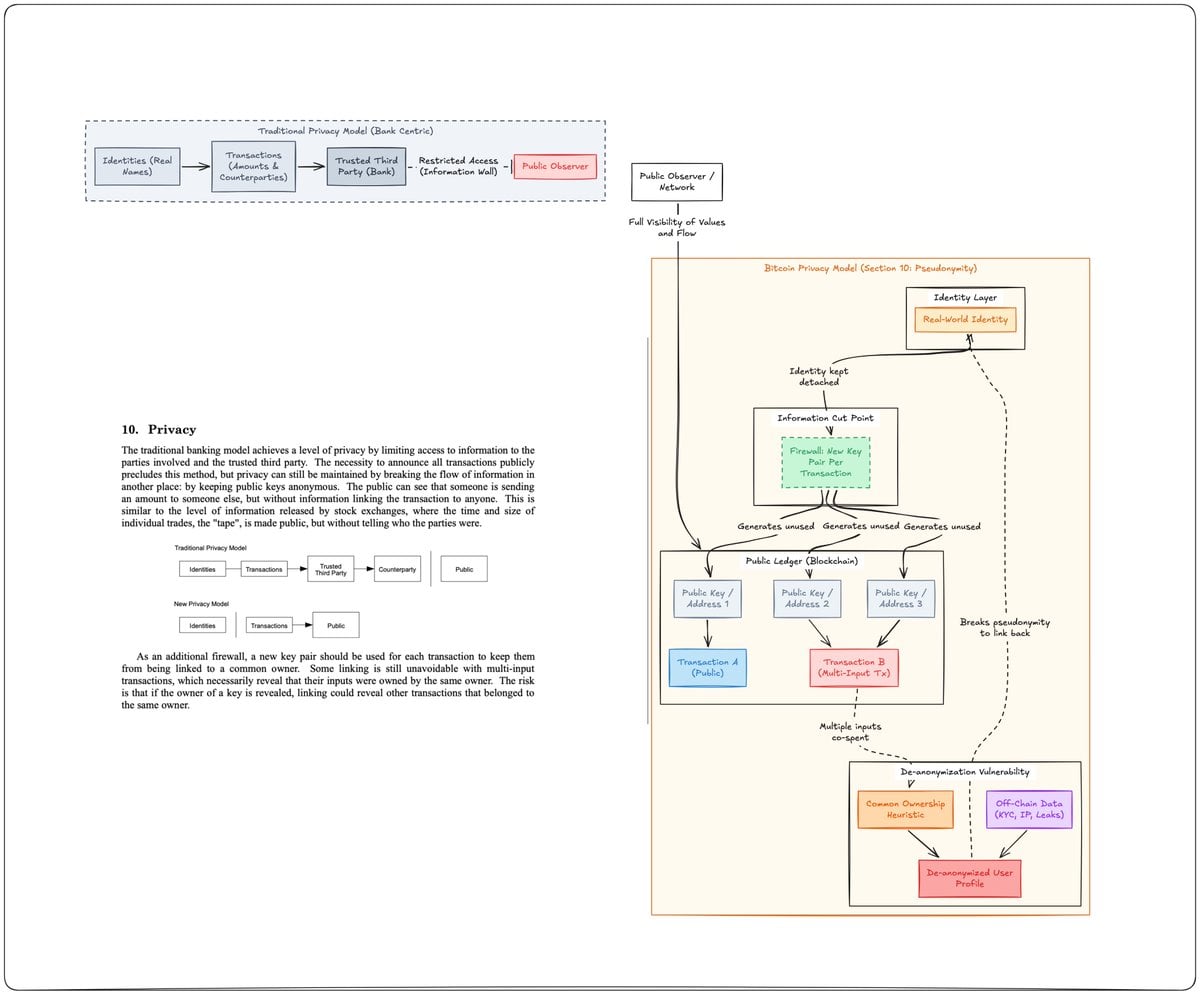
Section 10 of Satoshi Nakamoto’s 2008 Bitcoin white paper addresses privacy directly. Rather than keep transactions from public view, it proposes keeping public keys separate from real-world identities and using a new key pair for each transaction. Nakamoto also recognized a weakness: spending multiple inputs together can reveal a connection between them.
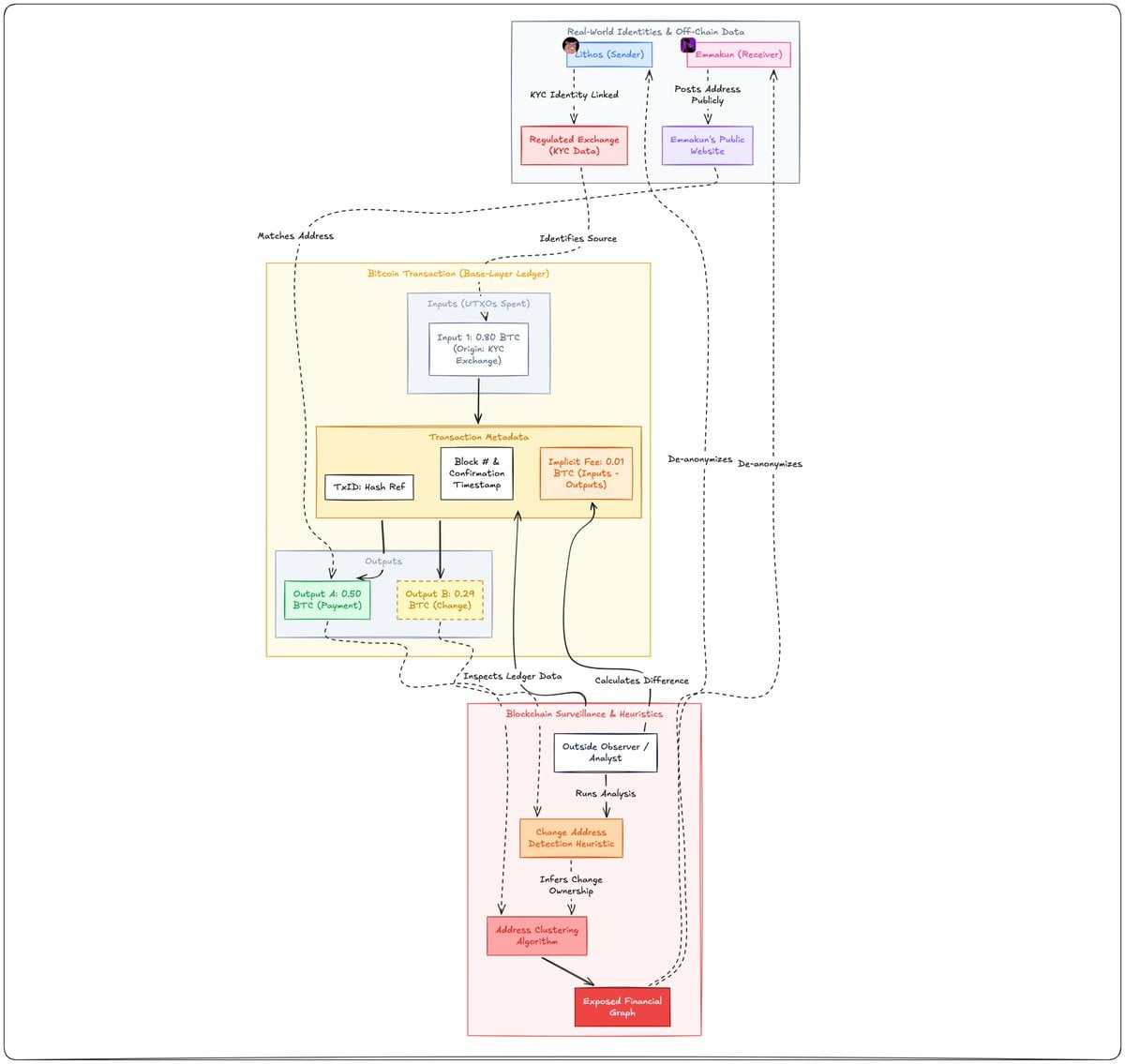
Bitcoin’s ledger exposes transaction inputs, outputs and amounts, as well as the block in which a transaction is confirmed. A name need not appear on-chain for this history to become revealing. If an address is linked to a person through information outside the ledger, an analyst can investigate related activity. Identifying a sender’s change output involves heuristics, however, and those guesses are not always correct. Bitcoin’s native model is therefore pseudonymity, not confidential payments.
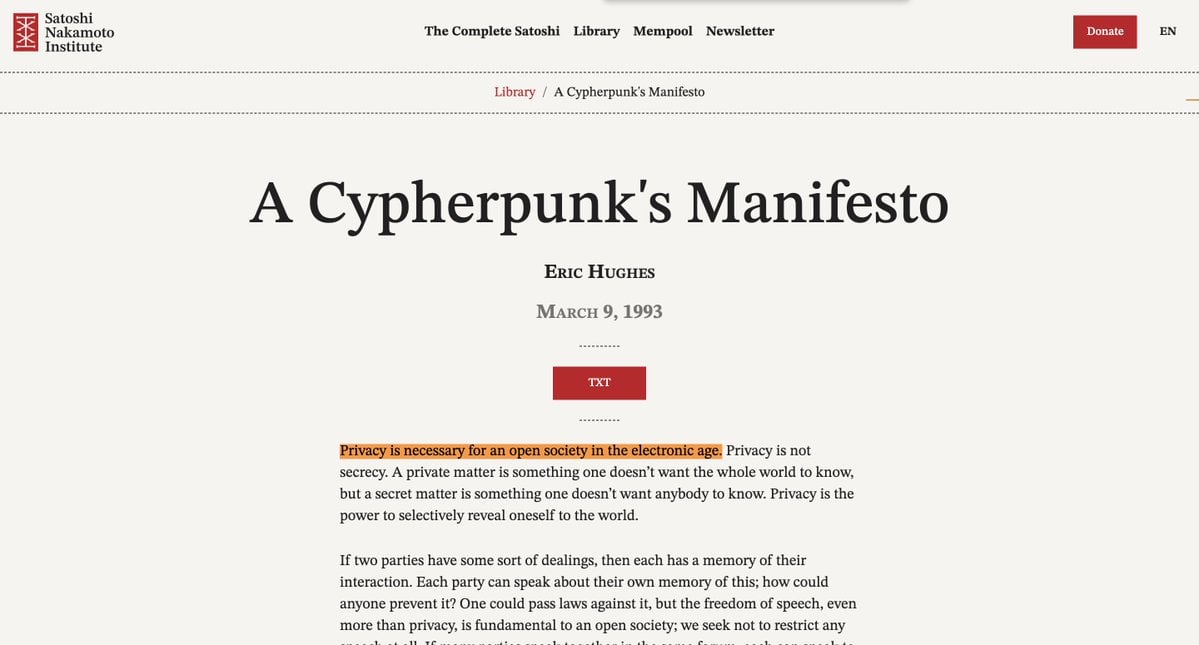
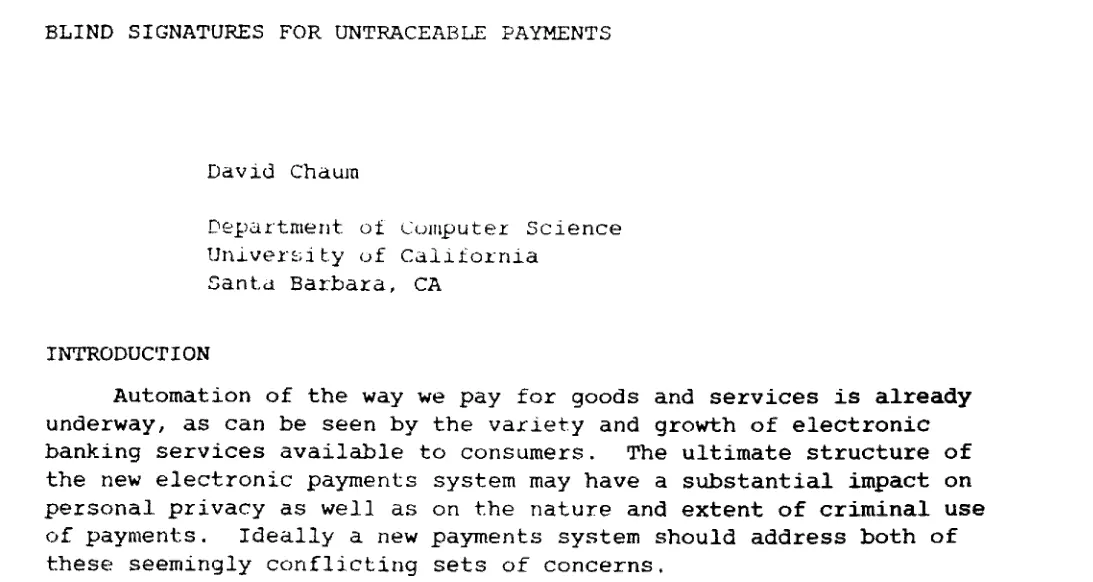
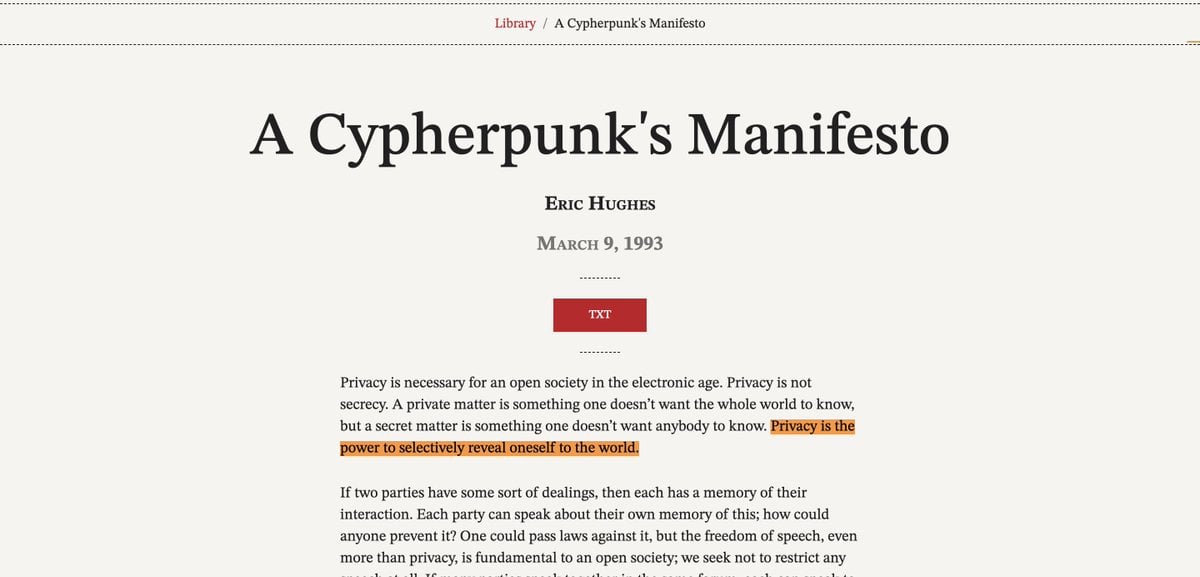
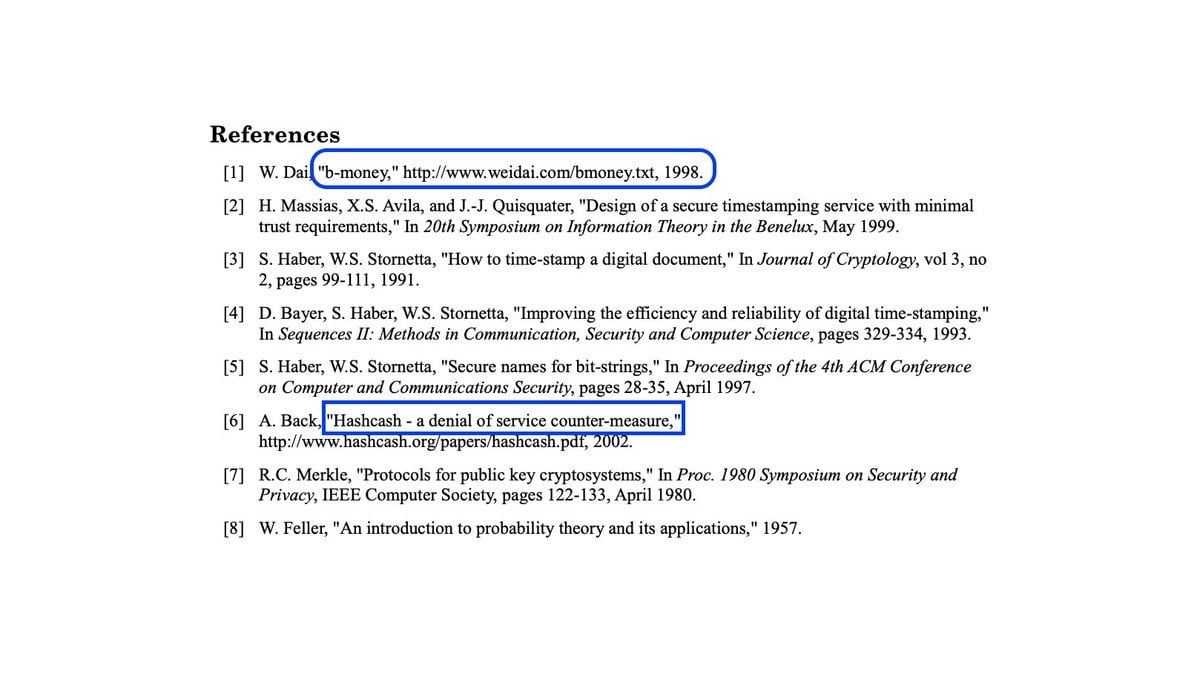
The distinction predates Bitcoin. David Chaum’s 1982 work on blind signatures explored payments that an issuer could not link to their eventual use, while still depending on a centralized issuer. Eric Hughes’s 1993 A Cypherpunk’s Manifesto framed privacy as the ability to reveal oneself selectively. Earlier digital-cash proposals also supplied different pieces of the technical background: Adam Back’s Hashcash, Wei Dai’s b-money, Nick Szabo’s bit gold and Hal Finney’s reusable proof of work. Bitcoin’s white paper cited Hashcash and b-money.
Hiding a payment is not one mechanism
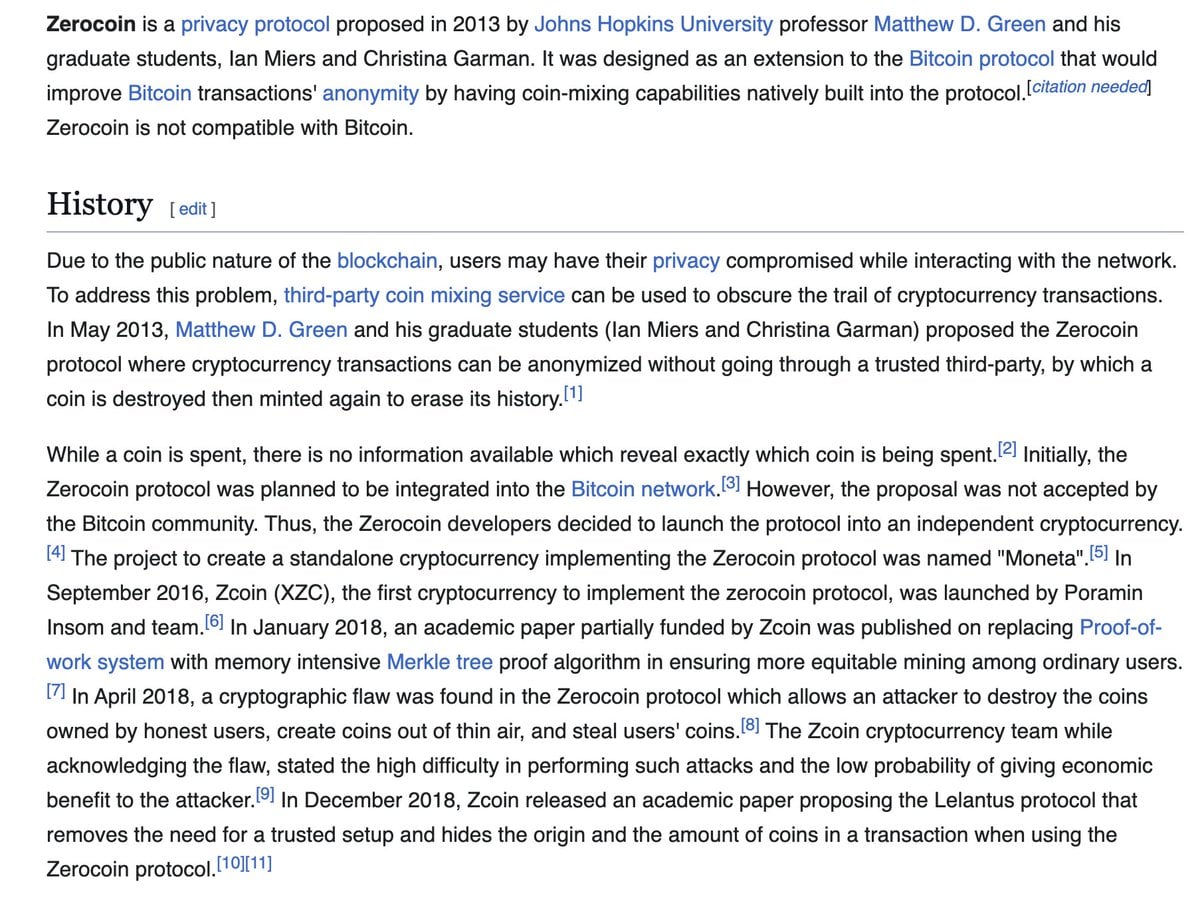
Subsequent research asked whether a network could validate a payment without publishing all its details. The 2013 Zerocoin paper explored breaking the link to a payment’s source but left its destination and amount visible. The 2014 Zerocash work used zk-SNARKs to develop a design for concealing sender, recipient and amount while allowing validity checks.
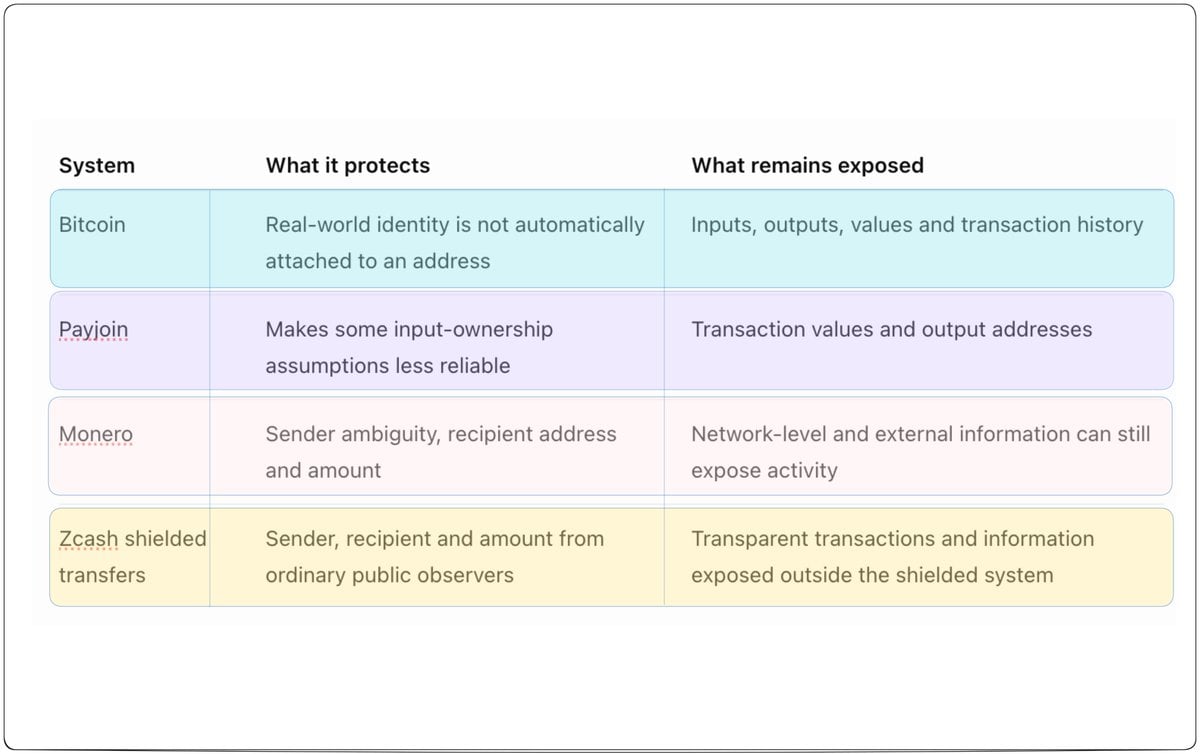
Implementations protect different parts of the transaction record:
- Bitcoin Payjoin, specified in BIP 78, lets a recipient contribute an input to a payment. This undermines the common analytical assumption that every input to one transaction belongs to its sender. It does not hide amounts or make the transaction confidential.
- Monero uses ring signatures to obscure which output was spent, stealth addresses to separate receipts from a recipient’s public address, and RingCT to hide amounts. The source notes that sender privacy depends on the ring and on information an observer obtains elsewhere. Its Dandelion++ network-broadcast measures do not eliminate every network-level leak.
- Zcash supports shielded transfers whose details are not disclosed on the public ledger, alongside transparent addresses whose activity remains visible. Privacy in practice depends in part on which address types people use and how funds move between transparent and shielded pools. Viewing keys provide a means of disclosing information to a chosen party without granting spending authority.
These are comparisons of what an observer can learn from the ledger. They do not establish protection against an exposed IP address, a compromised device or identity information held by an exchange.
Privacy becomes an application and wallet question
Smart contracts introduce data beyond payment amounts: application inputs, state changes and user queries can also reveal information. The source describes several distinct architectural approaches, not interchangeable guarantees.
Aztec is designed as an Ethereum Layer 2 with private and public contract functions. In its described model, a private function executes in the user’s local private execution environment, which generates a proof; a public function operates on shared public state. A remote node serving the client may still learn what data the client requests.
Oasis Sapphire instead uses hardware trusted execution environments for confidential contract execution, including encrypted inputs and confidential state. That approach brings hardware and implementation trust assumptions that differ from those of a zero-knowledge proof system.
Umbra’s V2 design centers transfers within a shielded pool on Solana. Deposits and withdrawals can still leave observable amounts and timing clues. Privacy Pools, developed by 0xbow, uses association sets and zero-knowledge proofs so a withdrawing user can demonstrate membership in a screened set without identifying a particular deposit. The source presents this as a selective-disclosure design, not as proof that every compliance or privacy risk has been removed.
Finally, a confidential transaction cannot protect information already disclosed by a wallet query. A remote RPC provider may learn which address a wallet checks when it requests a balance or transaction history. Kohaku, described as an open-source privacy-oriented wallet and SDK specification, targets that layer; the source describes private information retrieval as a way to request account data without revealing the specific account being queried to the server.
The research conclusion is narrower than a claim that blockchain privacy has been solved. Cryptography can conceal particular ledger fields or prove particular statements, but the result still depends on client software, network communication, hardware assumptions and the information made public when funds enter or leave a system. Evaluating any design starts by identifying its disclosure boundary—not by treating “privacy” as a single feature.