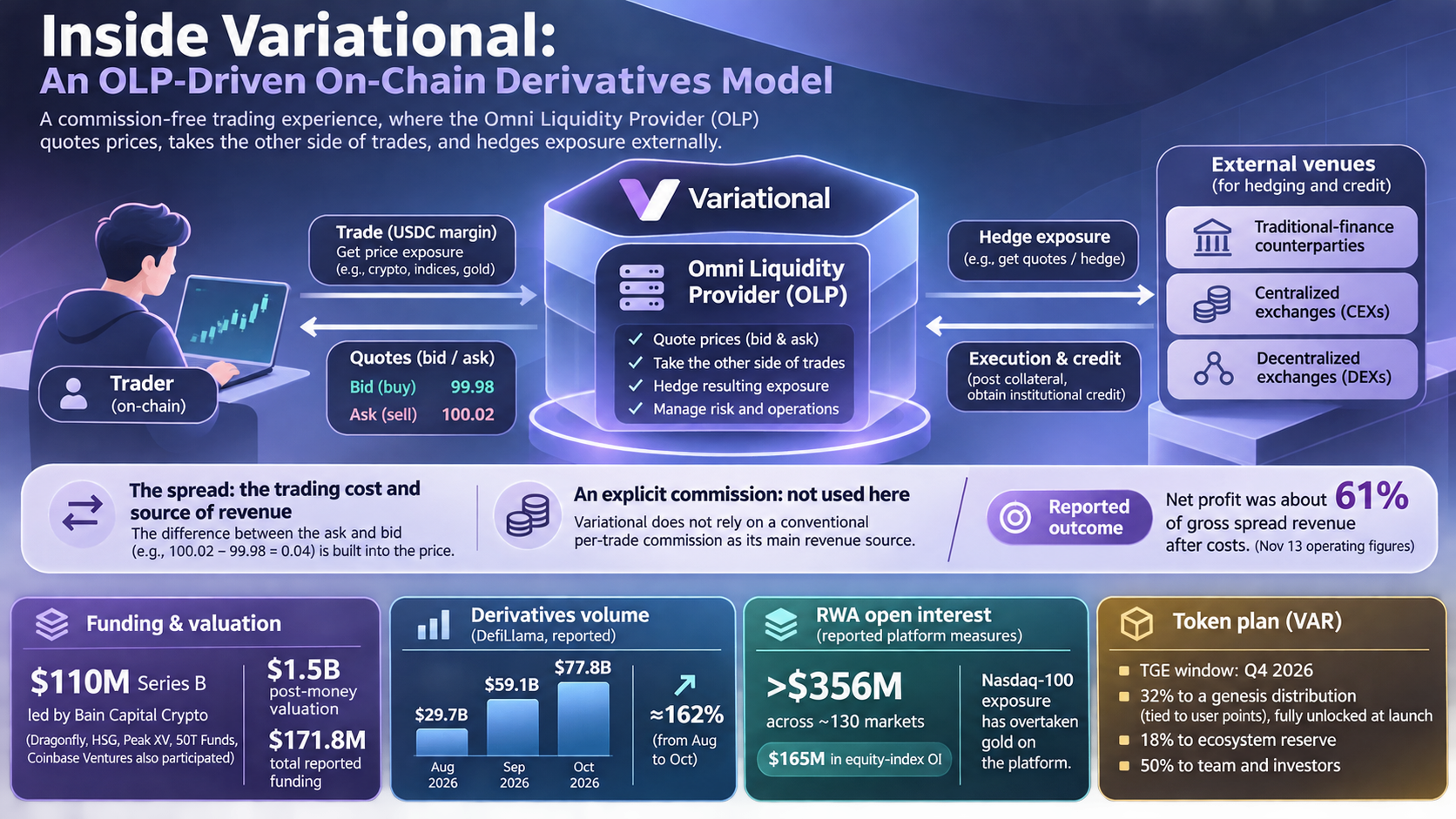
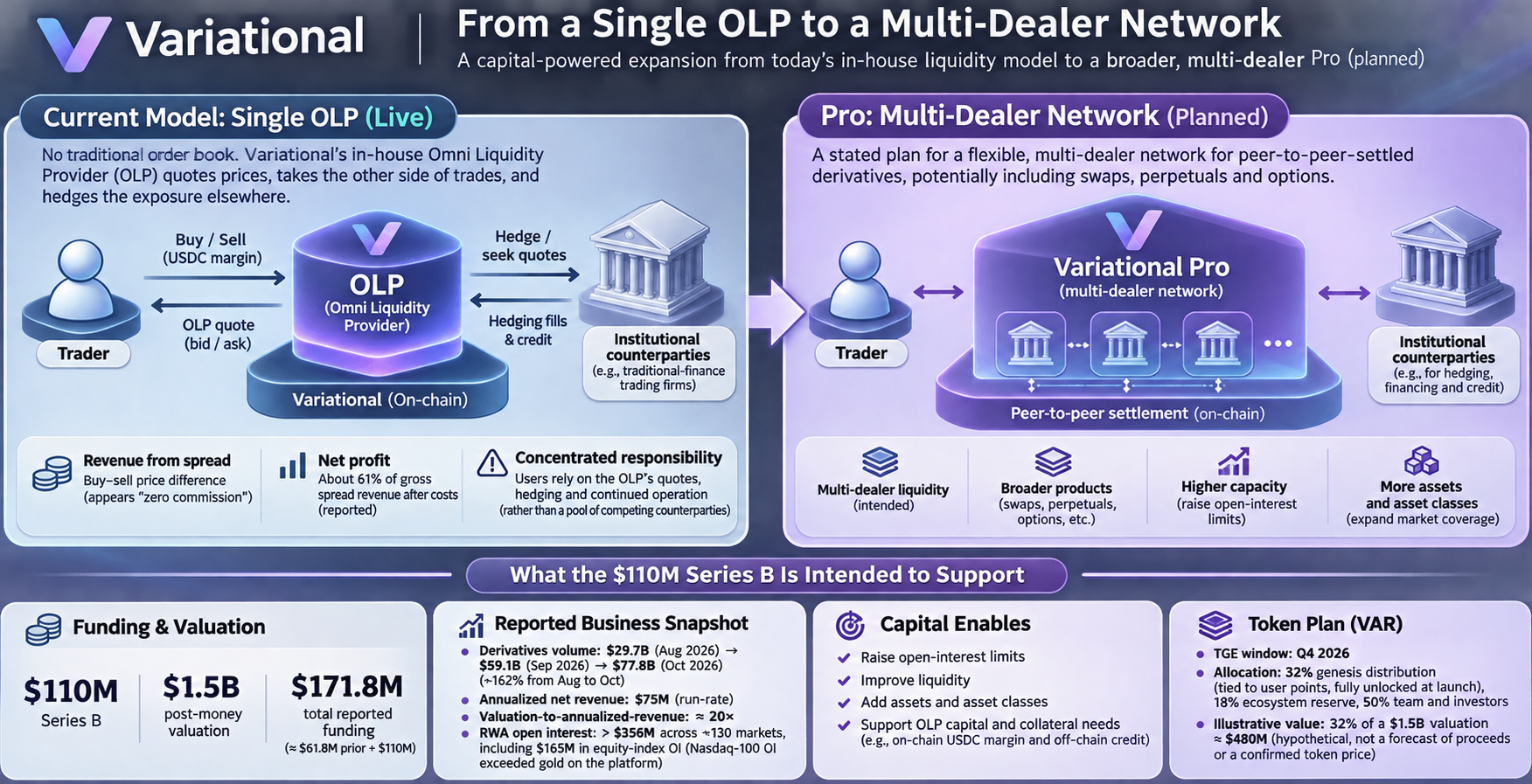
As reported on November 19, 2026, Variational had announced a $110 million Series B led by Bain Capital Crypto, with participation from Dragonfly, HSG, Peak XV, 50T Funds and Coinbase Ventures. The round valued the on-chain derivatives protocol at $1.5 billion post-money. Together with approximately $61.8 million raised previously, it brought reported funding to $171.8 million.
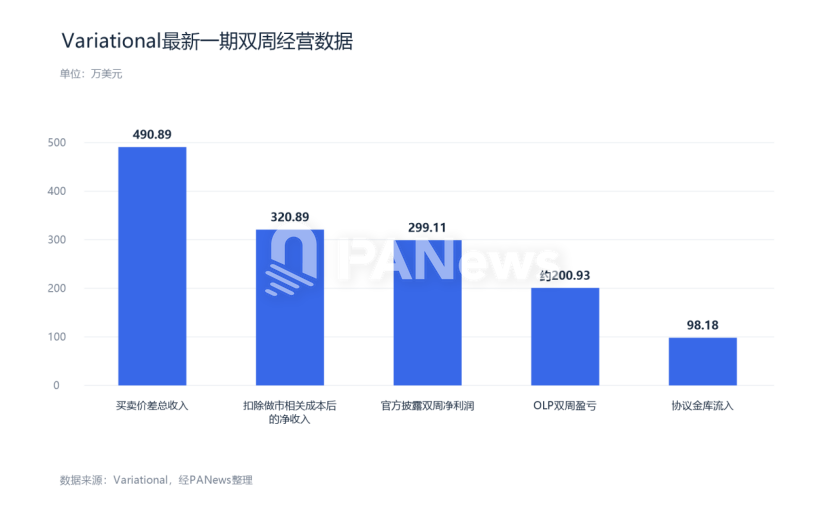
The research question is what that capital supports. Variational’s current model does not depend on a conventional perpetual-futures order book. Its in-house Omni Liquidity Provider (OLP) quotes prices to traders, takes the other side of their trades and hedges the resulting exposure elsewhere. This can make a trade appear free of an explicit commission, but the difference between the OLP’s buy and sell quotes—the spread—is a trading cost and a source of revenue. Variational’s November 13 biweekly operating figures said net profit was about 61% of gross spread revenue after costs.
That structure also concentrates responsibility. Users rely on the OLP’s quotes, hedging and continued operation rather than on a pool of competing counterparties in a public order book. Variational co-founder Lucas Schuermann has likened the OLP to an on-chain brokerage; the analogy describes its intended role, not evidence that its pricing or risk controls match those of any particular broker.
What the reported activity shows
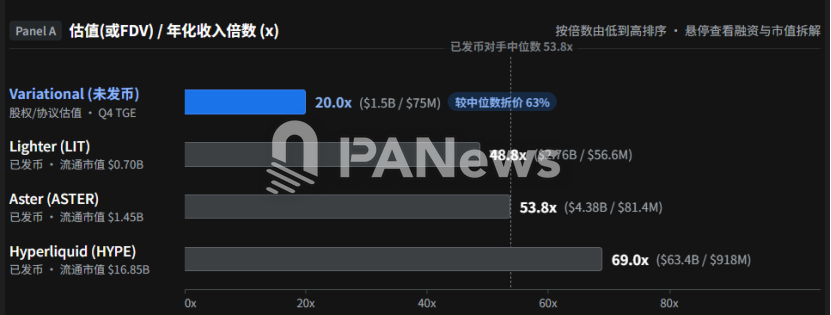
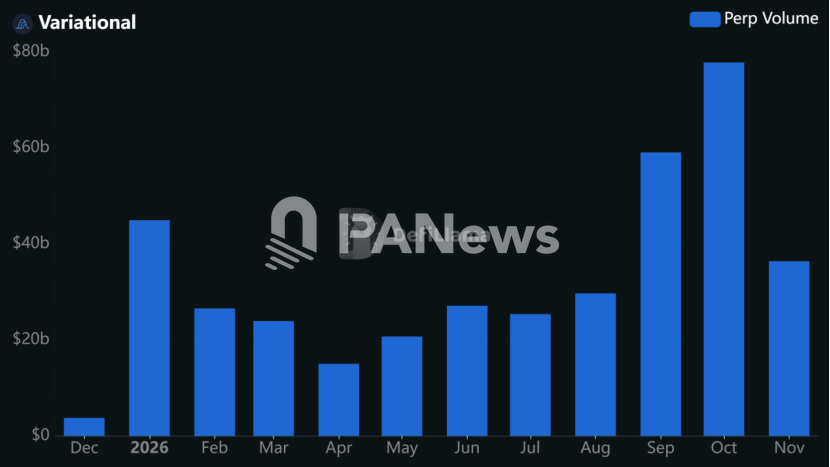
DefiLlama figures cited in the November 19 report put Variational’s derivatives volume at $29.7 billion in August 2026, $59.1 billion in September and $77.8 billion in October—an increase of roughly 162% from August to October. Variational disclosed $75 million in annualized net revenue, which implies a valuation-to-annualized-revenue ratio of about 20 at the Series B valuation. Annualized revenue is a run-rate measure, not a full year of realized revenue.
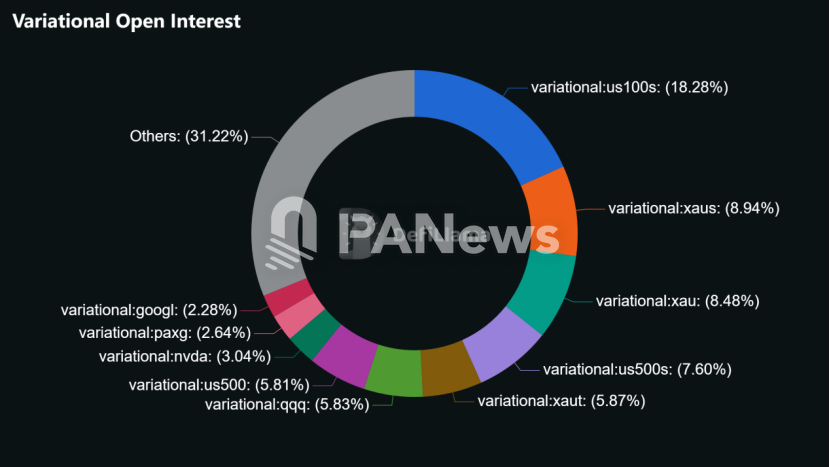
The report also put real-world-asset (RWA) open interest above $356 million across nearly 130 markets, including $165 million in equity-index open interest. It said Nasdaq-100 exposure had overtaken gold on the platform. These are reported platform measures, not independently established valuations of the underlying assets.
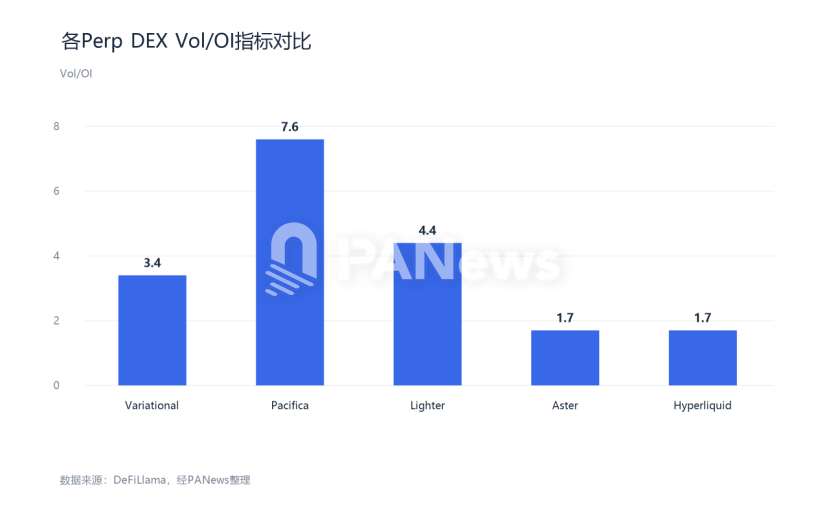
The report estimated Variational’s daily volume-to-open-interest ratio at about 3.4, versus 7.6 for Pacifica, 4.4 for Lighter and 1.7 for each of Hyperliquid and Aster. It raised the possibility that points incentives affected activity. A lower ratio alone cannot establish how much volume reflects durable demand.
Why expanding swaps requires capital
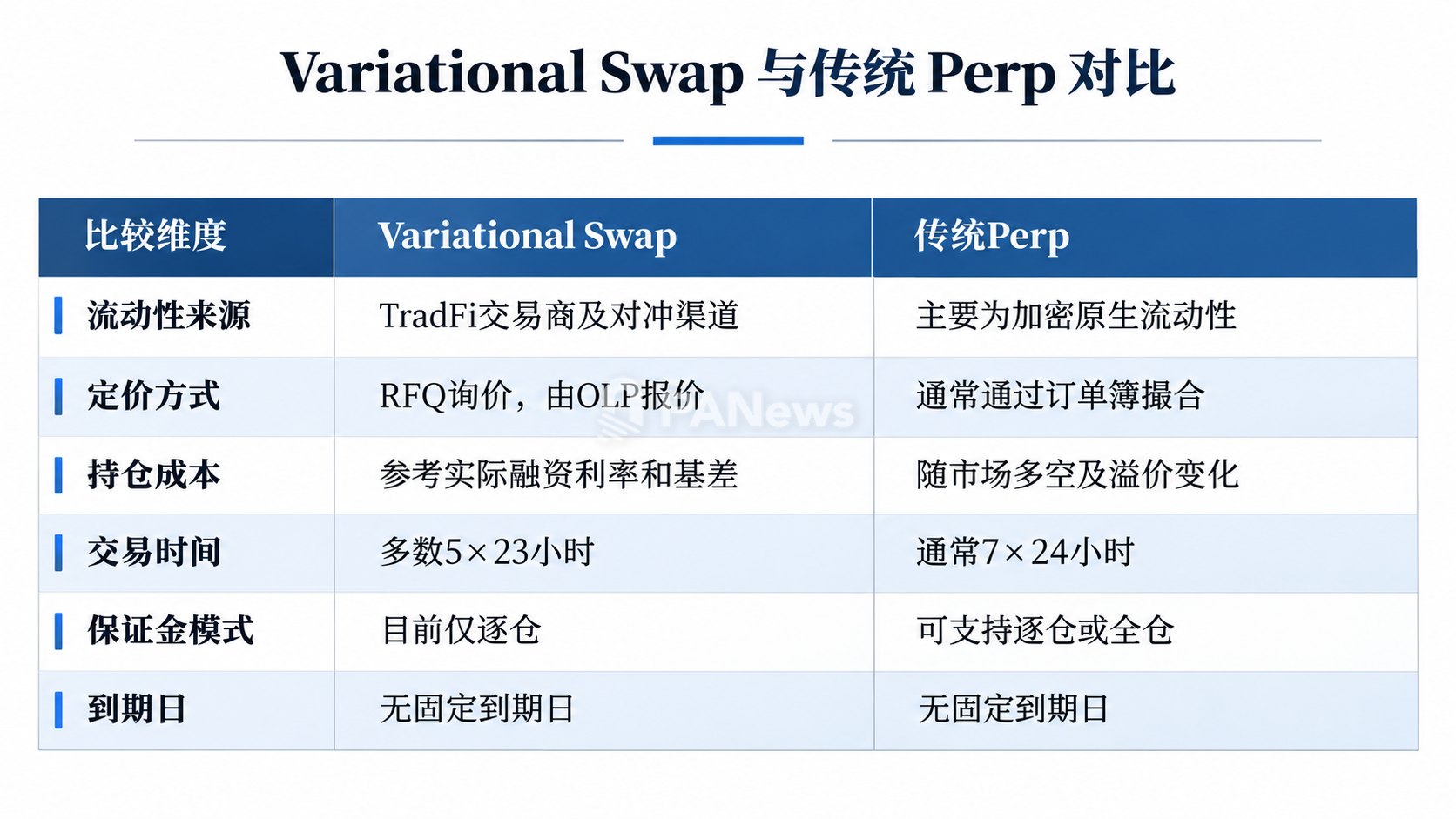
Variational’s swaps are USDC-settled derivatives that provide price exposure without ownership of the referenced asset; they are not spot-token exchanges. According to the report, the OLP can seek quotes or hedges from traditional-finance counterparties. It must also support positions with on-chain USDC margin and post collateral with off-chain institutions to obtain credit. The report said Variational had arranged more than $1 billion of institutional credit capacity by September 2026, while initially setting an open-interest ceiling of about $10 million per swap market to manage risk. Credit capacity, therefore, was not the same as immediately available capacity in every market.
Following the financing, co-founder Edward Yu said the intended uses included raising open-interest limits, improving liquidity and adding assets and asset classes. He also described a planned Pro product: a flexible, multi-dealer network for peer-to-peer-settled derivatives, potentially including swaps, perpetuals and options. That network is a stated plan, distinct from the current OLP-centered model.
Token estimates are scenarios, not proceeds
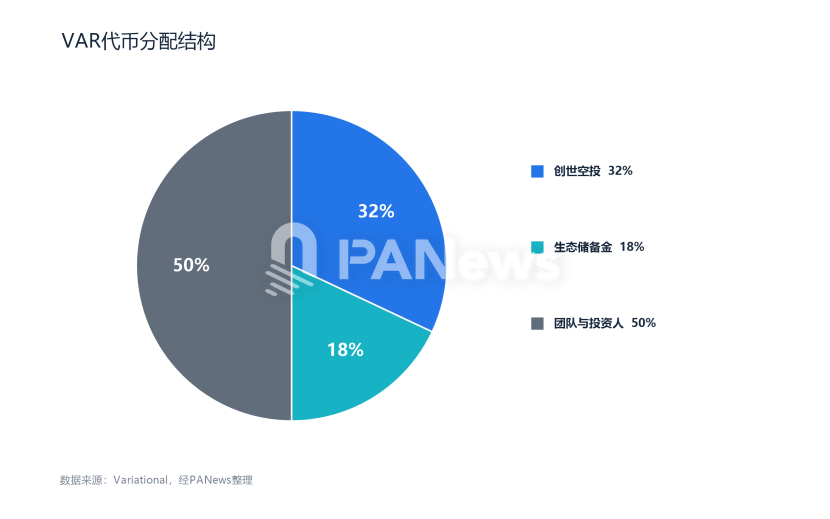
Variational’s September 2026 token plan set a fourth-quarter window for VAR’s token generation event. It allocated 32% of supply to a genesis distribution tied to user points, with that allocation fully unlocked at launch; 18% went to an ecosystem reserve and 50% to the team and investors.
Applying the $1.5 billion financing valuation to the 32% allocation yields a hypothetical $480 million value, not a forecast of first-day sales or a confirmed token price. The report also calculated roughly 10.05 million points from 3 million retrospective points and approximately 47 weekly pools of 150,000. On those assumptions, a $1 billion–$1.5 billion fully diluted token valuation would imply about $31.8–$47.8 per point. Both calculations depend on valuation and distribution assumptions; neither establishes what recipients could realize.
Variational’s financing and volume growth show the scale the reported model had reached by November 19, 2026. Its next constraints are more specific: whether spread income remains sufficient after hedging costs, whether the OLP can manage concentrated counterparty risk, and whether additional capital can safely support higher swap open-interest limits.