In an analysis published on November 17, 2026, Deven Matthews argues that Hyperliquid’s API wallets have become too permissive to serve as safely restricted credentials for personal AI agents. The concern is not limited to a stolen key: an agent exposed to malicious instructions could itself authorize actions its operator never intended.
Where the boundary falls short
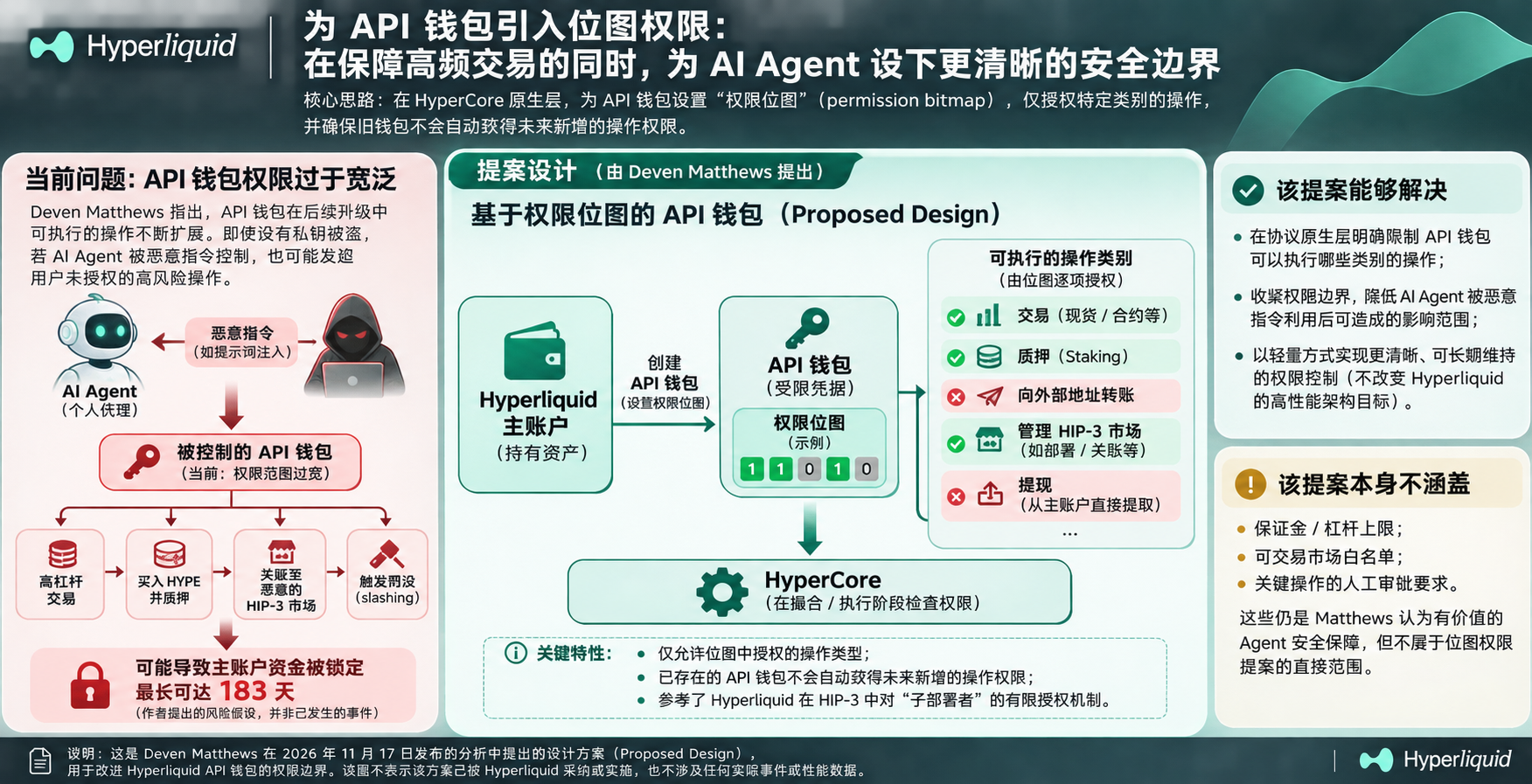
API wallets were originally restricted from directly withdrawing from a main account or transferring to external addresses, Matthews writes. But they had no limit on the margin they could use, leaving a compromised wallet able, in his account, to move value through leveraged trading. He argues that subsequent additions to API-wallet functionality have widened the set of actions available to a compromised credential.
Matthews gives a more specific hypothetical: if a main account held more than approximately $40 million in assets, a maliciously controlled API wallet could buy 500,000 HYPE for staking, associate that stake with a malicious HIP-3 market, expose it to slashing and lock the main account’s funds for up to 183 days. This is the author’s described risk scenario, not a reported incident.
What the proposal would change
Matthews says HyperEVM smart-contract accounts can check actions such as transfers and multisignature thresholds, but routing trades through Solidity checks before they reach HyperCore adds latency. Local policy checks by a custody provider offer another option, though they shift enforcement to an intermediary.
His proposed alternative is a permission bitmap set when an API wallet is created. HyperCore would check whether the signer is authorized for the requested action type. Matthews points to the limited rights granted to sub-deployers in Hyperliquid’s HIP-3 mechanism as a precedent. Under his proposal, an existing API wallet would not automatically gain permission for a newly introduced action.
That would address which categories of action a wallet may perform. It would not, by itself, provide the margin limits, market allowlists or human approval requirements that Matthews also identifies as useful agent safeguards. The analysis proposes a narrower native permission boundary; it does not establish that the change has been implemented or measure its performance cost.