In a November 16, 2026 report, TechFlow said an attacker had taken approximately 53.9 million KAVA, valued at about $1.83 million, from HARD Lend, a lending application on Kava Chain. The reported failure was in a dormant BUSD collateral market—not Kava Chain’s consensus mechanism.
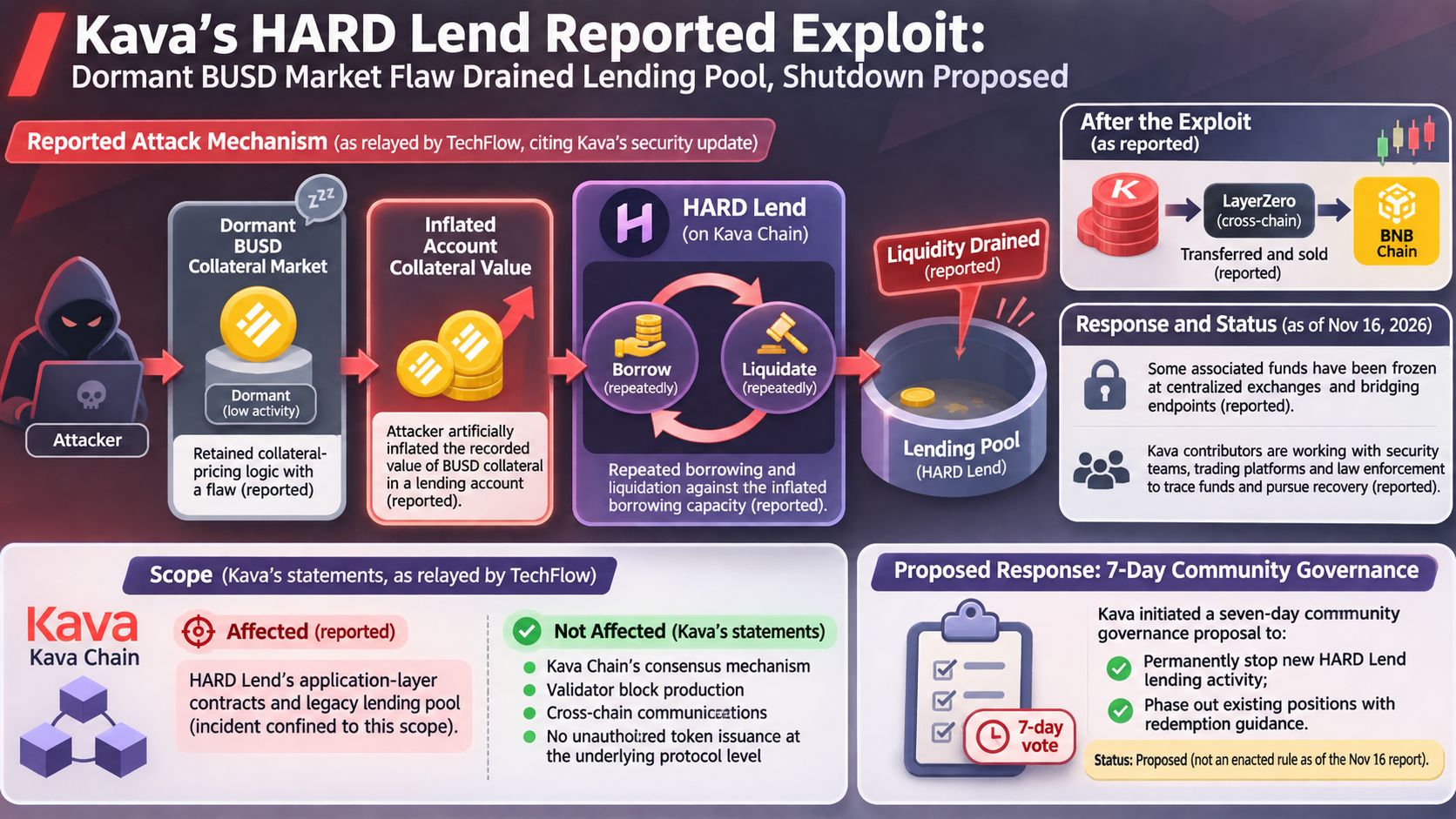
How the reported exploit worked
Citing Kava’s security update, TechFlow said the dormant market retained collateral-pricing logic that allowed the attacker to inflate the recorded value of BUSD collateral in a lending account. The attacker then repeatedly borrowed and liquidated against the inflated borrowing capacity, draining available liquidity from the lending pool. The report does not provide the transaction-level data or calculations needed to independently assess that account.
TechFlow said on-chain data showed that approximately 49.2 million KAVA, or 91.28% of the reported stolen amount, was transferred to BNB Chain through LayerZero and sold. It did not name a dataset for that figure. As of November 16, the report said some associated funds had been frozen at centralized exchanges and bridging endpoints, while Kava contributors were working with security teams, trading platforms and law enforcement to trace funds and pursue recovery.
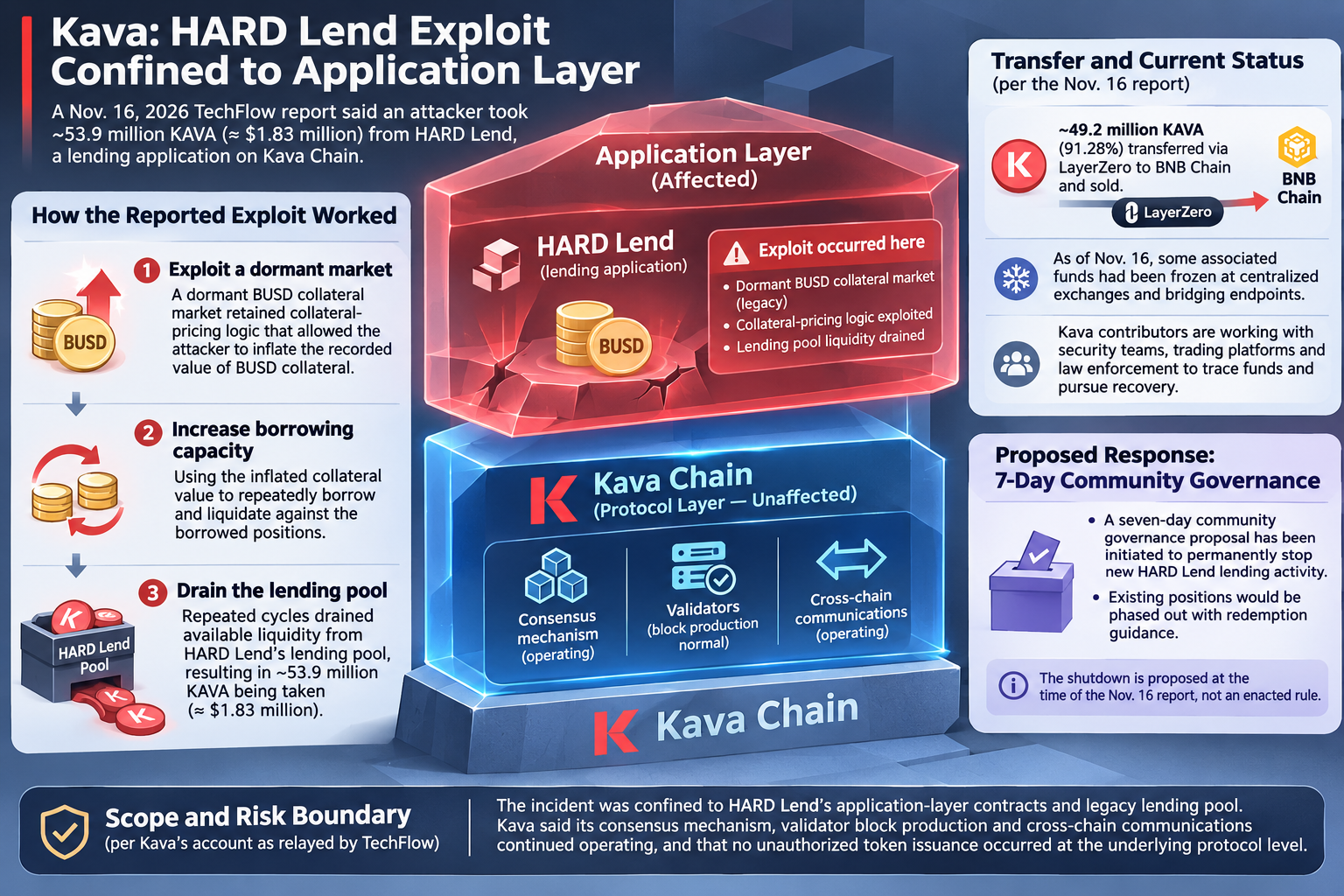
Scope and proposed response
According to Kava’s account as relayed by TechFlow, the incident was confined to HARD Lend’s application-layer contracts and legacy lending pool. Kava said its consensus mechanism, validator block production and cross-chain communications continued operating, and that no unauthorized token issuance occurred at the underlying protocol level. Those are Kava’s statements about the incident’s scope, not an independent assessment of every application or user balance.
The team also initiated a seven-day community governance proposal to permanently stop new HARD Lend lending activity and phase out existing positions with redemption guidance. At the time of the November 16 report, that shutdown was proposed, not an enacted rule.