As reported on November 19, 2026, Ethereum’s post-quantum work had moved beyond a question about which signature algorithm might replace ECDSA. The harder question was how an open network could change its cryptography without leaving users unable to control their existing accounts and assets.
In protocol priorities published in September 2026, the Ethereum Foundation set a target—not a completed upgrade—of making Ethereum L1 resistant to quantum attacks across its execution, consensus and data layers by December 2029. An article by imToken describes the technical work and the account-migration problems that target entails.
The risks differ by cryptographic component
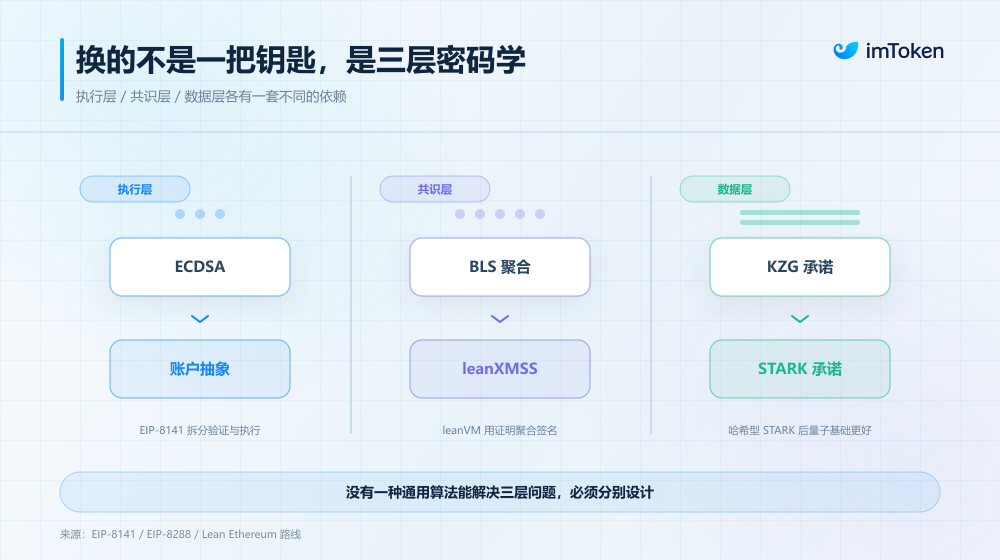
Ethereum accounts use ECDSA signatures, while proof-of-stake validators use BLS signatures that can be aggregated. A sufficiently capable fault-tolerant quantum computer running Shor’s algorithm could, in theory, undermine the elliptic-curve assumptions behind both. That would put exposed account and validator public keys at risk without an attacker needing to obtain a seed phrase or compromise wallet software.
The exposure is not identical for every externally owned account. An Ethereum address is derived from a hash of its public key. If an account has never sent a transaction or disclosed a signature off-chain, its full public key has not been exposed in the way it would be after a signed transaction. Once it has signed a transaction, the public key can be recovered from the public signature, creating a different long-term risk if elliptic-curve cryptography becomes breakable.
Other components need separate treatment. KZG commitments used with blobs and rollup data availability rely on assumptions involving elliptic-curve pairings. Some pairing-based SNARKs face related concerns, whereas hash-based STARKs avoid that particular dependency. Hash functions such as Keccak-256 are comparatively more resilient: Grover’s algorithm offers a quadratic speedup, not the kind of break Shor’s algorithm poses to the relevant public-key systems.
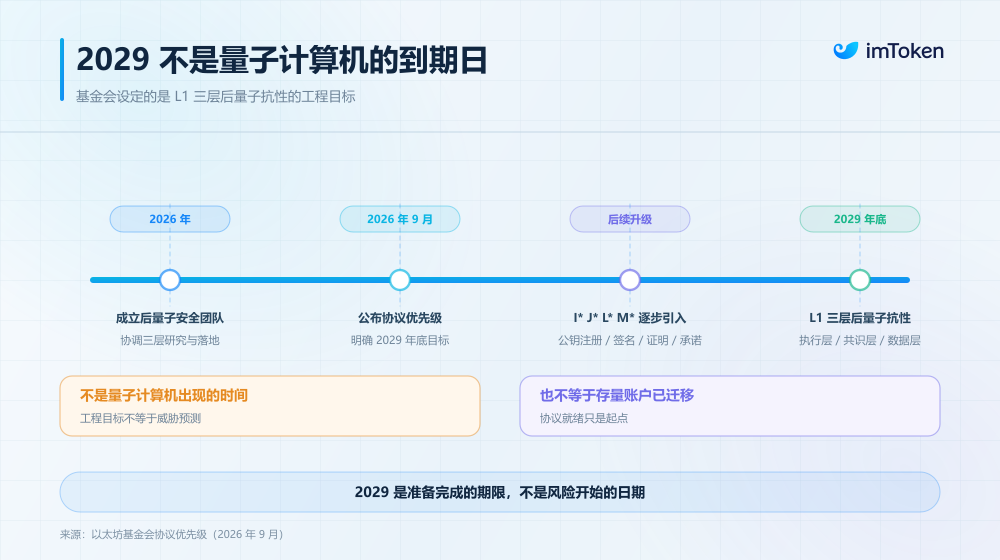
The source reports no quantum computer currently capable of breaking these cryptographic systems. The reason to plan ahead is the time required to migrate a network of accounts, validators and applications—not evidence of an immediate need for users to move assets.
Three layers, different proposed tools
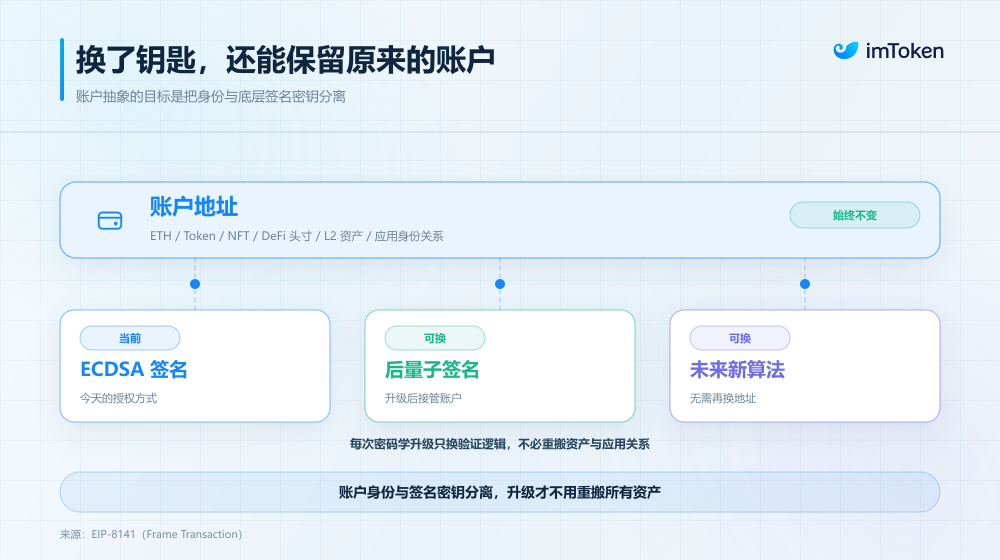
At the execution layer, the issue is that a conventional account’s authority is tied to its ECDSA key. EIP-8141, discussed in the source as a native account-abstraction proposal, aims to separate transaction validation, execution and gas payment. Programmable validation could make key rotation and support for other signature schemes possible without necessarily requiring a new account address. Post-quantum signature-verification precompiles are also under study.
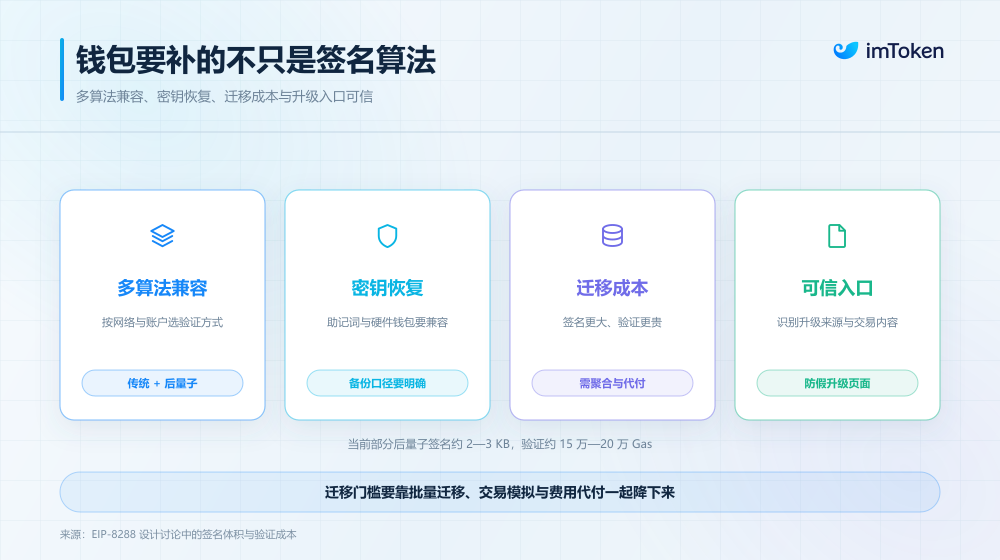
Larger post-quantum signatures introduce data and verification costs. EIP-8288 proposes using recursive STARK aggregation to reduce the on-chain burden of verifying many such signatures. These are proposed approaches, not capabilities that the source says are already deployed.
At the consensus layer, directly replacing aggregated BLS signatures with larger signatures could increase network propagation, storage and verification costs. The Lean Ethereum directions described in the source include leanXMSS, a proposed hash-based validator signature scheme, and leanVM, a proposed way to aggregate verification into compact proofs. At the data layer, KZG commitments and proof systems used beyond L1 would also need to be assessed; changing account signatures alone would not complete the migration.
The unresolved account question
Generating a new post-quantum key is only one step. A user may also have tokens, NFTs, DeFi positions, assets on different L2 networks and application permissions associated with an existing address. Account abstraction could, in principle, allow an account to change its validation rules while retaining its identity, but that outcome depends on the eventual design and implementation.
The timing of authorization matters. While an old key remains secure, its valid signature could authorize a new key. If an attacker can already forge that signature, the old key alone cannot establish which party is the legitimate owner. Dormant accounts, lost keys and owners who never upgrade pose a further unresolved problem; the source notes debate over whether such assets should remain at their old addresses or face measures such as a future freeze.
Any migration process would also need to avoid becoming a phishing route. Pages claiming to offer a “quantum-safe upgrade” could be used to solicit seed phrases or malicious approvals. The supported conclusion is therefore limited but important: Ethereum’s post-quantum effort is not just a search for replacement algorithms. It is also a design problem involving upgradeable account authority, system-wide costs and a migration users can verify before the old cryptography becomes unsafe.