As reported on November 16, 2026, trading figures cited by the original article pointed to growing activity in stock- and commodity-linked products on crypto exchanges. The figures show a shift in reported trading mix, but they do not establish why exchanges listed those products or whether altcoin trading will continue to decline.
Hyperliquid: a shared-margin market
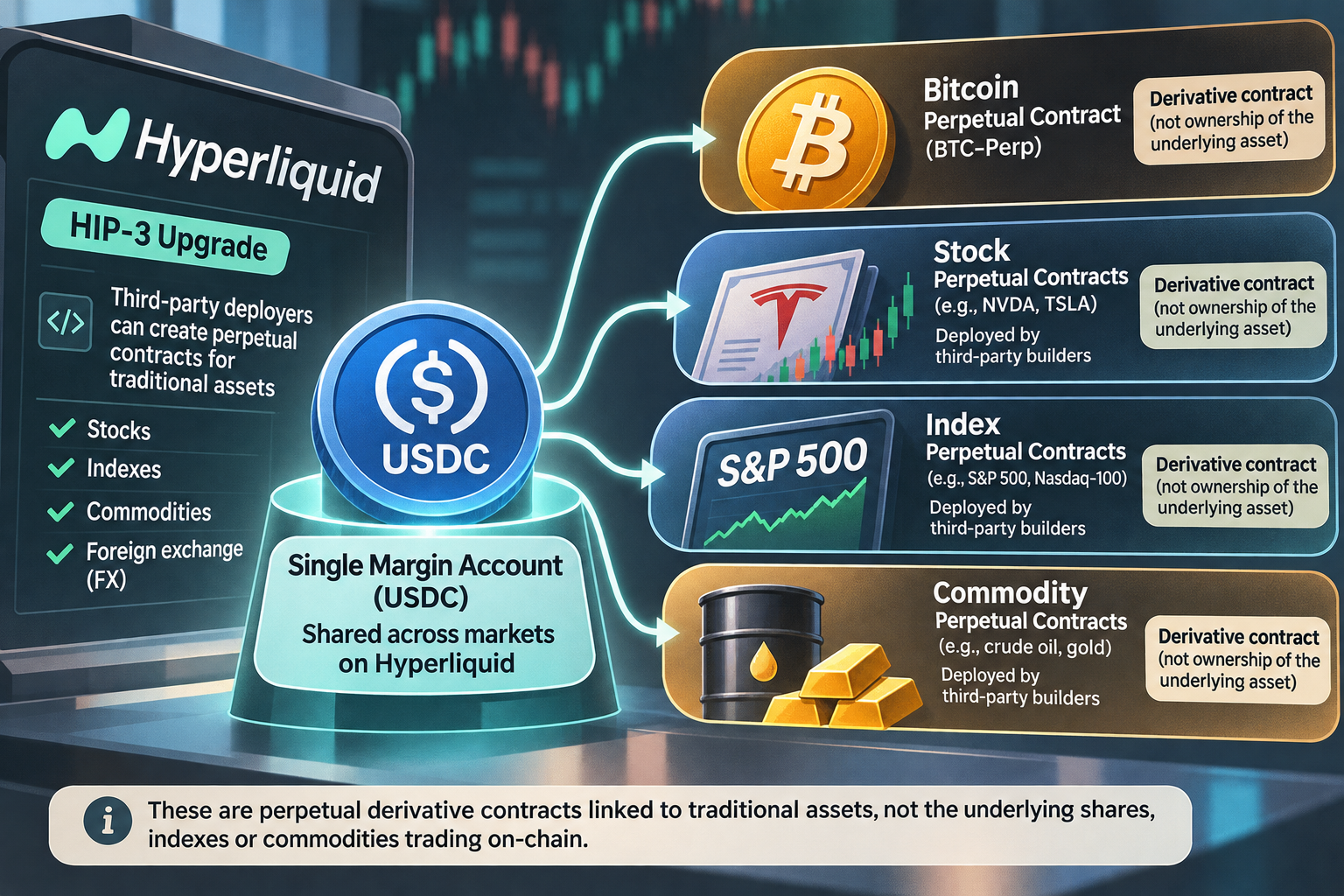
Hyperliquid’s HIP-3 upgrade allowed third-party deployers to create perpetual contracts linked to stocks, indexes, commodities and foreign exchange. According to the article, traders can use the same USDC margin account for those markets and Bitcoin contracts. These are derivatives linked to traditional assets, not evidence that the underlying shares or commodities trade on-chain.
Citing Datawallet and on-chain statistics, the article reported that Hyperliquid’s trailing 30-day perpetual volume reached $216.9 billion by the end of the third quarter of 2026. It separately reported more than $548 billion in cumulative volume for externally deployed stock, commodity and index markets, and said non-crypto markets had settled at around 30% of total volume. Those figures cover different periods and should not be treated as parts of a single 30-day total. The article said the non-crypto share briefly reached 51% in July 2026, while the share of open interest attributed to real-world assets rose from 6% at the start of the year to 24%.
What the Binance figures measure
The article cited a CryptoQuant report covering 16 major exchanges from late February to late October 2026. It attributed approximately $676 billion in tokenized-stock trading volume to Binance over that period, with nearly 60% of average daily market share and a peak daily volume of $12.1 billion.
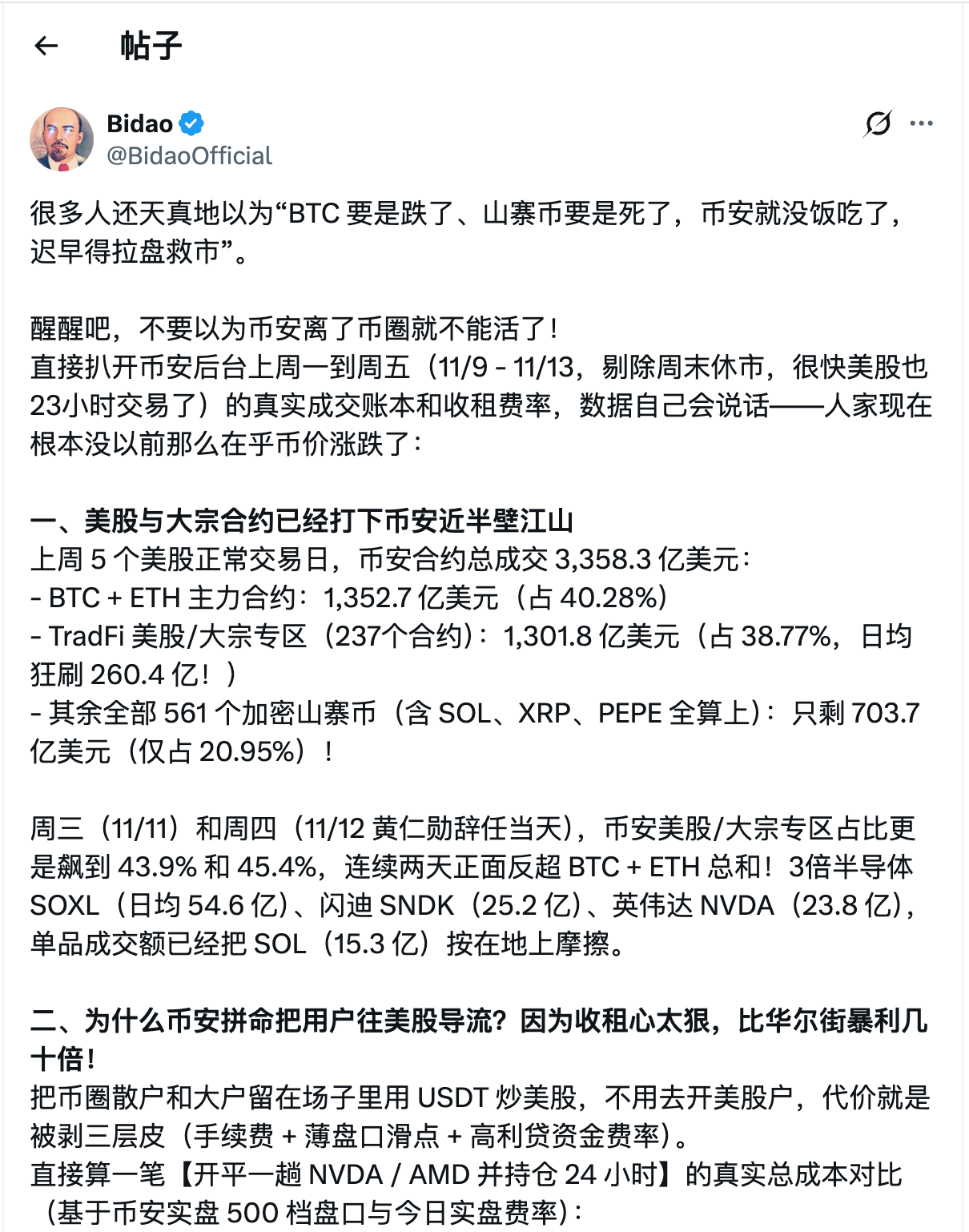
A separate tally by crypto commentator Bidao covered the five US-market trading days of November 9–13, 2026. It put Binance futures volume at $335.83 billion: $135.27 billion (40.28%) in BTC and ETH contracts, $130.18 billion (38.77%) across 237 TradFi stock and commodity contracts, and $70.37 billion (20.95%) across 561 other crypto contracts. Bidao reported that the TradFi segment’s share reached 43.9% on November 11 and 45.4% on November 12, exceeding BTC and ETH combined on each day.
The CryptoQuant period and Bidao’s five-day futures tally measure different windows and product groupings; neither is a measure of exchange fee revenue. The article also described OKX and Bybit expanding access to traditional-asset-linked trading, but supplied no comparable volume series for those platforms.
The research question is therefore narrower than the article’s claim that exchanges no longer need crypto: these reported volumes suggest traditional-asset-linked contracts had become substantial competitors for trading activity on some crypto venues by November 2026. They do not, on their own, demonstrate an exchange-wide change in revenue, incentives or long-term commitment to altcoin markets.