As reported on November 5, 2026, in the United States, Zcash’s planned NU7 upgrade was approaching block 3,543,405. At publication, the latest available block was 3,543,027. The activation time depended on block production, but was expected Thursday evening in the United States.
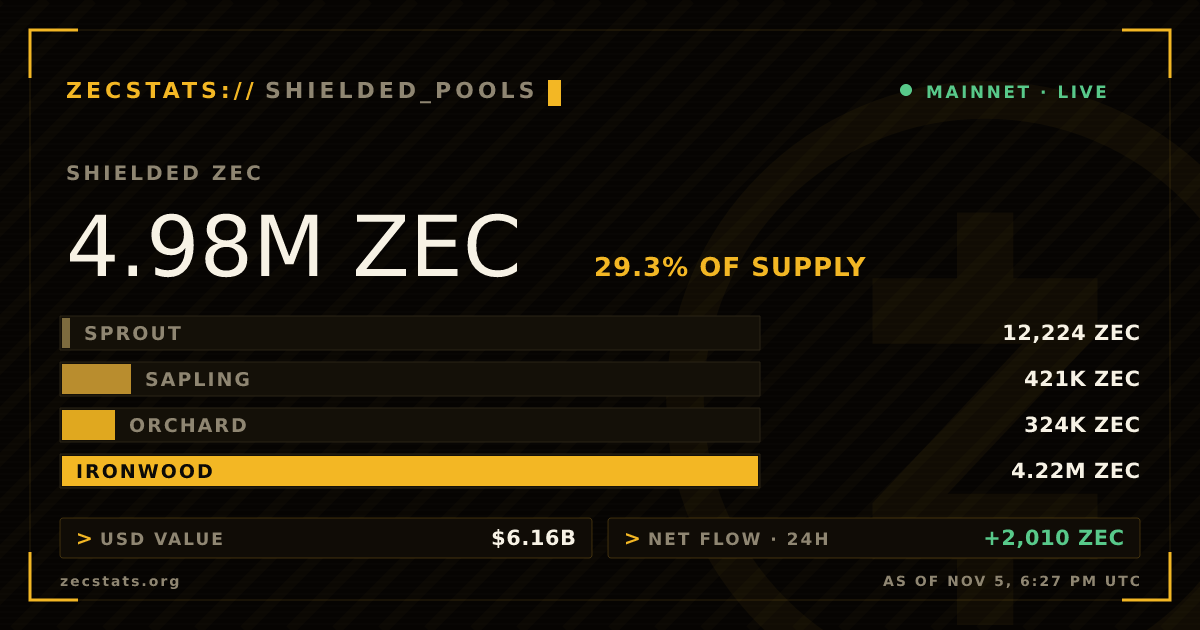
The consequence for Zcash’s oldest privacy pool, Sprout, was unusually stark. ZecStats data updated that Thursday showed approximately 12,224 ZEC still in the pool—worth roughly $15 million to $16 million at the market prices cited in the original report. Under the NU7 specification, version-4 transactions would become invalid at activation. Because that was the only transaction format capable of moving funds out of Sprout, any ZEC left there would become unspendable under the new rules, even if its owner retained the relevant keys.
Why Sprout is affected
Sprout introduced Zcash’s zero-knowledge privacy system at the network’s 2016 launch. Later systems include Sapling, Orchard and Ironwood. New deposits to Sprout had already been closed for years, although holders could still withdraw before NU7. Retiring its older transaction-verification machinery would remove legacy complexity and risks that developers sought to eliminate.
The coins would be frozen, not burned: they would still count in Zcash’s circulating issuance calculations. A future upgrade could theoretically restore access, but none was guaranteed; the specification warned that spending might never be re-enabled. The blockchain also could not establish how much of the remaining balance belonged to active holders rather than people who had already lost access to their keys.
Holders with ZEC still in Sprout—whose addresses begin with zc—faced the deadline to withdraw through a compatible mechanism. Users of modern supported wallets did not need to migrate coins out of Sprout. Separately, the Zcash Foundation said NU7 would reduce the target block interval from 75 to 25 seconds, making first confirmations approximately three times faster.