In an analysis published on November 12, 2026, Blockhead treated third-quarter results from publicly traded Bitcoin miners as a signal about the value of power. Its central estimate: at the prevailing hashprice, leasing a megawatt to an AI tenant could bring in roughly twice the revenue earned by using it to mine Bitcoin. The comparison helps explain both miners’ infrastructure plans and their sales of BTC, but it does not make every mining site suitable for conversion.

The revenue comparison
Hashprice measures mining revenue per unit of computing power. According to MillionMiner data cited by Blockhead, it fell from $40.24 per petahash per second (PH/s) per day on October 1 to $33.18 at the end of October, a 17.5% decline. MARA reported a cost of $30.80 per PH/s per day; on that measure, its margin at October’s end was approximately 7%. At its owned sites, electricity priced at $0.04 per kilowatt-hour translated to $39,674 of power cost per BTC mined, about 55% of its reported average sale price of $71,688.
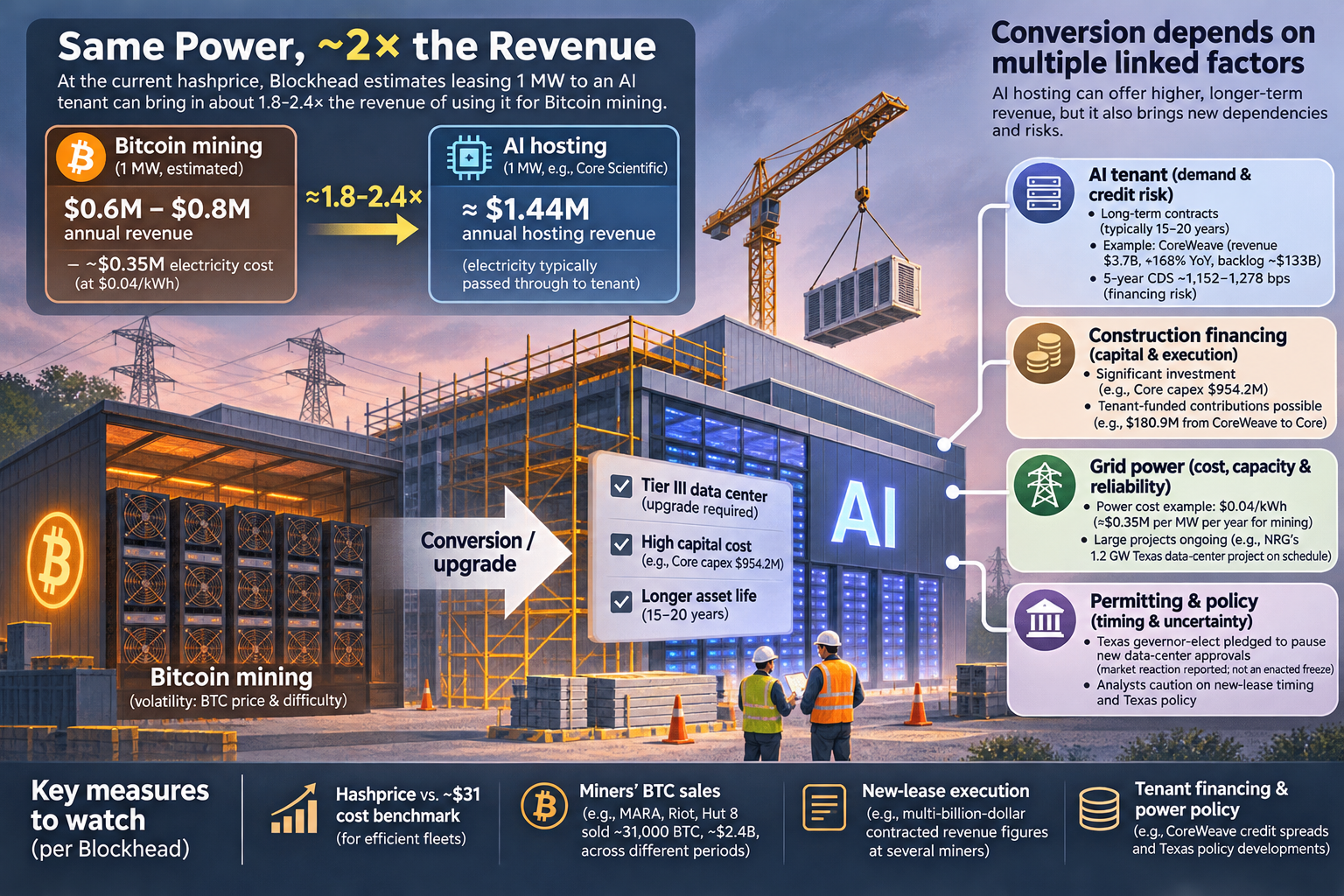
Core Scientific disclosed 485 megawatts of billable power capacity associated with more than $700 million in annualized hosting revenue—roughly $1.44 million per megawatt annually—with a 57% adjusted EBITDA margin. By contrast, Blockhead estimated that a megawatt of mining capacity, using machines rated at 15–20 joules per terahash and a $33 hashprice, would generate $600,000–$800,000 in annual revenue before approximately $350,000 in electricity costs at $0.04 per kilowatt-hour. On those assumptions, which exclude depreciation, the AI hosting payment is 1.8–2.4 times mining revenue.
The businesses allocate costs differently. Blockhead noted that standard AI data-center contracts pass electricity costs through to tenants, while miners pay for power out of variable mining revenue. A filing also showed that CoreWeave paid $180.9 million toward Core Scientific’s capital expenditure in the first half of the year. These contract terms matter as much as the headline revenue comparison.
HIVE reported a 34% gross margin for Bitcoin mining and 51% for high-performance computing and AI services. It described an 80% EBITDA margin as a target for new GPU clusters, not a realized result. HIVE also reported a $78.7 million GAAP loss after a non-cash impairment linked to lower mining-equipment values.
Selling BTC to fund conversion
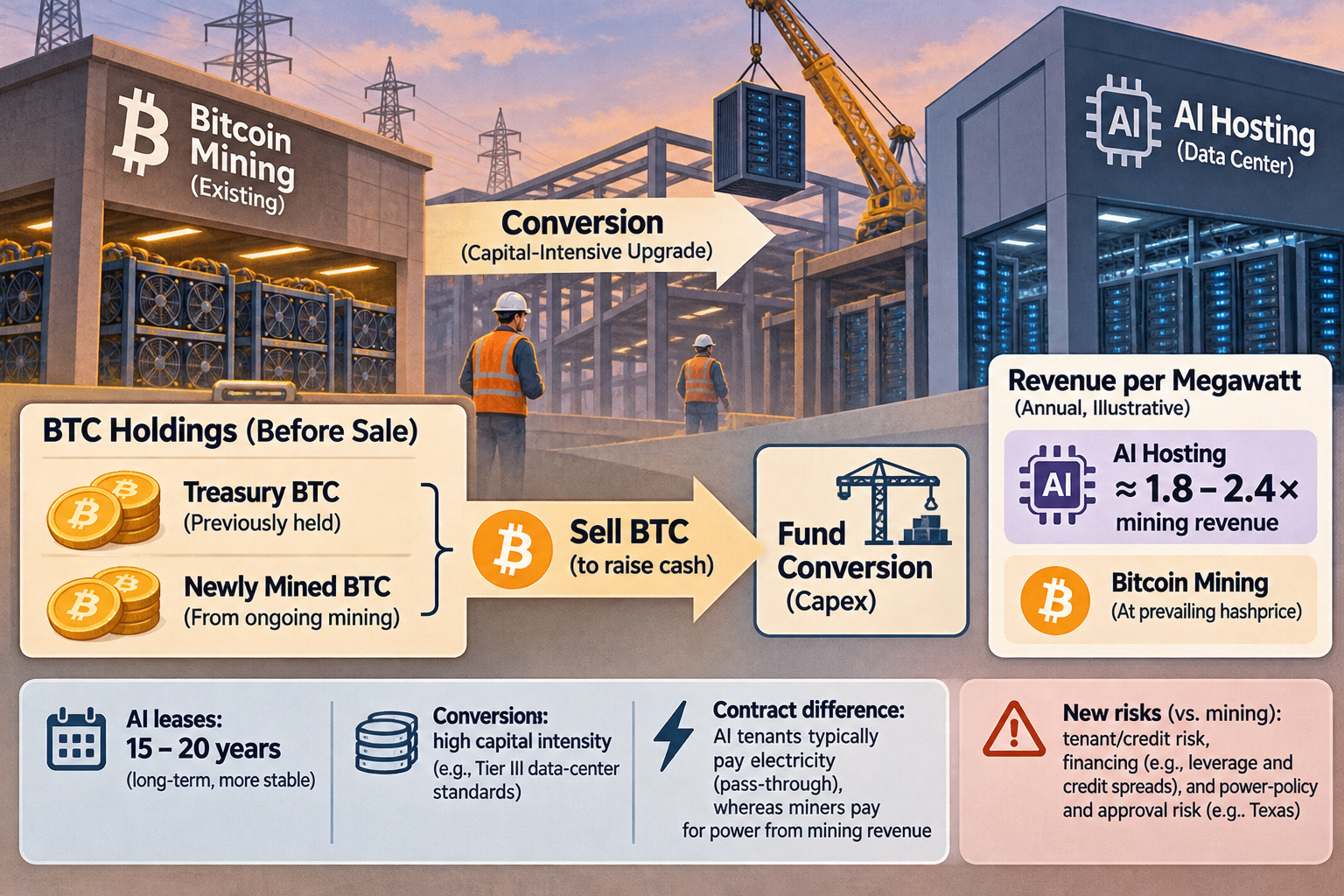
Mining income moves with BTC prices and network difficulty. MARA said a 37% decline in Bitcoin’s average price reduced its quarterly revenue by $94.8 million. AI leases, by contrast, can run for 15–20 years. Disclosed contracted-revenue figures cited in Blockhead’s analysis exceeded $24 billion for Core Scientific and totaled $16.6 billion for Cipher; it also cited approximately $19 billion for one TeraWulf campus and $26.6 billion for Hut 8. Rolling Out reported a combined figure above $85 billion, though the underlying figures use different measures and should not be treated as directly comparable revenue already earned.
Conversion requires substantial investment. Core Scientific’s first-half capital expenditure reached $954.2 million, while IREN reported a $263 million net loss in its fiscal first quarter. Blockhead characterized AI conversion as a capital-intensive upgrade requiring Tier III data-center standards, rather than a simple change in how existing mining equipment is used.
Treasury sales show another consequence. MARA said it sold 17,488 BTC in the quarter—7.8 times the 2,247 BTC it mined—and planned further sales to finance AI infrastructure and meet note obligations. Riot sold 10,599 BTC in the third quarter; Hut 8 sold about 3,100 BTC across the third quarter and October. Blockhead put the three companies’ combined sales at roughly 31,000 BTC, or $2.4 billion, equivalent to about 69 days of new issuance. Those sales cover different reporting windows and include BTC previously held in treasury, not just newly mined coins. Miners leaving the network do not change Bitcoin’s approximate issuance of 450 BTC per day; they can change who holds and sells it.
Capacity and risks shift
MillionMiner data put miners’ daily revenue in October at $34 million–$43 million and network hashrate at about 1,069 exahashes per second (EH/s) on November 2, roughly 8% below its record. Core Scientific said its active mining-machine count was nearly 50% below its level at the end of 2025. IREN mined 402 BTC in the quarter, versus 2,039 a year earlier. Using disclosed figures, Blockhead estimated that combined mining revenue at Core Scientific, TeraWulf and IREN had fallen about 84% year over year, from $334 million to roughly $54 million. Core expected to exit Bitcoin mining in the fourth quarter and become a hosting-only provider in 2027; IREN expected its transition away from mining to be ‘substantially complete’ by the end of 2026. Meanwhile, MARA reported an 18% increase in energized hashrate and a rise in its share of block rewards from 5.0% to 5.4%.
Blockhead’s interpretation is that power at a convertible site now has an AI leasing alternative: the operator has a reason to keep mining only when the expected return justifies forgoing that alternative. This is a site-level economic argument, not proof of a fixed floor under network-wide hashprice. Mining difficulty can adjust as capacity leaves, while the dollar value of mining rewards remains exposed to BTC prices.
Hosting replaces some of that exposure with tenant, financing and power-policy risks. Core Scientific’s hosting agreements with CoreWeave cover 590 megawatts, with construction funded by CoreWeave. CoreWeave reported $3.7 billion in revenue, 168% growth and about $133 billion in backlog, and said it expected to finance remaining spending mainly through delayed-draw term loans matched to customer contracts. CNBC reported that its five-year credit-default-swap spread was near 1,152 basis points on a Tuesday and closed at 1,278 basis points that Thursday. Those observations point to financing risk; they do not establish that the contracts will fail.
The policy picture was also unsettled in the original reporting. NRG said a 1.2-gigawatt Texas data-center project was on schedule. Separately, Averin reported that NRG shares fell 13.5% on November 4 after a Texas governor-elect pledged to pause new data-center approvals. That account is a report of the pledge and market reaction, not an enacted approval freeze. Blockhead cited analysts’ concerns about the timing of new leases and Texas policy.
The evidence therefore supports a narrower conclusion than a wholesale replacement of mining by AI: where conversion is feasible, long-term hosting contracts can offer materially higher revenue per megawatt, but realizing it requires capital, tenants and power approvals. Blockhead identified hashprice against an approximately $31 cost benchmark for efficient mining fleets, miners’ BTC sales, new-lease execution, and tenant financing and power policy as the measures to watch. CleanSpark’s first report after moving to quarterly disclosures was also still pending in the original analysis.