Variational has ended the private test of Omni, its onchain trading application, and removed the invitation requirement for new accounts. As reported on November 13, 2026, the change puts a distinctive design under a broader test: Omni routes requests for quotes to one liquidity provider rather than matching orders in a public order book.
Volume is growing, but the measures differ
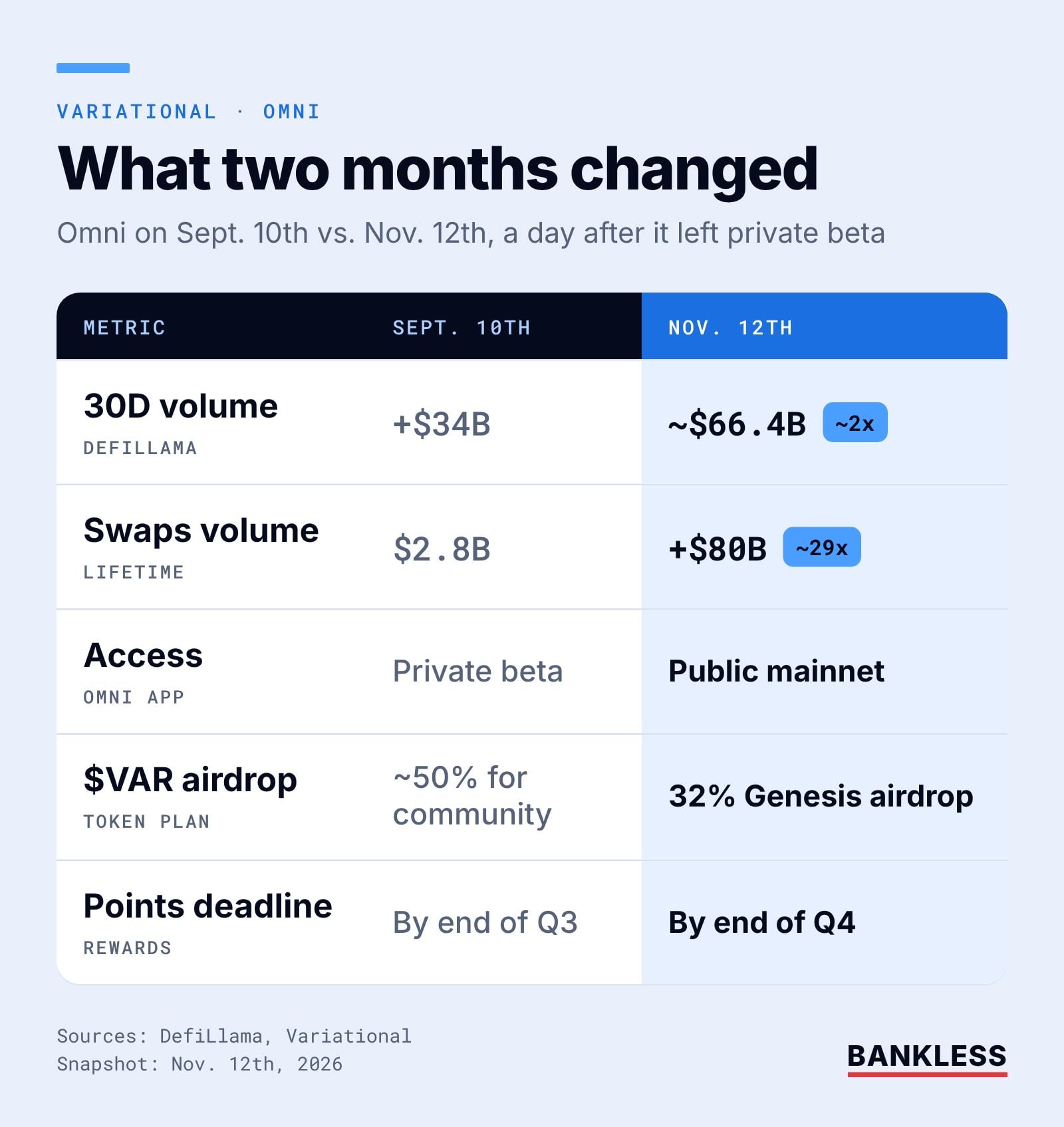
DefiLlama showed approximately $66.4 billion in 30-day Variational trading volume on the Thursday morning preceding the report, up from more than $34 billion cited for September 10. Its roughly $2.2 billion in 24-hour volume ranked third among perpetuals platforms at that measurement point, behind Hyperliquid at approximately $9.84 billion and Lighter at $2.69 billion.
Traditional-finance markets have become a substantial part of Omni’s activity. Variational said on November 10 that cumulative volume in its Swaps markets—which include gold, crude oil and equity indices—had exceeded $80 billion. The report said these markets accounted for more than 60% of Omni’s trading volume. That cumulative Swaps figure is a different measure from DefiLlama’s 30-day platform total and should not be compared as though the periods match.
Variational’s public data API showed approximately $595 million in Nasdaq-100 swap volume and $458 million in Bitcoin volume over the 24 hours measured on Thursday morning. Three of Omni’s five most active markets tracked US equity indices or stocks.
The architecture—and its trade-off
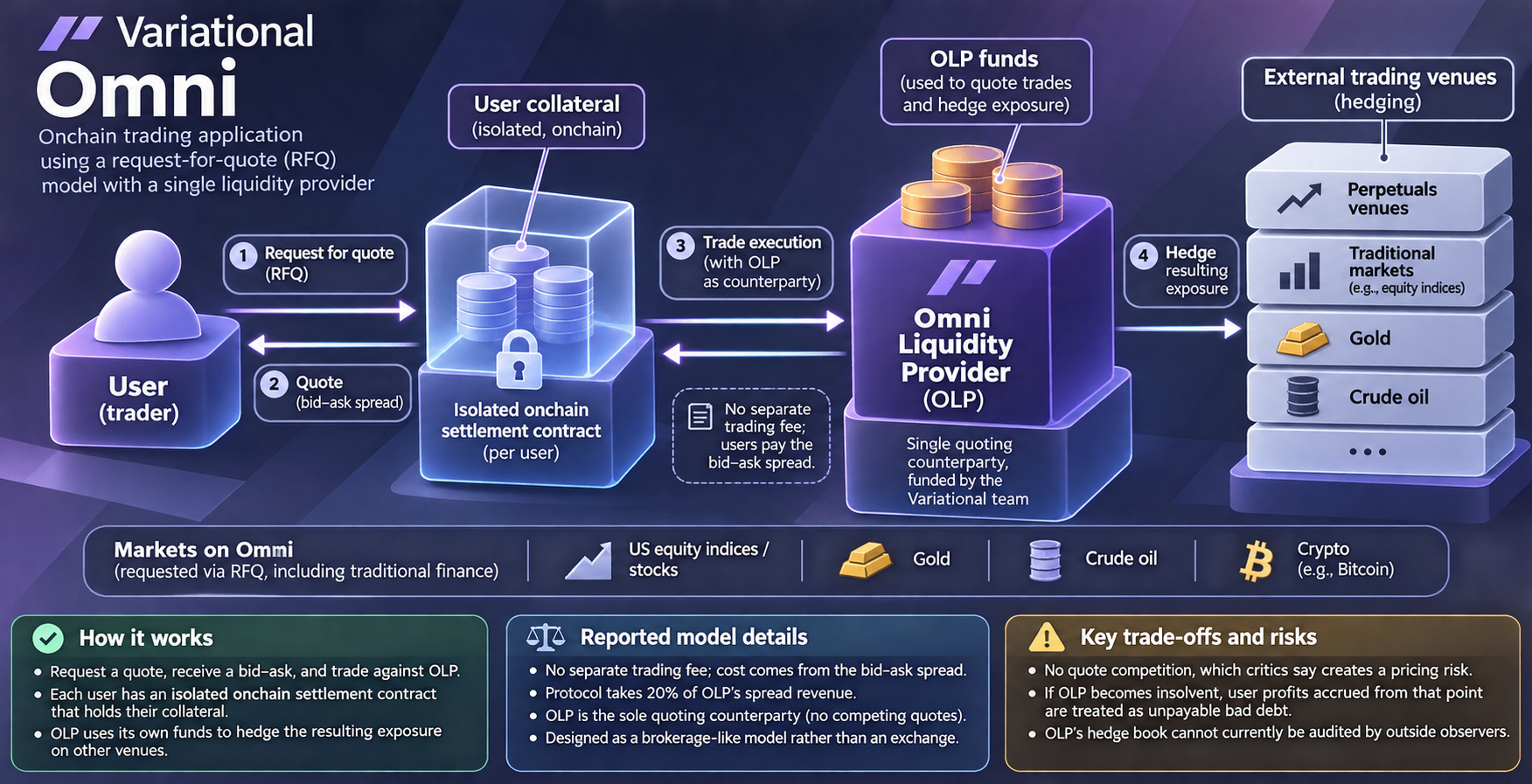
Omni uses a request-for-quote model. Its sole quoting counterparty is the Omni Liquidity Provider, or OLP, a pool initially funded by the Variational team. OLP quotes trades and hedges the resulting exposure on other venues. CEO Lucas Schuermann described Omni to Bankless in September as a brokerage-like model rather than an exchange.
Users do not pay a separate trading fee; they pay the bid–ask spread. The protocol currently takes 20% of OLP’s spread revenue. Alea Research estimated Variational’s third-quarter spread cost at 2.35 basis points of volume, compared with an average 2.40-basis-point perpetuals fee on Hyperliquid. That estimate relies in part on data disclosed by the team. It is evidence about estimated costs over that period, not a guarantee of future quote quality.
The single-counterparty structure has drawn criticism. On October 31, X user 0xLoris argued that Omni is not a genuine perpetuals DEX and noted that traditional RFQ systems commonly let multiple market makers compete for a quote. X user Rencrypta likewise identified the absence of competing quotes as the central pricing risk. Variational co-founder Edward Yu responded that collateral is committed transparently onchain and that Omni must still compete for users against other perpetuals venues. Yu has also said single- and multi-market-maker platforms serve different purposes; a multi-maker design could appear in the planned Variational Pro product, which had not launched as of the report.
Omni assigns each user an isolated onchain settlement contract holding that user’s collateral, while OLP uses its own funds to hedge elsewhere. Following a Binance security incident on October 29, Yu said less than 25% of OLP’s funds were held there and that any losses would fall on liquidity providers rather than ordinary users. That statement does not remove every counterparty risk: OLP’s documentation says that, if it becomes insolvent, user profits accrued from that point would be treated as unpayable bad debt. Outside observers also cannot currently audit OLP’s hedge book.
What remains to be tested
Variational’s September 23 tokenomics post allocated 32% of the planned VAR supply to a genesis airdrop for points holders, moved the token-generation event to the fourth quarter of 2026, and proposed using 100% of treasury revenue to buy back and burn VAR. Those are plans, not completed token operations. Schuermann said on November 4 that the team remained on track for a 2026 token event and expected to release the trading API publicly later in November; it had already opened the API to a small group of early testers. The reported Polymarket probability of a launch before year-end was about 71%, not a confirmation of delivery.
The report also noted that weekly points distribution was fixed at 150,000 points, recently shared among roughly 32,000 accounts. Variational disclosed approximately $1.05 million in treasury revenue from its 20% share over the preceding two weeks. Future buybacks would depend on that revenue stream and on the team carrying out its stated plan. US and Canadian residents could not use Omni at the time of reporting.
Public access establishes a wider test, not its outcome. The evidence to watch is whether OLP can maintain competitive spreads and meet obligations as participation grows and markets or hedging venues come under stress. The available volume and cost figures describe particular measurement windows; they cannot settle those longer-term questions.