This analysis revisits a report published on April 27, 2026. The rates and loss estimates below reflect that reporting period, not current market conditions.
A USDC deposit earning roughly 5% on a DeFi lending market may look attractive beside traditional cash products. The question raised by Tom Dunleavy’s analysis is whether that yield compensates depositors for failures elsewhere in the protocols their market depends on. His answer is a proposed pricing framework—not an observed market-wide default rate.
The incidents behind the question
The report says Drift Protocol lost $285 million on April 1, 2026, following a social-engineering attack on an administrator’s private key. It says KelpDAO suffered a $292 million cross-chain bridge attack on April 18. According to the report, stolen rsETH was subsequently deposited as collateral in Aave V3, leaving Aave with approximately $196 million in bad debt. Aave’s total value locked fell from $26.4 billion to $17.9 billion over three days.
These are different failure paths, but the KelpDAO account illustrates the pricing problem: a lending protocol can face losses without its own contracts being the initial target. The report says Aave’s USDC market utilization reached 99.87% for four consecutive days and its deposit rate rose to 12.4% amid withdrawal pressure. It also says Circle chief economist Gordon Liao proposed a fourfold increase in a borrowing cap; that was a governance proposal, not an enacted change.
From bond spreads to a DeFi estimate
Dunleavy starts with a bond-pricing decomposition: a risk-free rate, expected loss—default probability multiplied by loss given default—and additional compensation for uncertainty and illiquidity. He argues that DeFi deposits also expose lenders to smart-contract exploits, oracle or governance attacks, and losses transmitted through connected protocols.
For context, the report cites Moody’s long-run figures for speculative-grade bonds: a 4.5% average annual default rate and approximately 40% recovery for senior unsecured high-yield debt. Multiplying the corresponding 60% loss given default by 4.5% gives an estimated 2.7% annual expected loss. That comparison is a pricing reference, not evidence that bond and DeFi risks behave alike.
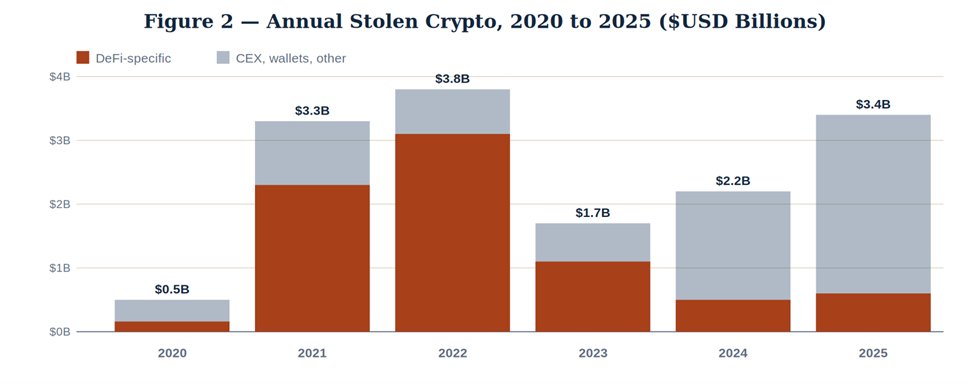
The report then estimates DeFi-specific losses of about $500 million against $75 billion in average total value locked in 2024, and $600 million against $120 billion in 2025—ratios of 0.67% and 0.50%, respectively. Its 2026 figure is explicitly conditional: using the two April incidents and an assumed $95 billion average total value locked, the author suggests a 2.0%–2.5% annualized loss rate if that pace persists. Those ecosystem-level loss-to-TVL ratios are not measured default probabilities for an individual USDC deposit.
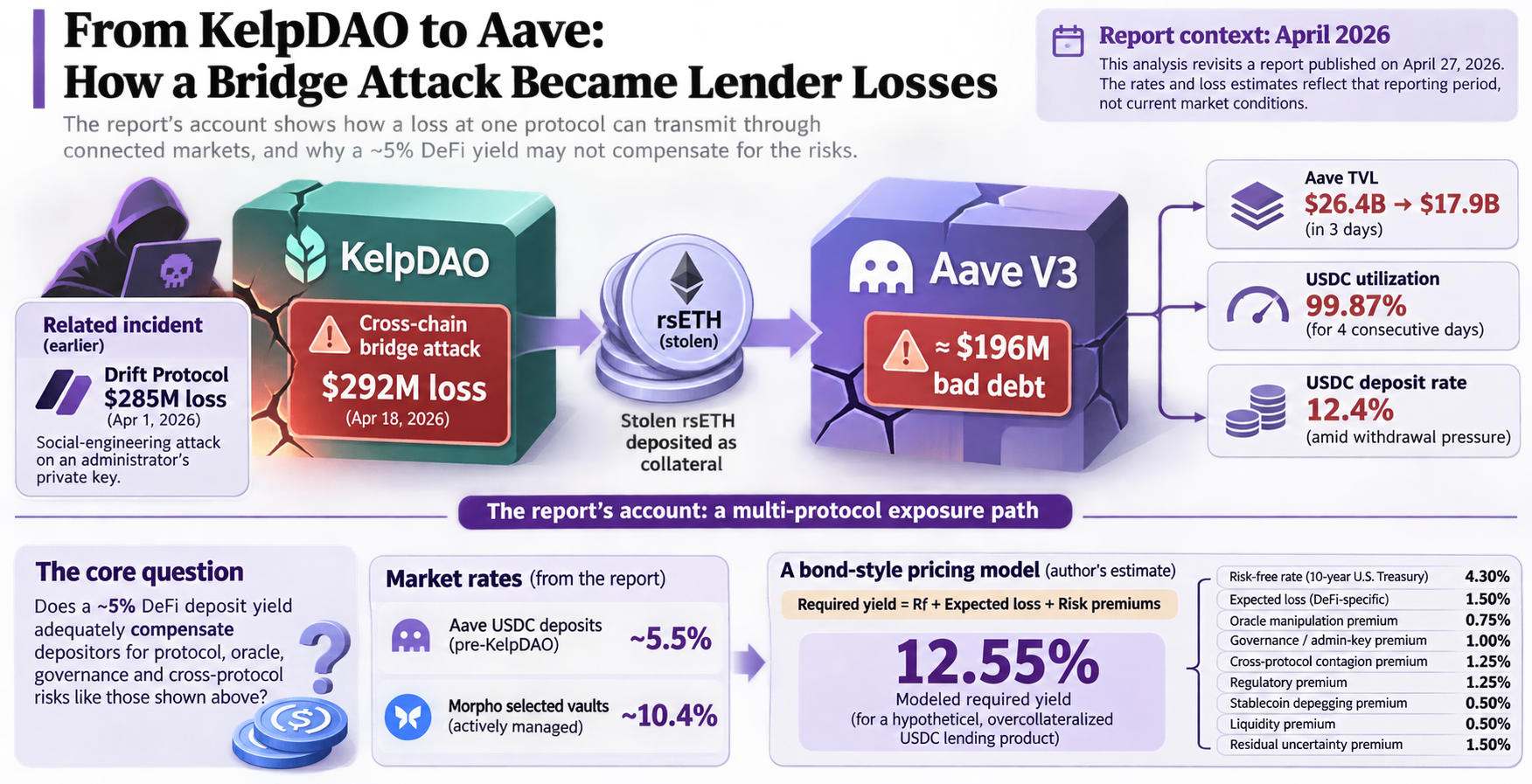
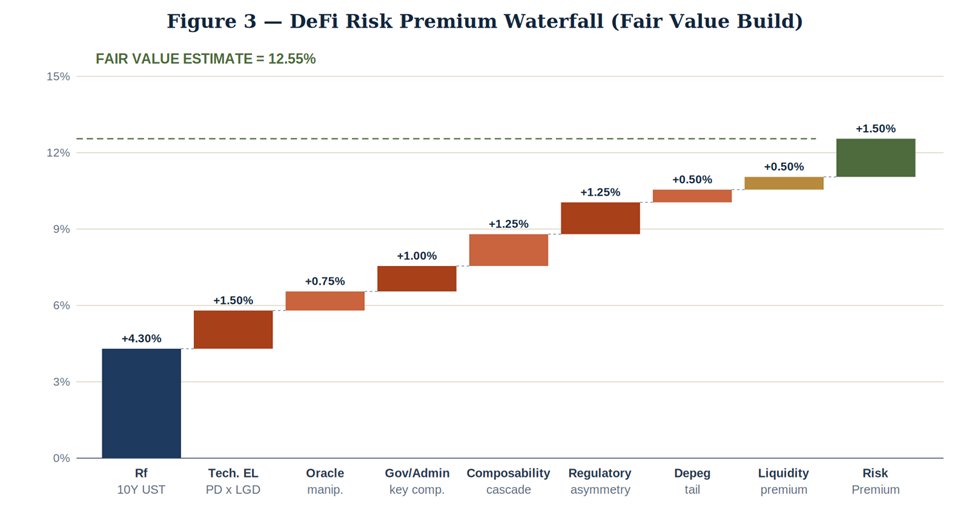
For a hypothetical, overcollateralized USDC lending product on a major Ethereum protocol, Dunleavy assigns a 1.50% expected-loss component and adds separate premiums for oracle manipulation, governance or administrator-key risk, cross-protocol contagion, regulation, stablecoin depegging, liquidity and residual uncertainty. Added to a roughly 4.30% 10-year US Treasury benchmark, his inputs total 12.55%. That result depends on the selected benchmark and premiums; it is the author’s modeled required yield, not a quoted deposit rate or a demonstrated fair value.
The useful distinction is therefore between a market rate and the risks a depositor is being paid to bear. The report contrasts Aave USDC deposits at roughly 5.5% before the KelpDAO incident with selected, actively managed Morpho vaults at roughly 10.4%. Different vault selection and management introduce their own assumptions, so the gap alone cannot establish which rate correctly prices risk.