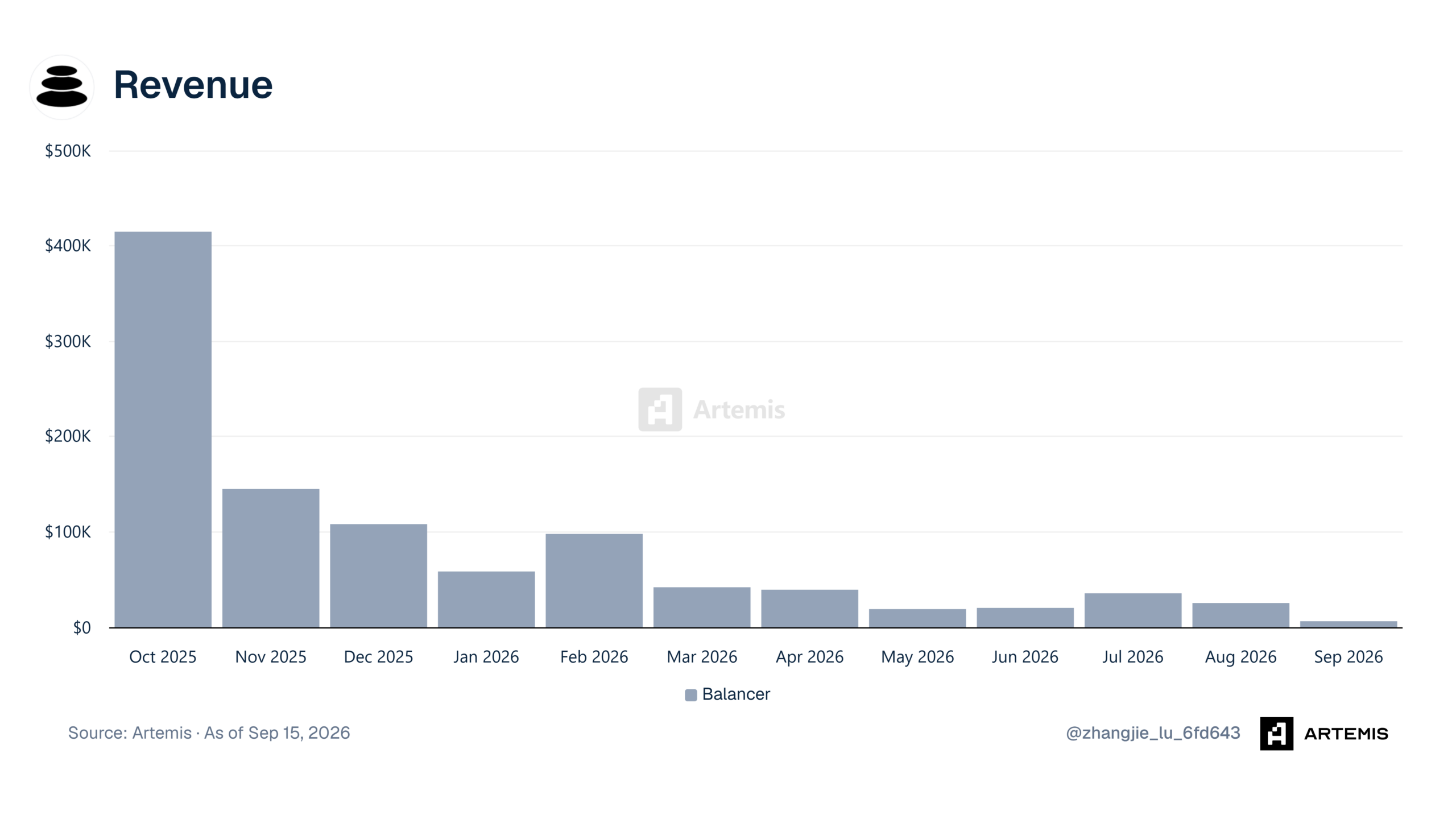
As reported on September 15, 2026, Balancer was considering a nearly two-year wind-down—not carrying out an approved liquidation. On September 15, treasury council representative Marcus Hardt submitted a governance proposal to end routine operations and development, then distribute at least $9 million in non-BAL treasury assets to eligible BAL holders who burn their tokens. The plan would run through mid-2028.
The proposal raises a practical question for DAO governance: which assets can be returned to holders without counting the DAO’s own token as a source of repayment? The portfolio managed by kpk was valued at no less than $9 million and consisted mainly of stablecoins, liquid assets and lower-risk yield-bearing positions. Treasury-held BAL would be excluded. Eligible holders would instead receive a proportional, in-kind share of the external assets. For context, the report put BAL’s circulating market capitalization at approximately $8 million; that figure is not a valuation of the assets available for distribution.
Different routes out of locked positions
The proposed exit depends on what a holder owns:
- veBAL: Locks would be forcibly released into BAL/WETH liquidity-pool tokens in an 80/20 ratio. Holders would need to exit that liquidity position themselves to obtain BAL for the burn-and-distribution process.
- auraBAL and sdBAL: Holders of these third-party derivatives would need to exit through a secondary market or their respective protocols before the first distribution round closes. Shares not exited by that deadline would become ineligible.
- tetuBAL: Because its permanent lock cannot be upgraded or redeemed, the proposal offers an exception: the DAO treasury would provide BAL compensation calculated at 50% of the snapshotted locked amount.
The plan also separates any future recovery of historically stolen funds from the treasury distribution. Under the proposal, recovered funds would go to affected liquidity providers, not BAL holders participating in the wind-down. It envisages two redemption rounds, redistribution of unclaimed shares, staged reductions in infrastructure and, ultimately, removal of governance powers. The report placed the first distribution in May 2027, leaving a substantial wait after the September 2026 proposal.
Why the proposal emerged
The report traces Balancer’s financial pressure in part to a November 3, 2025 attack on its V2 Composable Stable Pools. It reported losses exceeding $128 million across chains including Ethereum, Arbitrum, Base and Avalanche, with white-hat teams recovering about $28 million. It also described potential legal-liability exposure for Balancer Labs OÜ; that exposure was a reported risk, not an established liability.
In March 2026, BIP-918 and BIP-919 sought to reduce spending and reset the operating model. The changes described in the report included dissolving Balancer Labs, moving operations to DAO-contracted Balancer OpCo Limited, halving the full-time team and cutting the annual budget by 34% to $1.9 million. On the token side, they stopped BAL inflation, ended veBAL fee sharing and directed all protocol fees to the DAO treasury. They also included a commitment to begin voluntary buybacks after 12 months, capped at 35% of treasury net asset value.
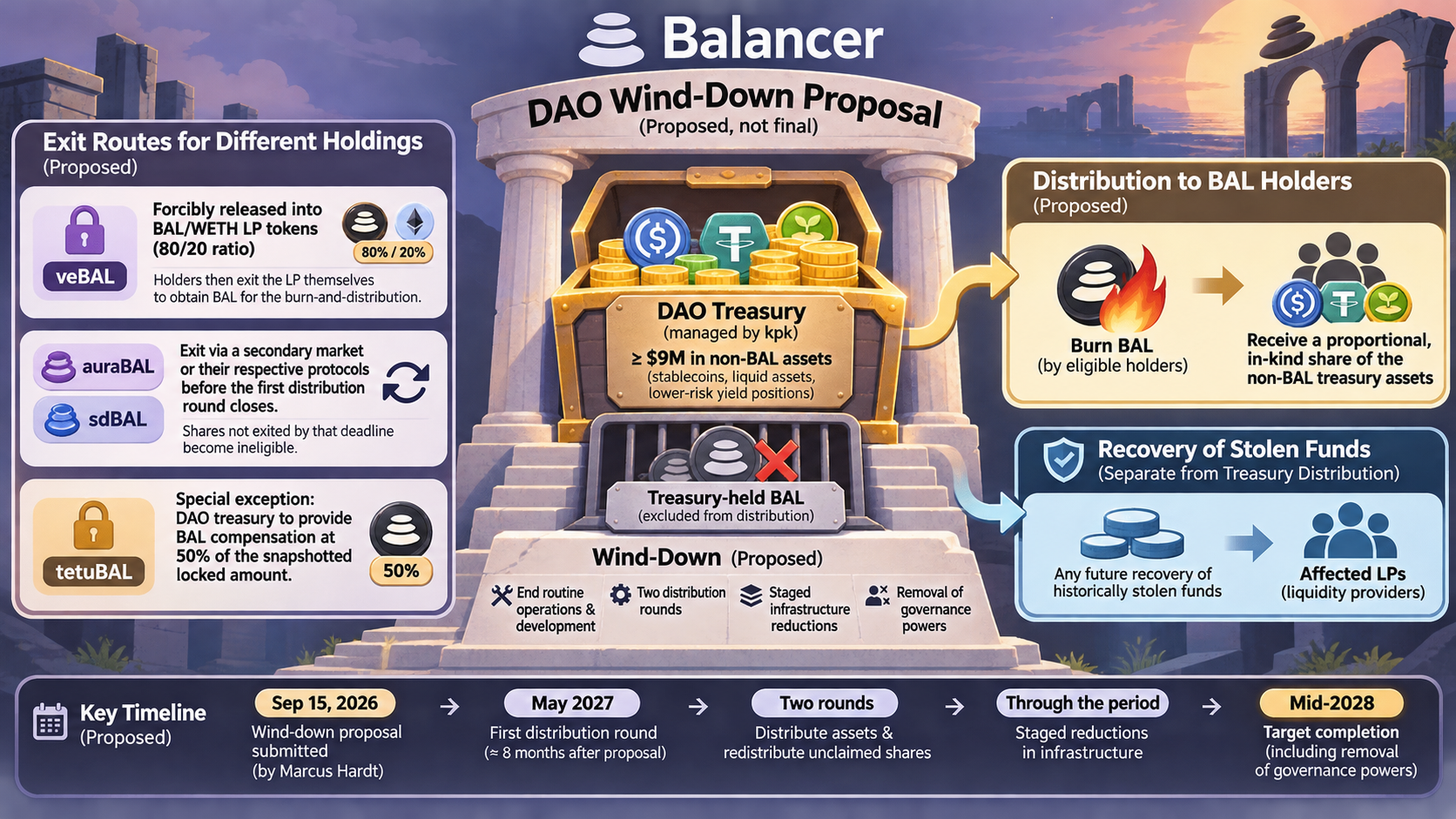
That reset aimed to reduce the annual deficit from $2.6 million to $700,000 while giving a new V3 version time to grow. But the report said monthly gross protocol revenue had fallen to about $25,000 by August 2026, against roughly $150,000 in monthly fixed costs. BIP-918 required governance to propose revisions if monthly gross revenue remained below $60,000 for three consecutive months. Those reported figures explain the pressure behind Hardt’s proposal; they do not make its terms final. Whether, when and on what terms holders receive assets depends on the governance process and execution of the proposed wind-down.