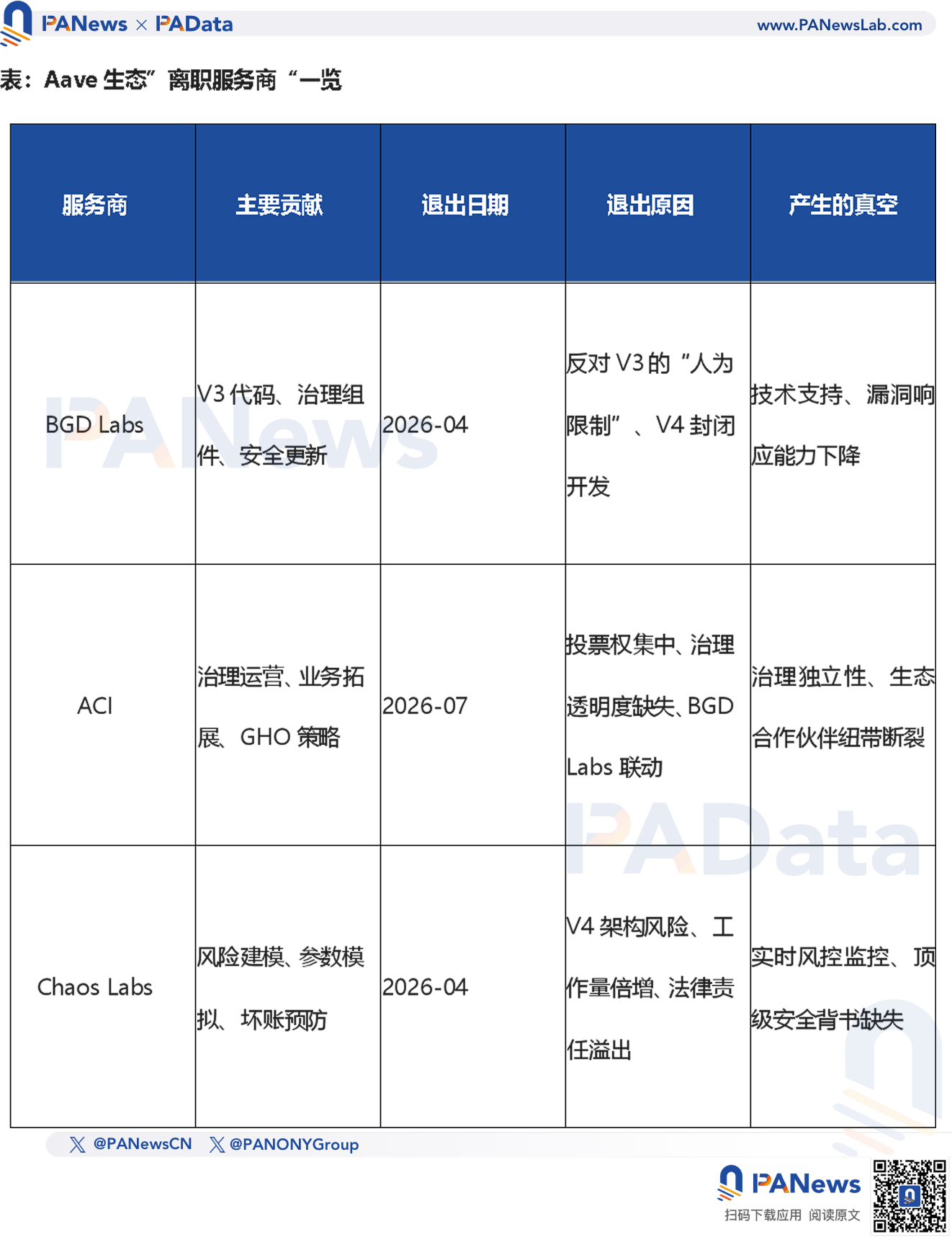
As of PANews’ April 10, 2026 report, three Aave service providers had announced departures or plans to leave: V3 technical contributor BGD Labs, governance service provider Aave Chan Initiative (ACI), and risk manager Chaos Labs. Their exits raise a question for Aave’s planned V4 transition: how will the protocol replace specialist oversight while changing its architecture? The departures alone do not establish that its contracts or deployments have failed.
Why Chaos Labs is leaving
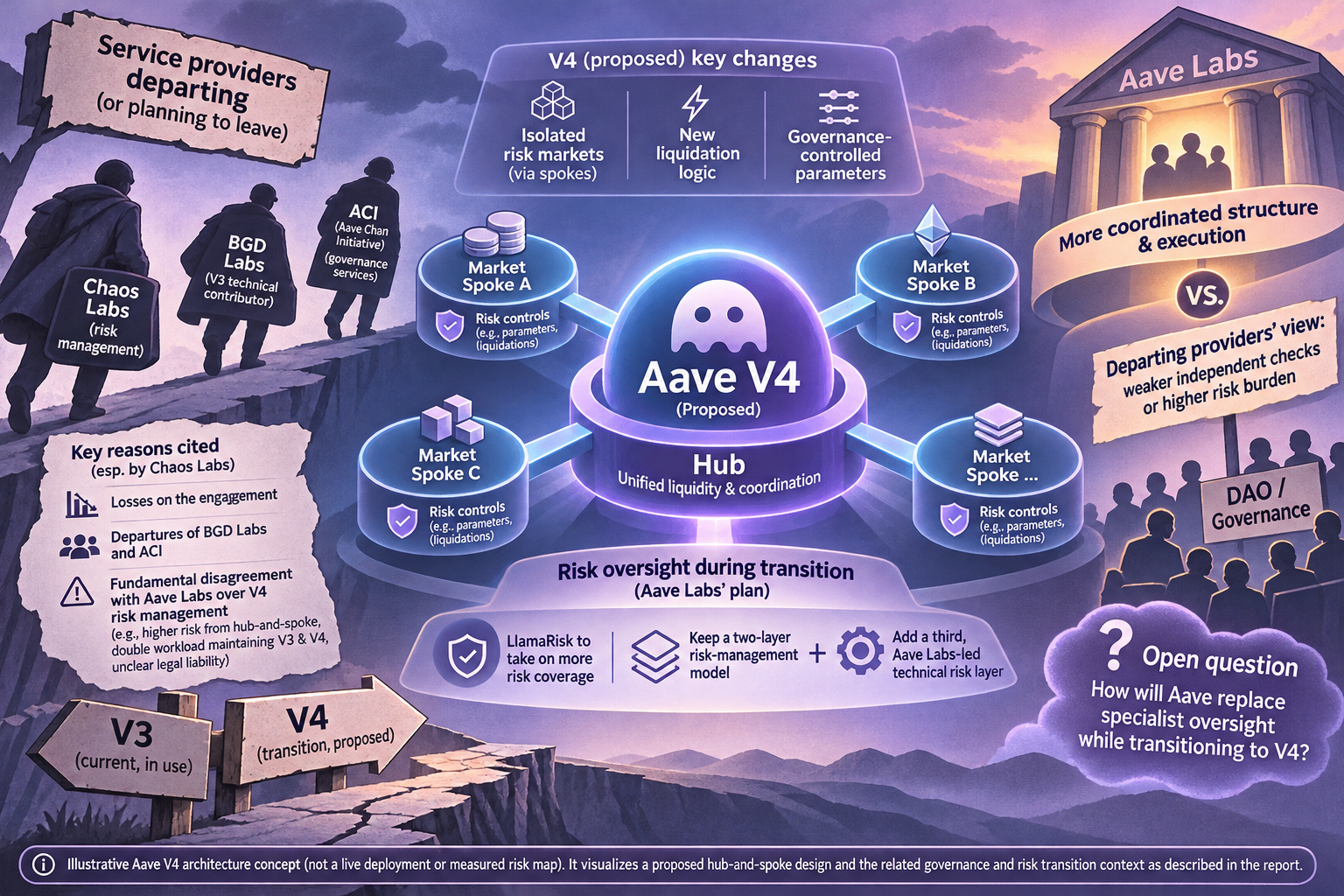
Chaos Labs said on April 7 that it would end its Aave engagement after three years working on V2 and V3. It cited losses on the engagement, the departures of BGD Labs and ACI, and a fundamental disagreement with Aave Labs over V4 risk management. Chaos Labs argued that V4’s hub-and-spoke design would increase risk and that maintaining V3 and V4 in parallel would double its workload amid unclear legal liability. Those are the firm’s assessments, not measured outcomes for a deployed V4 system.
Aave Labs said it respected the decision and that Aave’s smart contracts and network deployments were unaffected. It also gave a different account of renewal talks: it said it supported raising Chaos Labs’ risk-management fee to $5 million, but not an increase to $8 million without additional terms. Aave Labs said it opposed proposals to make Chaos Labs the sole risk manager, replace Chainlink with Chaos Labs oracles, and make an unaudited Chaos Labs vault the default for all B2B integrations. These are Aave Labs’ descriptions of the disputed proposals, not adopted protocol rules.
A separate operational issue adds context. The report says a March 2026 on-chain configuration error involving an Aave CAPO oracle managed by Chaos Labs undervalued wstETH by about 2.85%, triggering roughly $27 million in liquidations of positions it describes as healthy. Aave Labs said LlamaRisk would take on more risk coverage during the transition, with additional team, budget, engineering and analytical support. It also said it would retain a two-layer risk-management model and add a third, Aave Labs-led technical risk layer. The report does not establish how those arrangements will perform.
A broader dispute over control
BGD Labs announced on April 1 that it would end its technical contributions. It accused Aave Labs of restricting V3 development to advance an immature V4, devaluing V3 and using parameters to push migration. BGD claimed V3 accounted for 98% of Aave’s code, nearly all its total value locked and more than $100 million in annual revenue. Those figures and accusations are BGD’s claims as presented in the report.
ACI, led by Marc Zeller, planned to leave in July 2026, with BGD’s departure described as the immediate catalyst. Zeller accused Aave Labs of concentrating governance power and said on-chain data showed it controlled 23% of the AAVE token supply. The supplied report does not identify the dataset or measurement date behind that figure.
The technical and governance questions meet at V4. According to the report, its proposed spokes would introduce isolated risk markets, new liquidation logic and governance-controlled parameters. Aave Labs’ case for a more coordinated structure rests on execution; departing providers argue that the shift weakens independent checks or increases the burden of managing risk. Likewise, the report describes a potential return of all front-end revenue to the DAO under the “Aave Will Win” proposal—not an enacted revenue arrangement. Whether Aave can retain effective oversight through the transition remains unresolved.