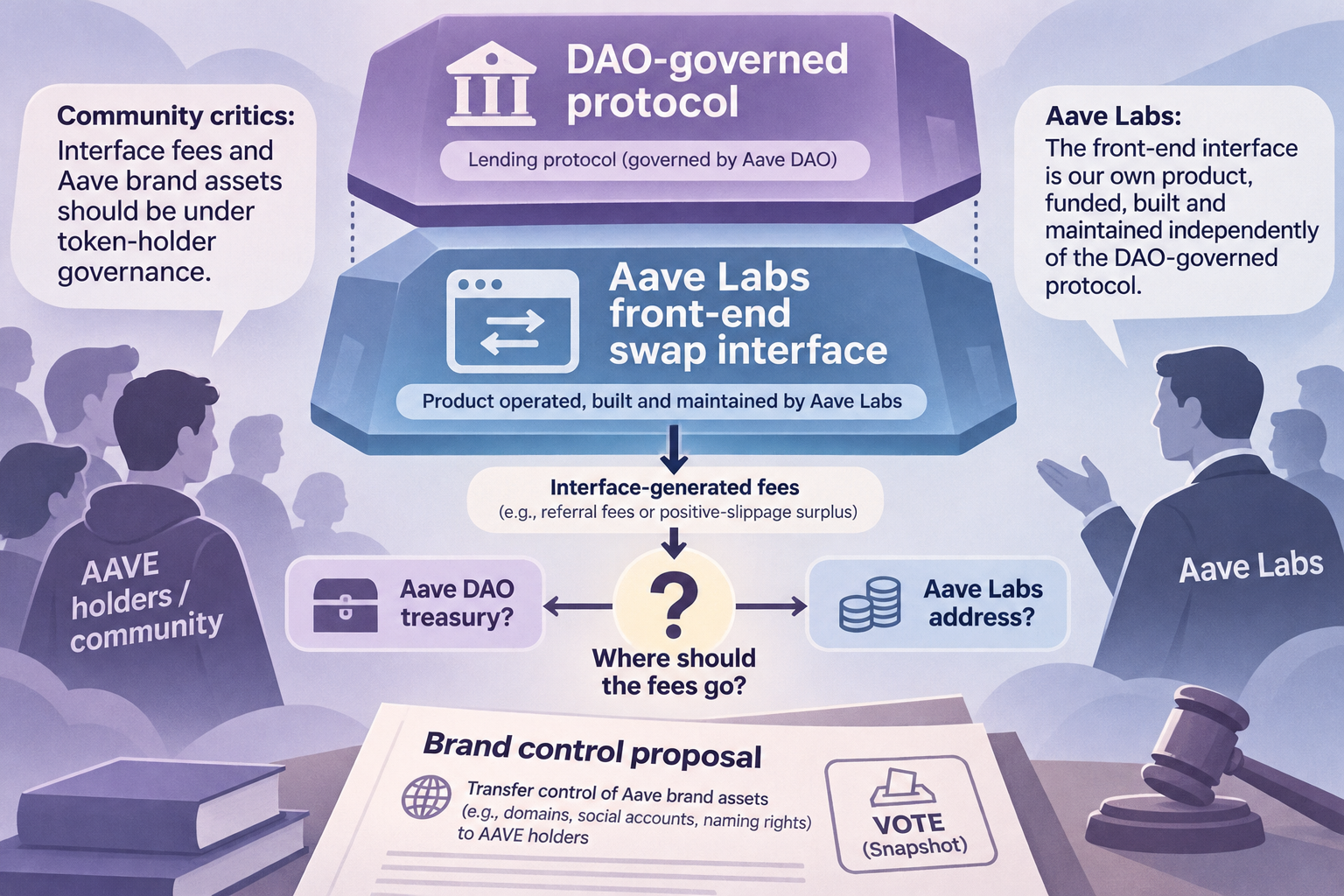
As reported on December 23, 2025, a dispute over fees from Aave’s front-end swap feature had widened into a debate over who should control the Aave brand. The question was not whether Aave DAO governs the lending protocol, but where its authority ends when Aave Labs operates a product under the same name.
From a routing change to a revenue dispute
On December 4, Aave announced that CoW Swap would replace ParaSwap as the default route for swaps made through its front end, citing CoW Swap’s protection against maximal extractable value (MEV) as a way to obtain better quotes.
Community representative EzR3aL subsequently raised a different issue on Aave’s governance forum: fees associated with the swap feature, including referral fees or positive-slippage surplus, had previously gone to the Aave DAO treasury but, after the change, went to an Aave Labs address. Based on the revenue flows EzR3aL tracked on Ethereum and Arbitrum, they estimated the fees at roughly $200,000 a week, or more than $10 million annualized. That is EzR3aL’s estimate, not an independently established annual revenue figure.
Aave Labs responded that it funds, builds and maintains the front-end swap interface independently of the DAO-governed protocol. In its account, earlier payments to the DAO were voluntary contributions, not an obligation. The disagreement therefore turns on more than the destination of a fee stream: the parties differ over whether revenue generated by an Aave-branded interface belongs within DAO governance.
Brand control remained a proposal
On December 16, former Aave CTO Ernesto Boado proposed transferring control of Aave brand assets—including domains, social accounts and naming rights—to AAVE holders. The proposal called for a DAO-controlled entity, with its precise form still to be determined, and protections against appropriation. It had not enacted a transfer.
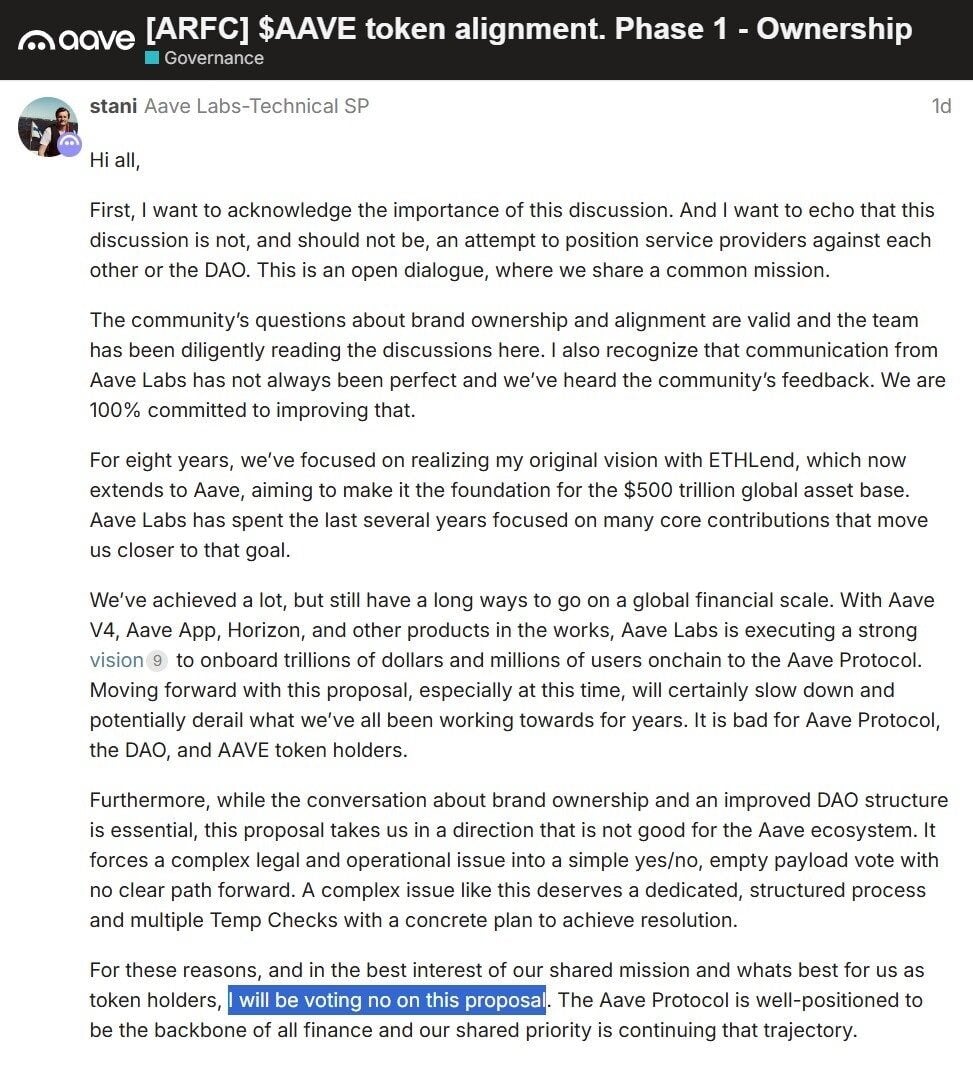
Aave founder Stani said he would vote against the proposal. He argued that it reduced a complex legal and operational question to a yes-or-no vote without a clear implementation path, and called instead for a structured process with concrete solutions. At the time of the December 23 report, Aave Labs said an ARFC Snapshot vote on the proposal had been initiated to let holders register their positions; no outcome was reported.
The report also described a large holder, excluding project, protocol-contract and centralized-exchange addresses, selling 230,000 AAVE worth about $38 million in the early hours of December 23. It reported an average sale price of approximately $165 against an average purchase price of $223.40 in late 2024 to early 2025, implying a loss of about $13.45 million. AAVE fell roughly 12% over the short term, according to the report. The sale and price move illustrate the market context, but do not by themselves establish how much of the decline the governance dispute caused.
The unresolved issue is an institutional one: Aave Labs describes the interface as its own product, while community critics question whether fees and brand assets associated with Aave should be controlled by token-holder governance. The proposed vote could record holders’ preferences, but the source did not establish a legal or operational route for transferring those assets.