Historical report: originally published by DeepTide TechFlow on November 11, 2026, at 09:57 UTC+8. The article credits Noveleader of Castle Labs as its author.
The Castle Labs weekly report links several product launches to a broader question: can control of a user entry point, trading venue or execution layer create durable demand for a protocol? Its examples describe mechanisms and early activity, but the supplied report does not establish how durable that activity will be.
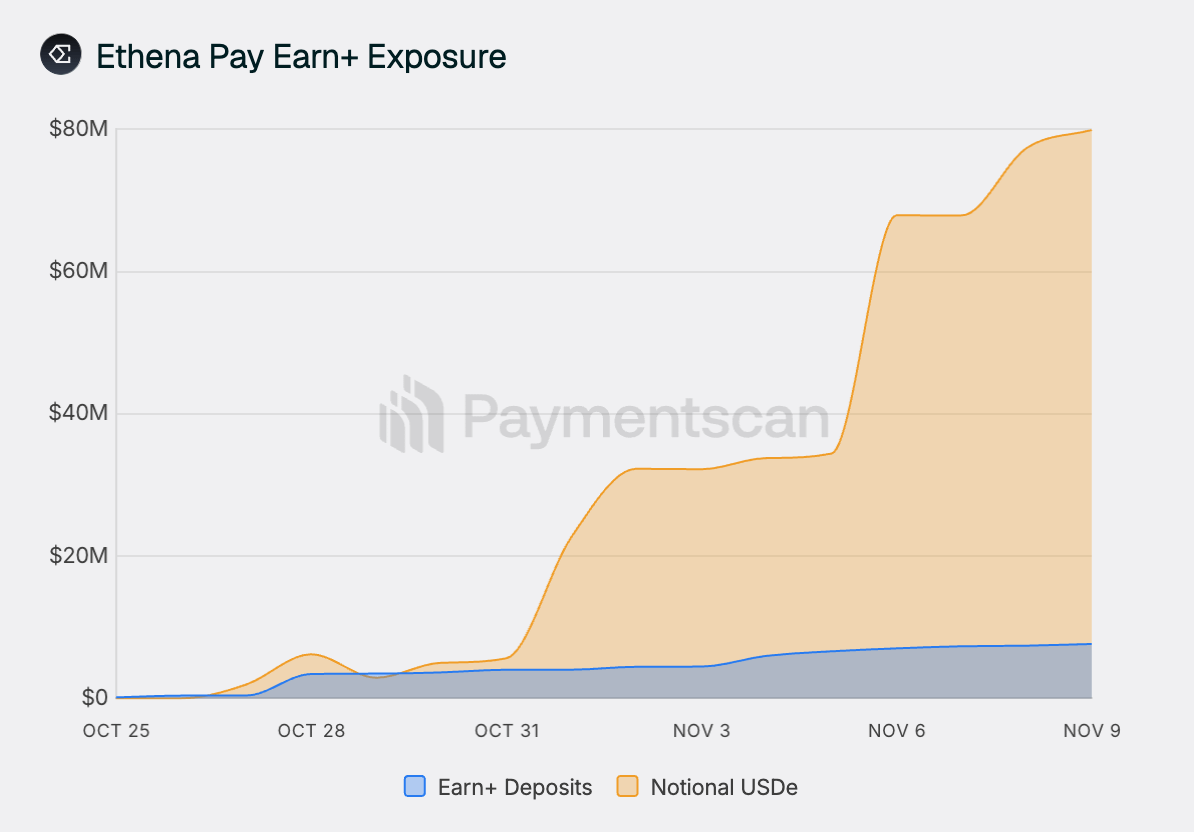
Ethena Pay: deposits and USDe demand
The report says Ethena Pay launched in September 2026 and added Earn+ in late October. Earn+ offers depositors leveraged USDe exposure with an advertised annual percentage yield of up to 12%. At the time of reporting, Castle Labs put Earn+ deposits at $7.64 million and the associated USDe demand at approximately $80 million. It does not provide a calculation that independently verifies that demand figure.

In an interview for the report, Ethena Pay go-to-market lead Lito said customer accounts hold USDe by default, making account growth a potential distribution channel for the stablecoin. He also said an account-tier upgrade, expected to be announced in the following weeks, would require users to hold and lock ENA. That was a stated plan, not an implemented requirement at publication. The report says ENA buybacks would begin if total USDe supply exceeded $7.5 billion; it does not say that threshold had been reached.
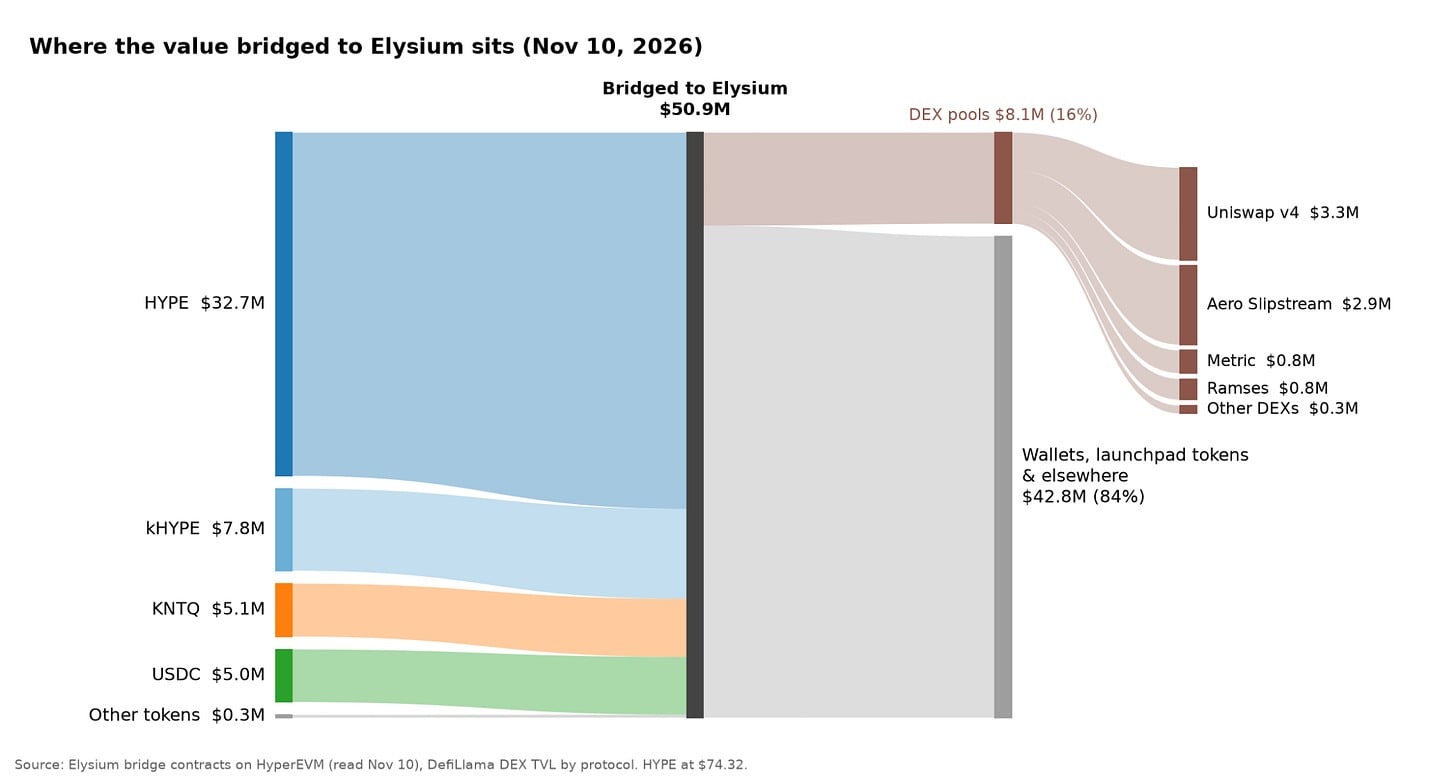
Elysium: where sequencer revenue would go
According to the report, Elysium launched its mainnet on November 10, 2026. It uses the Arbitrum Orbit stack, HYPE as its gas token and HyperEVM for final settlement. Its stated revenue-allocation mechanism directs 50% of sequencer revenue to buybacks, 25% to a treasury and 25% to developer incentives. Those percentages describe the mechanism, not a measured amount of revenue or completed buybacks.
Castle Labs reported more than $50 million bridged to Elysium after launch; its accompanying breakdown put net bridging at $50.9 million, with most funds still in wallets rather than decentralized-exchange pools. The report also described a planned upgrade, roughly four weeks away, to let applications read Hyperliquid order-book data. Whether that access attracts sustained application activity remained untested at publication.
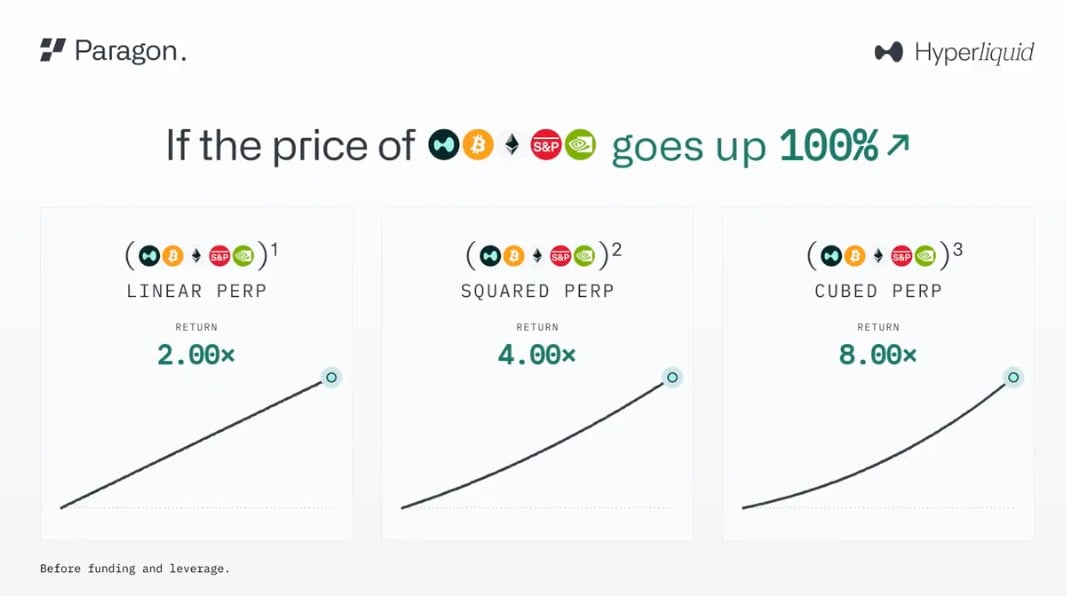
Power perps and prediction markets
Paragon, identified in the report as a Hyperliquid HIP-3 contract deployer, had launched power perpetuals: contracts designed to track a power of an underlying price rather than its price directly. For a squared-price exposure, a 10% underlying rise corresponds to a 21% increase in the squared value; a 10% fall corresponds to a 19% decrease. These are illustrations of the payoff curve before funding rates and leverage, not realized trading returns. Unlike conventional options, the described perpetual has no strike price or expiry.
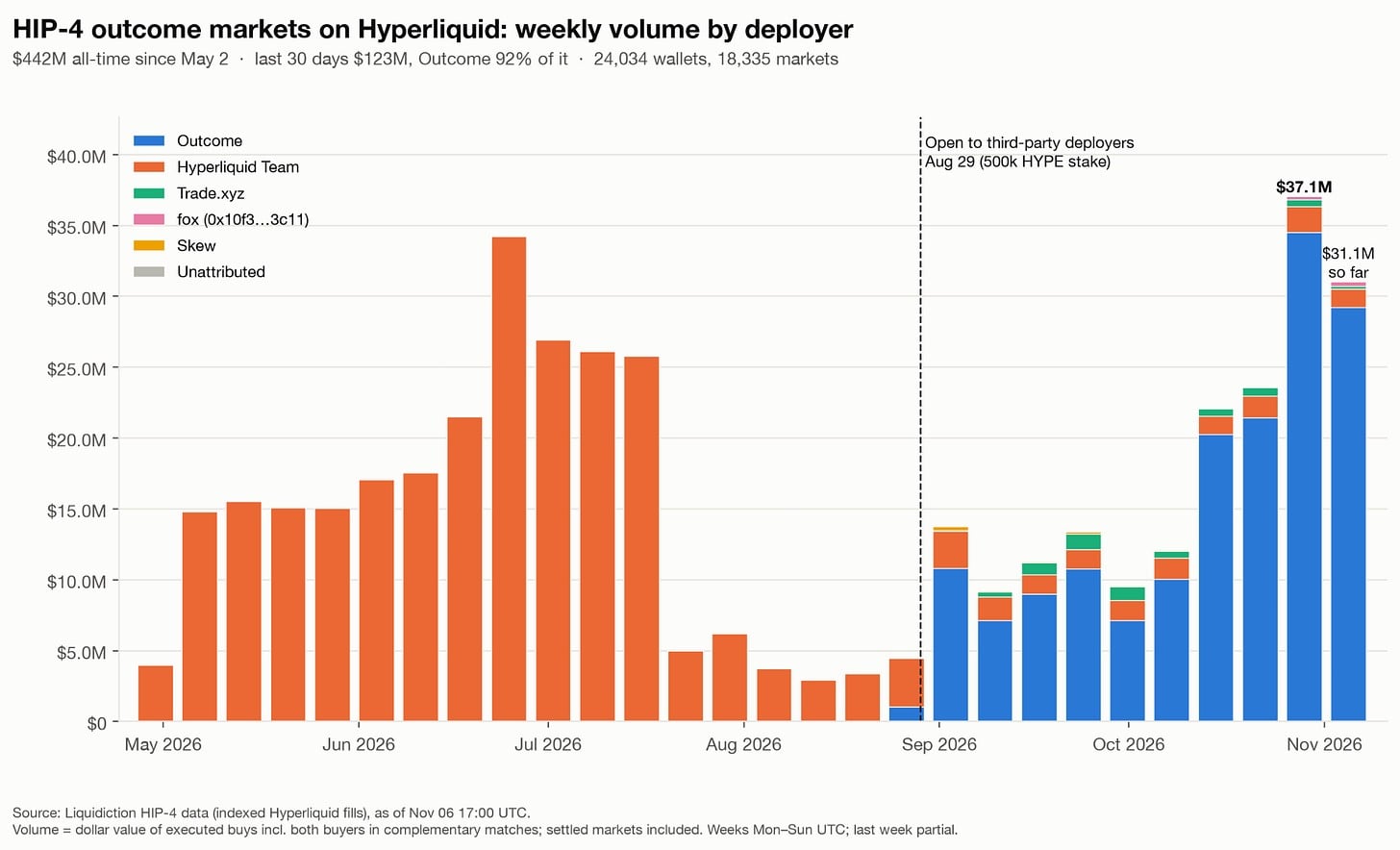
For HIP-4 prediction markets, the report identifies Outcome as a leading deployer following the opening of permissionless third-party deployment on August 29, 2026. It says sports markets accounted for most trading volume in its review of markets active during the seven days through November 10, 2026, ahead of crypto-price markets. The supplied text does not give numerical volumes. Its discussion of liquidity rewards and possible future incentives is speculative; it also notes that a two-sided order strategy can leave a trader with one-sided exposure if only one order fills.
Other developments and evidence limits
The report says Derive was moving toward real-world-asset options, Rysk Finance had introduced an Nvidia options-yield strategy, and fixed-rate borrowing protocol IRIS had gone live using a solver network across markets including Morpho, Spark and Aave. It also reports that a New York Stock Exchange tokenized-securities platform selected Avalanche for settlement. These are the report’s descriptions; the supplied material contains no independent implementation checks or comparative performance data.
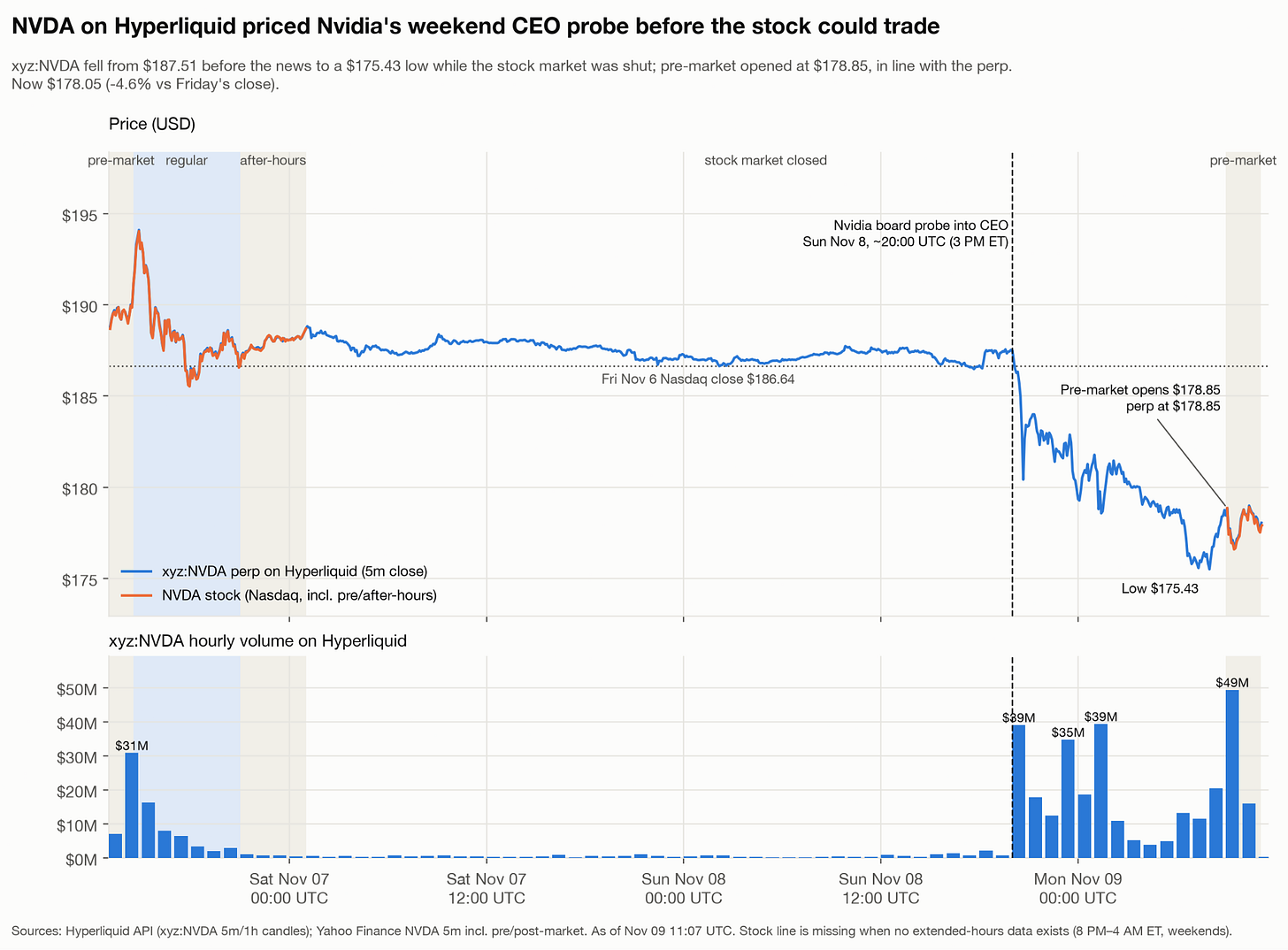
Castle Labs further describes trading in TradeXYZ’s xyz:NVDA market during a weekend rumor while Nasdaq was closed. Its chart reportedly showed a move to $175.43. That is a reported price in the on-chain market, not confirmation of the rumor or a Nasdaq share-price print.
Source: techflowpost.com (originally published 2026-11-11 09:57 UTC+8)